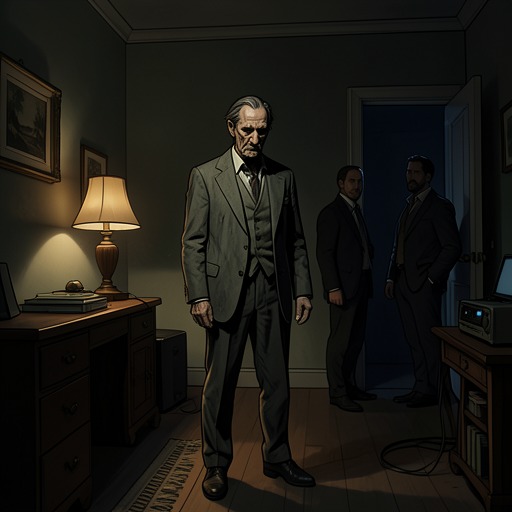
Thomas Tomakin
Brave New WorldThomas Tomakin, known professionally as the Director of Hatcheries and Conditioning, is a senior World State official whose work embodies the system’s attempt to manufacture people for a stable, stratified society. His decisive personal defeat comes when Linda identifies him as Tomakin and John calls him his father: the family relationship his society treats as abhorrent becomes public, and Tomakin resigns from his post.
Identity and Institutional Authority
As Director, Thomas Tomakin supervises a society that treats reproduction as an industrial process and human beings as products of deliberate planning. The Director’s account of Bokanovsky’s Process describes eggs made to divide into as many as ninety-six buds, each developing into an embryo; he presents this multiplication as a means of producing standardized people in uniform batches. In his view, a single egg could supply the workforce of a small factory, linking biological production directly to social stability.
The scale of that project is made concrete through Podsnap’s Technique. By accelerating the maturation of eggs, the Centre can obtain at least 150 mature eggs within two years and, after fertilization and division at an average multiplication of seventy-two, produce nearly 11,000 same-age individuals in 150 batches of identical twins. The Director also cites exceptional production exceeding 15,000 adults from one ovary. These figures are not incidental boasts: they show how his institution imagines population as something to be adjusted to present requirements rather than allowed to develop over generations.
The Centre’s control extends beyond multiplying embryos. During a tour, Henry Foster explains procedures that include artificial circulation in each bottle, injections at measured points along the embryo’s course, movement training, and precautions intended to reduce the shock of decanting. Embryos are tested and labelled by sex; most female embryos receive hormones and are decanted sterile, while a proportion are allowed to develop normally. The Director’s organization thus joins reproduction, bodily development, and social assignment within a single system of management.
The Director’s Judgment of Bernard
Thomas Tomakin’s authority is most openly displayed when he prepares to dismiss Bernard Marx before the Centre’s workers. He chooses the Fertilizing Room because it contains more high-caste employees than any other room in the building and intends Bernard’s punishment to serve as a public example. Although Henry acknowledges that Bernard does his work well, the Director argues that intellectual distinction increases the danger of leading others away from accepted behavior.
In the Director’s stated reasoning, murder harms an individual, but unorthodoxy threatens Society itself. He points to the rows of microscopes, test-tubes, and incubators as proof that an individual can be replaced. The argument reveals the logic beneath his administrative severity: people have value insofar as they serve the social order, while dissent is treated as a collective danger. He publicly accuses Bernard of heretical views on sport and soma, an unorthodox sex life, and disobedience to Fordian teaching, then proposes dismissal and transfer to Iceland.
Linda and John Reveal the Family Secret
Bernard interrupts the proceeding by bringing Linda into the room. Her appearance and manner mark her as an outsider among the Centre’s youthful workers, and the employees react with astonishment. When she recognizes the Director, she addresses him as Tomakin and asks whether he remembers her. Her uncertain appeal turns the planned disciplinary spectacle into an encounter with a past the Director cannot control.
Linda identifies herself as the woman he knew and explains that he made her pregnant. In the World State, where natural childbirth and motherhood are regarded with disgust, her disclosure exposes both a private connection and a public taboo. She calls for John, who enters and kneels before the Director, addressing him as his father. The single declaration confirms the relationship and makes the Director’s personal history impossible to separate from the institutional ideology he represents.
The workers’ laughter converts the revelation into a spectacle. Their response is directed at the scandal of fatherhood itself, not at a sympathetic recognition of Linda or John. Thomas Tomakin goes pale, struggles to disengage from Linda, and finally puts his hands over his ears and rushes out as the laughter grows again. The scene reverses his earlier attempt to control the room: the official who had invoked social stability to condemn Bernard becomes the public object of a transgression his own society cannot accommodate.
Resignation and Significance
After the Fertilizing Room scene, Thomas Tomakin resigns immediately and never returns to the Centre. His fall is therefore direct and institutional as well as personal: Linda’s identification and John’s acknowledgment of their kinship end his public career. The evidence establishes no later conversation or reconciliation between them; the consequence shown is his abrupt departure from office.
Tomakin’s character is defined chiefly through the gap between administrative power and private vulnerability. He can describe mass reproduction in the language of efficiency and condemn individual nonconformity as a threat to Society, yet he cannot withstand the public appearance of his own family relationship. The Centre’s capacity to produce thousands of standardized people makes his claim that an individual can be replaced seem persuasive; the revelation of John’s parentage exposes what that logic excludes. The family bond that the system has made socially unspeakable returns not as a policy debate but as an undeniable fact, and the Director’s authority collapses under its disclosure.