World State
Brave New WorldThe World State is a technologically organized society whose defining achievement is to make political order govern both public institutions and private desire. Under the motto “COMMUNITY, IDENTITY, STABILITY,” it manages reproduction and social assignment, conditions children to accept hierarchy, and channels leisure and consumption toward stability. Its apparent harmony rests on a comprehensive design: citizens are shaped to want the life the system requires of them.
Institutional Design and Social Predestination
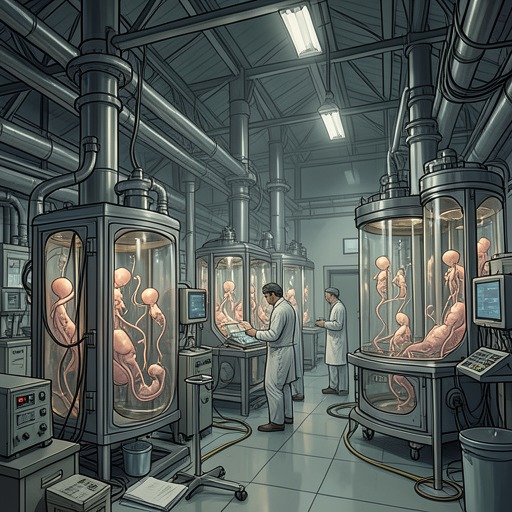
At the Central London Hatchery and Conditioning Centre, the World State’s governing logic is visible in a sequence of linked procedures. Eggs are transferred from test tubes into bottles, and details such as heredity, fertilization date, and Bokanovsky Group are recorded so each developing individual is identified rather than anonymous. The bottles then proceed to the Social Predestination Room, where extensive card indexes are updated daily and coordinated with production calculations.
These calculations connect population management directly to labor needs. Predestinators send figures to the Fertilizers, who supply the requested embryos; individuals of specified qualities are distributed in specified quantities, and the decanting rate is adjusted to anticipated demand. Even losses are treated as entries to be promptly replaced. The system thus regards people as both living subjects and planned components of a social workforce, coordinating biological production with occupational allocation.
Conditioning, Hierarchy, and Consent
The World State sustains its caste order not only through assignment but by teaching citizens to approve of it. A recorded sleep lesson has a Beta child express satisfaction with being a Beta: Alphas work harder, while Gammas, Deltas, and Epsilons are described as inferior. The lesson supplies its own rationale for hierarchy, turning class position into a child’s supposedly personal preference.
The Director compares repeated instruction to drops of sealing wax that adhere and build up until they cover the underlying surface. In his account, State suggestions become the mind that judges, desires, and decides, not simply a set of rules citizens can consciously obey or reject. The metaphor captures the regime’s central technique: political authority is made durable by inhabiting everyday thought and presenting its values as common sense.
The same logic governs consumption. The World State suppresses the lower classes’ love of nature because landscapes and flowers do not keep factories busy, but it preserves travel by conditioning people to dislike the countryside while enjoying sports that require elaborate equipment. Electric shocks form part of this training. The result is not a simple prohibition on leisure or movement: activities are redesigned so that recreation generates demand for manufactured goods and transport.
Stability as a Political Principle
The World State’s official justification is that stability depends on stable individuals. The Controller describes civilization as requiring social stability and social stability as requiring individual stability. His image of a machine whose wheels must keep turning gives the principle an economic and demographic edge: interruption threatens mass hardship, while obedient, contented workers keep the mechanism in motion.
This commitment also shapes the society’s account of history. The Nine Years’ War and the Great Economic Collapse are recalled as a crisis in which the choice was framed as World Control or destruction, stability or its opposite. The World State’s commemorative and communal practices—including Ford’s Day celebrations, Community Sings, and Solidarity Services—belong to the order that followed. The memory of catastrophe helps present centralized control not as one political arrangement among alternatives, but as the condition for avoiding renewed collapse.
Managed Pleasure and the Limits of Change
The system maintains contentment through a tightly organized package of work, leisure, and relief. Lower-caste workers, the Controller explains, have seven and a half hours of mild labor, followed by a soma ration, games, unrestricted sexual relations, and feelies. He argues that shorter hours would not necessarily make them happier: an earlier four-hour working-day experiment in Ireland produced unrest and increased soma consumption. In his view, additional leisure became something people sought to escape rather than enjoy.
The World State also limits inventions and scientific discovery when they threaten its settled arrangements. Although labor-saving plans accumulate in the Inventions Office and food could be synthesized, the Controller says such changes are withheld: shorter work and factory production would unsettle employment and established social patterns. Pure science is treated as potentially subversive and kept under close control. Stability therefore requires not simply technological capacity, but the political decision to restrain what technology might make possible.
The evening routines of Lenina Crowne and Henry Foster show how public order is reproduced through ordinary pleasure. After a meal and soma, they go to the Westminster Abbey Cabaret, where synthetic music, sensory spectacle, and dancing fill the evening. Their leisure appears personal, but it takes place within the system’s ready-made forms of consumption and emotional management. The contrast between that cheerful routine and the human being Henry imagines disappearing in a cremation incinerator exposes the cost hidden beneath the assurance that everyone is happy.
Significance
The World State’s power lies in joining administrative calculation to emotional formation. It plans populations and workforces, but it also teaches citizens what to enjoy, which classes to admire, and how to interpret stability as their own well-being. Conditioning, consumer demand, soma, and regulated leisure reinforce one another: desire supplies consent, and consent helps keep production and social roles undisturbed.
That design is not presented as limitless progress. The society can produce new inventions and expand technical control, yet its rulers deliberately restrain change because discovery, excess leisure, and scientific inquiry may destabilize the order. The World State is therefore defined by a paradox: it uses advanced organization to preserve a carefully controlled social equilibrium, securing happiness by narrowing the range of lives and changes citizens can imagine.