World State–Savage Reservation relationship
Brave New WorldThe World State–Savage Reservation relationship is not simply a contrast between two ways of life: it is an enforced separation built into the landscape. A high-voltage perimeter fences off the Reservation, and the World State controls access through permits and official escorts. The boundary presents the State’s order as triumphant and secure, but it also makes exclusion concrete: those within the Reservation are described as unable to leave, while approved visitors can cross in by aircraft.
The Reservation as a bounded territory
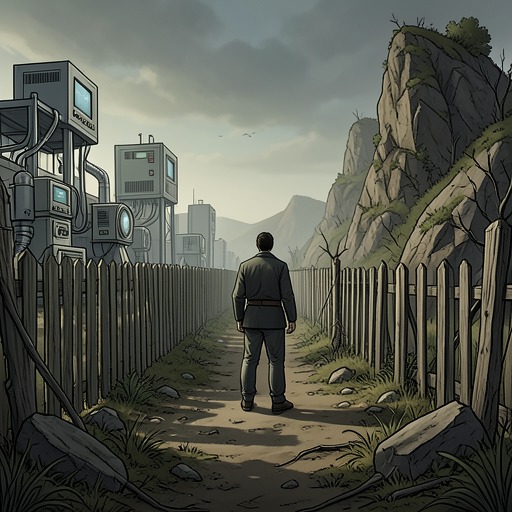
The Warden tells Bernard Marx and Lenina Crowne that the Reservation covers five hundred and sixty thousand square kilometres and is divided into four Sub-Reservations. Each is surrounded by a high-tension wire fence, with current supplied by the Grand Canyon hydro-electric station. The scale and infrastructure make the boundary more than a local barrier: it is a vast, engineered perimeter, powered by the same kind of modern utility that sustains the World State’s technological society.
The fence is described as extending for more than five thousand kilometres and carrying sixty thousand volts. The Warden makes its danger explicit: touching it means instant death. He insists that there is no escape from a Savage Reservation, then repeats the point when Bernard tries to leave before the permit has been countersigned. Access is therefore controlled at both edges. Bernard and Lenina cannot depart the Warden’s office until the administrative requirement is satisfied, while the people born inside the Reservation, the Warden says, are destined to die there.
A border crossed by permission
Bernard and Lenina’s crossing depends on formal authorization. Their permit needs the Warden’s signature; after it is secured, a Reservation Guard arrives with a plane and recites the planned itinerary. Their passage is thus not an informal journey through an open frontier but a managed visit, arranged by officials and conducted under escort. The Reservation is accessible to World State citizens when the authorities approve, even as the Warden presents it as a place from which its own inhabitants cannot escape.
Ten minutes after takeoff, the aircraft crosses the frontier between what the narration calls civilization and savagery. From above, the fence runs uphill and downhill, across salt and sand deserts, forests, canyons, crags, peaks, and table-topped mesas. Its unbroken straightness is set against the varied terrain it cuts through: a geometrical line imposed across a landscape. The view turns the boundary into an emblem of World State purpose, but the image also insists on the physical force required to maintain that division.
The violence of separation
At intervals below the aircraft lie white bones and unrotted animal carcasses. Deer, cattle, pumas, porcupines, coyotes, and even turkey buzzards have approached the wires and been electrocuted. The pilot treats these deaths as a joke, saying the animals never learn and laughing as though their destruction were a personal victory. His response shows how thoroughly lethal exclusion has been normalized: the barrier is not merely a warning but a device that kills, and its violence is converted into amusement for those who fly safely above it.
That aerial view sharpens the asymmetry between the two societies. World State visitors cross the border by machine, protected by official permission and transport; animals that encounter the fence die, and the Warden’s account denies an exit to people born inside. The Reservation is therefore both separated from the State and subjected to its technical power. Its enclosure keeps populations apart, but it does not signify an absence of State authority: the electrically lethal boundary is itself an expression of that authority.
Contrast and narrative significance
The Warden’s account also defines separation through opposed assumptions about birth and social life. He treats the fact that children are born in the Reservation as revolting, while describing those births as the condition that fixes their fate within its borders. The juxtaposition exposes the World State’s contempt for natural birth alongside its power to designate the Reservation as a place of permanent confinement. Cultural difference is not presented as an equal exchange between neighboring communities; the State’s official language marks one side as civilization and the other as savagery, while its technology enforces the distinction.
The relationship is consequently one of managed distance rather than complete disconnection. The World State can survey the Reservation, issue permits for visits, and carry its citizens across the frontier, yet the fence makes the people and lives on the other side objects of containment. The straight line through the varied landscape condenses that contradiction: a claim to order made visible through a system of separation whose clearest evidence is the danger it imposes. The Reservation’s isolation is not simply a difference in customs; it is a political and physical condition maintained by the World State’s machinery.