“Traveling” and a life of wandering
Breakfast at Tiffany's“Traveling” and a life of wandering is the identity Holly Golightly gives to her unsettled existence: first a word printed beneath her name on a mailbox card, then an explanation of why she cannot promise where she will live, and finally the condition that continues after she leaves New York City. The word makes movement sound like a chosen way of being, but its recurrence also reveals the uncertainty beneath that pose. Holly can name her direction more readily than her destination.
The Word on the Mailbox
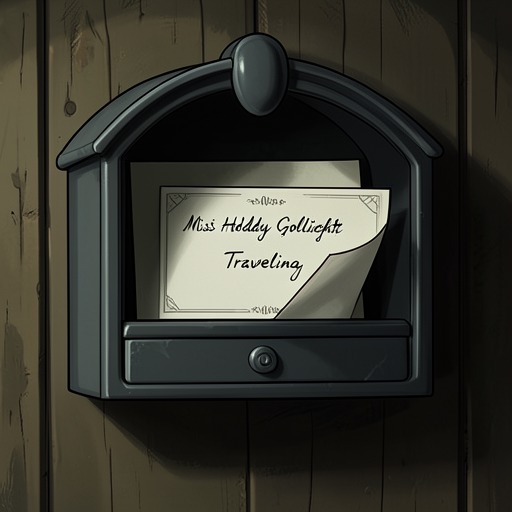
The narrator first notices the card on the mailbox for Apt. 2 about a week after moving into the brownstone. Its carefully formal lettering reads “Miss Holiday Golightly”; beneath the name, in the corner, is “Traveling.” The unusual label catches in his mind like a tune. Instead of an ordinary address identifying where its owner can be found, the card announces that she may not be in one place at all.
The detail also introduces Holly before the narrator knows her. Its formal presentation gives the card the air of a settled identity, while its final word unsettles that impression: “Traveling” supplies no destination or return date. Much later, the narrator learns that the cards came from Tiffany’s and that Holly had ordered them as a small purchase she felt she owed the people there. A polished keepsake of a moment becomes a durable sign of a life she cannot promise to keep in one place.
A Name for Uncertainty
When the narrator asks why she chose the word, Holly explains that she cannot know where she will be living tomorrow. “So I told them to put Traveling.” Her answer turns the card from an eccentric flourish into a concise account of her circumstances: the uncertainty is not merely about a particular next stop, but about having a place she can count on as home.
The word nevertheless offers a way to present that uncertainty as movement rather than as lack. Holly does not describe a fixed residence or a clear itinerary; instead, she gives the instability a name that sounds deliberate. The card holds together two aspects of her self-presentation: the wish to remain mobile and the admission that she does not know where she belongs. Its confident typography cannot resolve the question it prints beneath her name.
Departure Without a Destination
After her arrest in the Sally Tomato drug case, Holly plans to leave New York City while out on bail. She tells the narrator she has a reservation on a plane to Brazil, and insists that she is not chasing José Ybarra-Jaegar: the ticket is already paid for, and she has never been to Brazil. Her explanation makes travel sound like an opportunity she need not waste, even as the circumstances make the departure a flight from an unresolved legal case.
When the narrator warns that jumping bail may prevent her from coming home, Holly answers that home is wherever a person feels at home, and adds that she is still looking. The statement sharpens the meaning of “Traveling”: departure is not just a route between countries, but a response to the absence of a secure place of belonging. Her itinerary has a plane and a destination, but not the assurance of a home to return to. The original word on the card thus acquires a more serious edge: a freely chosen label now accompanies a choice whose consequences include the prospect of not being able to come back.
After the Journey
Months pass without word from Holly, and the brownstone's owner sells her abandoned possessions. In spring, a postcard arrives in the narrator’s hands, written in pencil and signed with a lipstick kiss. Holly reports that Brazil was “beastly” but Buenos Aires was “the best,” and compares the city favorably, though not completely, with Tiffany’s. The postcard provides news of another destination, but no fixed address; she says she will send one when she knows it herself.
The message also shows that movement has not resolved the question of where she belongs. Holly is living alongside a wealthy South American man, but he has a wife and seven children, and she is looking for somewhere to live. The postcard carries the breezy intimacy of a continuing connection while confirming that her whereabouts remain temporary and uncertain. Even when she reports a city she likes, she cannot turn that preference into a settled home.
The narrator never receives the promised address. By the novel’s close, “Traveling” remains less a record of completed travel than an unfinished condition: a word that first made Holly’s mailbox remarkable and later becomes the nearest thing she has to a stable account of herself. Its tension lies in the gap between motion and belonging. Holly can leave, arrive, and write from somewhere new; the lasting question is whether any destination will feel like hers.