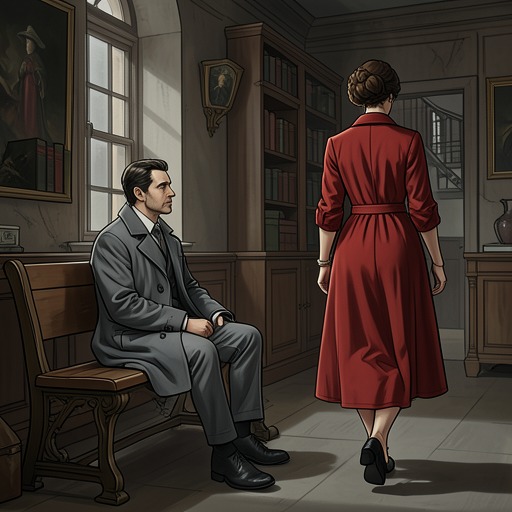
Holly Golightly and the narrator
Breakfast at Tiffany'sHolly Golightly and the narrator share an intimate, unstable friendship that turns acts of access and care into tests of belonging. She summons him in the middle of the night, rests beside him in grief, gives him a bird cage, and tells him she loves him after he is nearly killed. Yet she also withdraws, quarrels with him, and leaves without a settled address. Their bond culminates not in reunion but in the narrator’s promise to find Holly’s cat, an act of care that continues after she has gone.
Beginnings: A Door Open at Night
The friendship takes shape through a repeated midnight interruption. After promising not to ring I. Y. Yunioshi’s bell again, Holly starts ringing the narrator’s instead, sometimes at two, three, or four in the morning. She needs him to press the buzzer that releases the downstairs door; because he has few friends who might call at such hours, he knows who is outside before she explains. At first he goes to the door half-expecting a telegram bearing bad news. Holly’s explanation is simply that she has forgotten her key. The same nocturnal summons thus carries two meanings: it makes him useful to her, while leaving him alert to the possibility that her arrival signals something more serious.
Their closeness begins before either treats it as a formal relationship. The narrator says that they had never met, despite often encountering one another on the stairs and in the street: Holly, behind dark glasses and impeccably plain clothes, seemed not quite to see him. That early distance gives way to a private routine of entry and response. She does not need to explain herself fully for him to recognize her, and he does not require an invitation beyond her call at the door.
Confidences and Care
In one of their most vulnerable encounters, Holly has been involved in visits to Sally Tomato at Sing Sing, where she passes along weather phrases supplied for him to know that she has come. When the narrator questions the false identity she uses and the reports she leaves with the answering service, Holly dismisses the risk and says that she has looked after herself for a long time. She then draws the covers up to his chin, lies beside him, and asks to rest. Their intimacy is expressed less through explanation than through small acts of physical care and the permission to share a bed without conversation.
At six, the narrator pretends to be asleep as Holly touches his arm carefully, trying not to wake him. She whispers about Fred, asking where he is and saying that it is cold, with snow in the wind. Her cheek settles against the narrator’s shoulder, warm and damp with tears. The tenderness of the scene is inseparable from its limit: she is beside him, but her words are addressed to Fred. When the narrator asks why she is crying, Holly springs away and accuses him of being a snoop. Her need for comfort and her resistance to being observed arrive in the same moment; the narrator is close enough to witness grief but not entitled to claim it as confidence.
The bird cage becomes another expression of the friendship, first as a gift and later as an object caught up in a rupture. The narrator gives Holly a St. Christopher medal from Tiffany’s, but recalls that she gives him the bird cage. It remains with him through journeys to New Orleans, Nantucket, Europe, Morocco, and the West Indies, while he says that he has seldom remembered that Holly gave it to him. The distinction matters: the cage endures as a material trace of her care, but the narrator’s memory of its giver is interrupted by his own choice to forget after their falling-out.
Jealousy, Estrangement, and Affection
The narrator’s attachment becomes explicit when a newspaper headline leads him to believe Holly has married Rusty Trawler. Already distressed by losing his job, uncertainty about the draft, and a discouraging search for work, he reads the supposed marriage as another sign that the world is going wrong. He admits that his despair was intensified by being in love with Holly, though he describes that love as belonging to a broad and unusual category that had also included his mother’s elderly cook, a postman, and an entire family. That kind of love, he acknowledges, generates jealousy too. His feeling is therefore genuine but not possessive in a conventional romantic sense: he can love Holly, resent the prospect of her marriage, and recognize that his jealousy does not give him a claim over her.
The apparent marriage turns out to be a misreading. When the narrator buys a paper and sees the rest of the report, he learns that Rusty’s bride is Mag Wildwood, not Holly. His legs go limp with relief, and he takes a taxi the rest of the way home. The episode reveals how readily news of Holly’s possible departure can alter his emotional state, but it also exposes the uncertainty of his position: he is following her life through a headline, not through an assurance from her.
Their conflict later becomes sufficiently serious that the narrator says he chose to forget that Holly had given him the cage. He places it among the objects revolving in the “eye of our hurricane,” alongside O. J. Berman and a copy of his story that he had given Holly after it appeared in a university review. The account establishes the falling-out and identifies the people and objects drawn into it, but does not specify its full course in the surviving recollection. What it does make clear is that their friendship could turn its keepsakes into contested ground, and that the narrator’s continued possession of the cage outlasted the memory he had deliberately suppressed.
Rescue and a Declaration
The relationship takes another form when Holly saves the narrator during the Central Park horseback riding accident. Afterward, he tells her that he was not hurt and thanks her for saving his life, calling her wonderful and unique and saying that he loves her. Holly responds by calling him a damn fool and kissing him on the cheek. The exchange is both intimate and asymmetrical: he gives voice to love and gratitude, while her reply converts the intensity into a familiar rebuke and a kiss rather than a declaration of her own.
The scene nonetheless marks a clear change in what each can do for the other. Holly has acted decisively to protect the narrator; he answers by naming the value of her intervention. His declaration is not an abstract compliment detached from events but a response to the fact that she has just saved his life. The kiss makes affection visible, even as her teasing phrase keeps the moment from settling into a promise about their future.
The Cat, Departure, and What Remains
When Holly prepares to leave, she insists that she and the narrator had only met by the river and had made no promises to one another. Her voice collapses as she speaks, and, when the car pauses at a traffic light, she opens the door and runs back to search for her cat, whom she had left behind. The narrator follows. Holly calls for the cat up and down the block until a boy appears holding an old tom and offering to sell it. The episode turns her abstract defense of independence into an immediate confrontation with the creature she has abandoned.
At the limousine, Holly hesitates and looks beyond the narrator toward the boy and the cat. Shuddering and gripping the narrator’s arm to keep her balance, she admits that she and the cat had belonged to each other and that he had been hers. The admission directly unsettles her insistence that no bonds existed: she recognizes a mutual belonging only after she has acted as though the cat could be left behind. The narrator does not argue with her or promise that their own relationship will continue. Instead, he promises to return and find the cat, and to take care of him too.
Holly then asks what will become of her and says that she is very scared. She distinguishes this fear from the mean reds and from her fear of the fat woman: what frightens her now is not knowing what is hers until she has thrown it away. Her dry mouth and shivering give the fear a bodily force, while her decision to get into the car carries her away from the street and the abandoned animal. In this last exchange between them, she does not ask the narrator to rescue her or settle their relationship. She lets him promise care for the cat, then leaves.
Holly’s departure is followed by months of silence. A postcard arrives from Brazil, signed with a lipstick kiss, reporting that she is in Buenos Aires and looking for somewhere to live; she says she will send her address when she knows it herself. No address follows. The narrator has things he wants to tell her, including that he has sold two stories and is moving from the brownstone, but chiefly he wants to tell her about the cat. After weeks of searching through Spanish Harlem and many false sightings of striped fur, he finds the animal and keeps his promise. The cat’s recovery gives their friendship a practical afterlife: separated from Holly and unable to secure a reply, the narrator continues one responsibility she entrusted to him.
A Friendship Without Possession
The bond between Holly and the narrator is defined by closeness that repeatedly stops short of ownership. She relies on him to open the door, accepts his quiet presence when she grieves for Fred, and shares moments of affection and gratitude with him. He, in turn, becomes jealous at the prospect of her marriage, loves her, receives her kiss after the accident, and cares for the cat she leaves behind. But Holly’s defense that they made no promises, her sudden flight from the car, and the missing address preserve her freedom to disappear.
The bird cage and the cat give this relationship two different material endings. The cage remains with the narrator across continents, even through a period when he chooses to forget its giver. The cat is temporarily lost, searched for, and finally found through a promise the narrator makes as Holly departs. One object holds the trace of a closeness obscured by estrangement; the other converts that closeness into a continuing act. Together they show why the friendship cannot be reduced either to a settled romance or to casual acquaintance: its deepest commitments are real, but they persist as care and memory rather than as a shared home or guaranteed return.