I. Y. Yunioshi
Breakfast at Tiffany'sI. Y. Yunioshi is a photographer whose return to Joe Bell’s bar sets in motion the novel’s late, unresolved account of a possible African encounter with Holly Golightly. He is also part of the brownstone’s remembered domestic life: a tenant on its top floor, whose exasperated calls down the stairs punctuate Holly’s nocturnal comings and goings. Through him, a photograph and a wooden likeness become suggestive evidence of Holly’s travels, without establishing what ultimately happened to her.
Identity and Place in the Brownstone
The narrator recalls I. Y. Yunioshi as a photographer for one of the picture magazines. When the narrator knew him, he lived in the studio apartment on the top floor of the brownstone, above Holly’s apartment. His profession and residence place him in the house’s everyday community, while the later account of his journeys makes him a link between that small New York setting and a distant village in Africa.
The narrator’s recollection is more definite than Joe Bell’s initial approach. Joe asks whether the narrator remembers a gentleman from Japan; the narrator answers that Yunioshi is from California and recalls him perfectly. The exchange establishes both an old acquaintance and a small correction in how Joe introduces him. Joe is preoccupied with what the photographer may have seen, but the narrator’s memory first identifies him through his work and former address.
The Nocturnal Calls
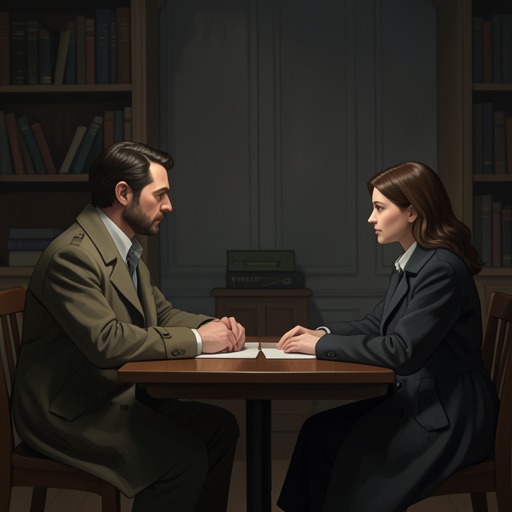
In the narrator’s recollection of the brownstone, Yunioshi’s voice travels down the stairs after midnight. He calls Holly by name and protests that she cannot keep ringing his bell. Holly replies from the bottom of the stairs that she has lost her key, addressing him affectionately even as she admits the cause of the disturbance. Yunioshi insists that she have a key made. The brief exchange makes their proximity practical as well as social: Holly’s lost key repeatedly turns the photographer’s doorbell into an improvised way back into the building.
The scene also gives Yunioshi a recognizable manner. His voice is stern and exasperated, rising from the top floor through the house; Holly’s answer is self-amused and apologetic. Their exchange is not a major confrontation, but it records a recurring domestic irritation and the ease with which Holly treats it as a familiar inconvenience. The contrast between his insistence on a simple solution and her continuing to lose the key captures the comic friction of shared life in the brownstone.
The Return and the Photographs
Years later, Yunioshi returns to Joe Bell’s bar after an absence Joe estimates at more than two years. Joe says the photographer had been in Africa, a report the narrator had also read in Winchell. To explain why he has summoned the narrator, Joe produces a manila envelope containing three photographs, similar images taken from different angles. They show a tall, delicate Black man in a calico skirt, smiling shyly and proudly as he displays an elongated wooden carving of a girl’s head.
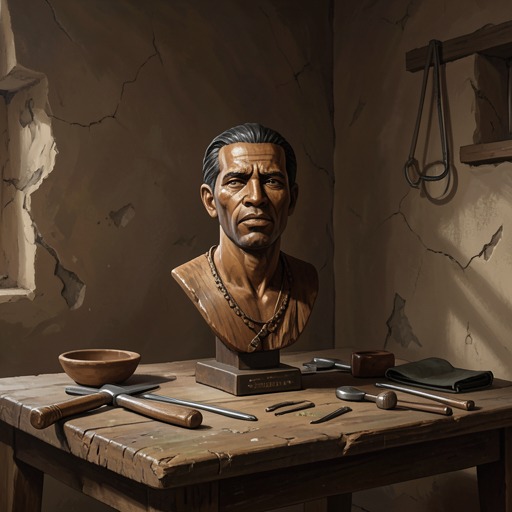
The carving’s features make the photographs arresting to the narrator: sleek, short hair, oversized tilted eyes, a tapering face, and a wide, emphatic mouth. At first it resembles primitive carving; then the resemblance resolves into a likeness of Holly. The object has come a long way from the familiar New York apartment, but it carries Holly’s face into Joe Bell’s bar in a form that feels at once unmistakable and strange. Yunioshi’s photographs supply the material basis for the claim, although the narrator sees only what the images show, not the circumstances behind them.
Joe is certain that the carving is Holly’s likeness and says Yunioshi recognized her immediately. The narrator asks whether Yunioshi actually saw Holly in Africa. Joe clarifies that he saw the statue, not Holly herself, and directs attention to the writing on the back of one photograph: “Wood Carving, S Tribe, Tococul, East Anglia, Christmas Day, 1956.” The caption gives the likeness a specific place and date, but it does not by itself prove that Holly was the woman who inspired it.
The Account from Tococul
Joe relays Yunioshi’s account of how he encountered the carving. On Christmas Day he passed through Tococul, a remote village of mud huts, monkeys in the yards, and buzzards on the roofs. Preparing to move on, he noticed a Black man carving monkeys on a walking stick in a doorway. Yunioshi asked to see more of his work and was shown the girl’s head. The photographer later told Joe that seeing it made him feel as if he were falling in a dream.
Yunioshi tried to buy the sculpture, but its maker refused. The offers grew from salt and ten dollars to a wristwatch, then to more salt and twenty dollars; none persuaded the carver to part with it. The man cupped a hand over his private parts, a gesture the account compares to tapping one’s heart, and said no. Yunioshi’s persistence did not secure the carving. Instead, he gave up his salt and watch to learn how it had been made, acquiring the story behind the likeness rather than the object itself.
As Joe recounts the exchange, the account crossed languages and forms of communication: African speech, pidgin English, and gestures. The story the photographer managed to learn was that, in the spring, three white travelers on horseback had emerged from the brush: a young woman and two men. Both men were feverish and spent several weeks shut away and shivering in an isolated hut. The young woman, according to the account, took a fancy to the woodcarver and shared his mat. The story offers a possible history for the carving, but it reaches the narrator through Yunioshi’s interpretation of a difficult exchange, then through Joe’s retelling.
Evidence, Speculation, and the Limits of the Portrait
Joe refuses to treat the story as settled fact. Though he accepts the likeness as Holly’s, he says he does not credit the account of her sharing the woodcarver’s mat. His disbelief rests on his own sense of Holly’s character, not on independent proof about the travelers. The distinction matters: Yunioshi’s photographs establish that a striking likeness existed in Tococul, and the reported story associates a young woman with the carver, but neither Yunioshi nor Joe can confirm that the woman was Holly.
Yunioshi is therefore central to the novel’s final movement without becoming a direct witness to Holly’s fate. He brings back photographs and a story from Africa; Joe interprets them with conviction and reservation, while the narrator encounters the evidence after the fact. The distance between image, reported encounter, and confirmed identity remains open. The carved head makes Holly seem present in a place she may have reached, yet the account offers no certainty that she was there. Yunioshi’s role is to carry that unresolved possibility from the faraway village into the brownstone’s circle of memory.
His other appearances sharpen the contrast between ordinary familiarity and distant mystery. In the house, he is the upstairs neighbor asking Holly to make a key; in Joe’s account, he is the returning photographer whose journey has yielded a likeness and a tale that neither he nor the narrator can fully verify. The book does not disclose what became of Yunioshi after this report. What remains is his mediated evidence: images, a dated caption, and a story that gestures toward Holly’s travels without closing them.