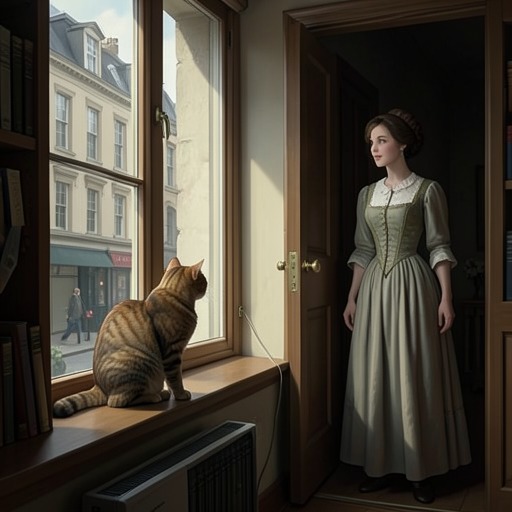
Madame Sapphia Spanella
Breakfast at Tiffany'sMadame Sapphia Spanella is a first-floor resident of Holly Golightly’s brownstone and a husky coloratura who roller-skates in Central Park. A recurring neighborly antagonist, she turns the building’s complaints about Holly into public pressure, then helps bring the police to Holly’s door. Her interventions make the brownstone’s domestic friction part of the larger crisis that ends in Holly’s arrest.
Identity and Place
Madame Sapphia Spanella lives on the first floor of the brownstone where the unnamed narrator and Holly Golightly also reside. The narrator recognizes her as the only former resident he remembers still living there when he returns to the street years later. Her identity is tied to both performance and routine: she is a coloratura, and she used to go roller-skating in Central Park every afternoon.
The building’s narrow shared spaces repeatedly bring her into contact with the other residents. She opens her door during Holly’s reunion with Doc Golightly and calls out at the disturbance, and elsewhere she watches and comments on the sounds and visitors associated with Holly’s apartment. Her position as a neighbor gives her access to the building’s common life, but it also makes her a self-appointed monitor of its standards.
Complaints and the Petition
As spring approaches, Madame Spanella organizes the brownstone’s other tenants against Holly. She circulates a petition asking them to join her in seeking Holly’s eviction, describing Holly as morally objectionable and accusing her of hosting all-night gatherings that put the neighbors’ safety and sanity at risk. The narrator refuses to sign, though he privately acknowledges that her complaints have some basis.
The petition fails, but the dispute does not quiet the building. With the windows open on warm spring nights, music and party noise continue to come from Holly’s apartment. Madame Spanella’s unsuccessful attempt at collective action therefore establishes a pattern that recurs later: when tenant pressure fails, she turns to outside authority.
Confrontations in the Building
Madame Spanella’s objections are expressed in public, abrupt interruptions. When Doc Golightly arrives and greets Holly, she opens her door and shouts for them to be quiet, calling the scene a disgrace and telling them to take their conduct elsewhere. The interruption places her moral condemnation beside a private reunion she does not understand or welcome.
Later, after the narrator reads a newspaper account of Holly’s arrest, he recalls that Madame Spanella had called the authorities several times to complain about her. He had assumed she was responsible for the arrest because of those earlier reports. The narrator’s account separates her persistent hostility from the actual scope of the case: her complaints help bring official attention to Holly, but the arrest is connected to the Sally Tomato affair.
The Arrest
The arrest takes place not in Holly’s apartment, as the newspaper claims, but in the narrator’s bathroom. The narrator is recovering from the effects of a horseback ride, and Holly is attending to him when someone knocks at the front door. Madame Spanella enters with two detectives in civilian clothes, including a female detective, and identifies Holly as the wanted woman. Her arrival converts the neighbor’s long-running dispute into direct participation in a police action.
The encounter becomes contentious. Madame Spanella points to Holly and the narrator and denounces Holly; Holly responds sharply to the female detective, who then strikes her. As the detectives take Holly downstairs, Holly calls back to the narrator with a practical instruction: he should feed her cat. Madame Spanella’s part in the scene is therefore consequential but limited: she supplies the police with a route into the home and publicly accuses Holly, while the detectives carry out the arrest.
Narrative Role
Madame Spanella is presented through the narrator’s recollections and judgments rather than through her own history or private perspective. Her petition, shouted complaints, and report to the authorities make her an agent of respectability within the brownstone, defining Holly’s parties and visitors as threats to the household’s order. Yet the narrator’s admission that she had grounds to complain complicates a simple portrait of her as a baseless persecutor.
Her recurring appearances also connect domestic conflict to the novel’s larger plot. At first, her influence is confined to a failed eviction petition and interruptions in the hall; later, she accompanies detectives into the narrator’s home and helps expose Holly to the legal system. The change is not that her objections become more persuasive, but that the consequences of acting on them grow more serious.