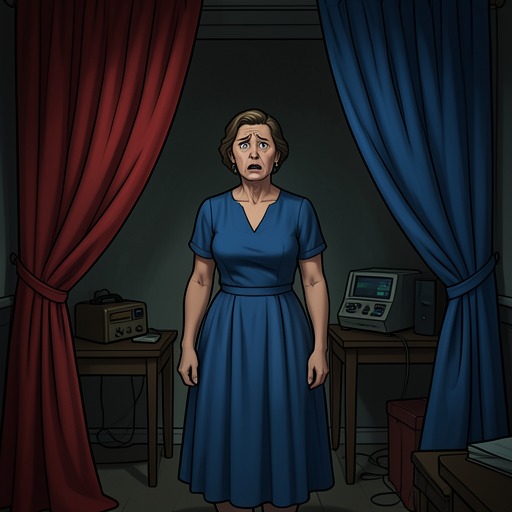
The mean reds
Breakfast at Tiffany'sThe mean reds are Holly Golightly’s term for a nameless, bodily fear that feels like a warning of disaster without revealing what the disaster might be. More than a colorful synonym for sadness, the phrase gives shape to an experience Holly cannot reason away: it is first managed through refuge and ritual, then recedes amid intimacy and ordinary routines, and at last is dwarfed by the concrete terror of irreversible loss.
Definition and Contrast
Holly introduces the phrase while explaining why she loves Tiffany & Co. She rejects the idea that the mean reds are simply the blues: sadness, she says, has an intelligible cause, such as gaining weight or prolonged rain. The mean reds are different. A person is afraid, sweats intensely, and senses that something bad will happen, but cannot say what it is. The distinction separates a recognizable low mood from a more disorienting anxiety, one whose threat is felt physically before it can be identified.
The conversation makes naming itself part of the expression’s meaning. The narrator offers “angst” as a term for the experience, and Holly accepts it provisionally before turning to the practical question of what helps. The exchange does not diagnose her or resolve the fear; it establishes the phrase as her own vivid shorthand for an emotion that arrives without a clear object. Its blunt, colloquial sound conveys urgency while preserving the uncertainty at its center.
Tiffany’s as Refuge
Holly’s answer to the mean reds is not an explanation but a destination. Alcohol and aspirin have failed to settle her, and marijuana, which Rusty Trawler recommends, only makes her giggle. What works best is getting into a taxi and going to Tiffany & Co. She describes the store’s quiet, its dignified appearance, the well-dressed men, and the smell of silver and alligator wallets as reassuring features of a place where nothing very bad could happen.
That refuge connects the expression to Holly’s larger uncertainty about belonging. While holding her nameless cat, she says she has no right to name him until he belongs to someone; she and the cat are independent, and neither yet has a settled place. She imagines that if she could find a real-life place with the feeling of Tiffany’s, she would furnish it and give the cat a name. The store therefore offers more than distraction from a passing mood: it stands for an ordered, safe setting in which attachment and possession might become possible without fear.
In the same conversation, Holly imagines that after the war she and Fred might go to Mexico, where she has seen a place near the sea suited to raising horses and where Fred’s skill with horses could matter. The thought links her wish for a secure home to a future still only imagined. Tiffany’s is immediately reachable by taxi; the life she pictures with Fred remains elsewhere and conditional. The mean reds emerge in that gap between the safety she can briefly visit and the stable belonging she has not yet found.
Recurrence and Change
The expression recurs as a measure of Holly’s changing circumstances. After a night involving drinking and exhaustion, she describes Mag Wildwood as suffering from a hangover with the mean reds on top of it. Here the phrase can be placed beside a physical aftermath, but it still names an additional distress rather than merely the effects of a hangover. Its recurrence shows that Holly’s term can travel beyond her own immediate account while retaining its association with fear and vulnerability.
Later, as Holly speaks about José, she says that he can laugh her out of the mean reds and that she no longer has them often. When they do appear, they are no longer so severe that she needs Seconal or has to take herself to Tiffany’s. Instead, she describes mundane activities: taking José’s suit to the cleaner or preparing mushrooms. The contrast makes change legible through what she no longer has to do. A feeling once answered by a retreat to a symbolic sanctuary has become less frequent and less overwhelming amid a relationship and its ordinary routines.
Holly’s account does not make that improvement into a permanent cure. She acknowledges that the mean reds still come sometimes, and her language measures their reduced intensity rather than declaring them gone. The expression thus retains its force even as its place in her life changes: it is a recurring vulnerability, not a single crisis neatly completed.
The Phrase at the Ending
After Holly leaves her cat and prepares to depart, she recognizes the bond she had resisted naming. Looking past the narrator and the boy offering the cat, she shudders and says that they did belong to each other and that the cat was hers. The narrator promises to find and care for him. Holly then asks what will happen to her and admits that she is very scared at last. The uncertainty she names is no longer only the possibility that something bad might happen: she is confronting what it means to have thrown away something that was hers.
In that final contrast, Holly says the mean reds are nothing beside this fear; even the fat woman, another source of fear mentioned in the passage, is nothing. Her dry mouth and shivering give the admission a bodily immediacy that recalls her earlier definition, where fear arrives with sweat before its cause can be named. But now the cause is painfully specific: separation and the possibility of lasting regret. The phrase’s meaning has not been disproved; it has been overtaken by a loss Holly can identify.
Narrative Significance
The mean reds organize several stages of Holly’s search for safety without reducing them to one explanation. The phrase begins as a distinction between ordinary sadness and unlocated fear, leads to Tiffany’s as a calming refuge, and returns as a way to register both the easing associated with José and the severity of a later separation. Its repetition creates a scale of feeling: anxiety may be manageable through a place, a person, or a familiar task, but the loss of a real attachment exceeds those earlier remedies.
The changing reference points also sharpen the story’s concern with belonging. At first, Holly describes herself and the cat as independent and avoids naming him because she does not yet know where they belong. At the end, she recognizes that they belonged to each other only after she has left him behind. Against that reversal, the mean reds name not just fear without an object but a recurring difficulty in finding security; the last scene gives that fear an object at the moment when recognition can no longer undo the departure.