Central Park horseback riding accident
Breakfast at Tiffany'sCentral Park horseback riding accident is the near-fatal episode in which Holly rescues the narrator after his horse bolts during a ride through Central Park. A birthday morning errand leads to a sudden crisis: the narrator is carried out of the park and into city traffic, while Holly races after him and helps stop the horse. The episode turns an ordinary outing into a direct test of their closeness, ending with the narrator’s explicit thanks and Holly’s worried attention.
Invitation and Setting
The accident begins on September 30, the narrator’s birthday. He is waiting in the vestibule for the postman, hoping for a monetary remembrance from his family. In retrospect, he identifies that chance circumstance as decisive: had he not been waiting there, Holly would not have invited him riding, and would not have had the opportunity to save his life.
Holly suggests walking horses around the park and explains that she wants to say goodbye to her old horse, Mabel Minerva. She is dressed in a windbreaker, blue jeans, and tennis shoes. The narrator’s response to the proposed farewell is surprise, but he goes with her. The ride begins as a modest excursion rather than an anticipated danger.
The horses come from stables on West Sixty-sixth Street. Holly chooses an old black-and-white mare for the narrator and reassures him that it is safe; his previous riding experience amounts only to childhood pony rides at carnivals. She helps him into the saddle, then mounts a silvery horse of her own. They cross Central Park West and enter a park riding path, where the narrator is at first swept into the pleasure of the ride and Holly’s happiness.
The Runaway Horse
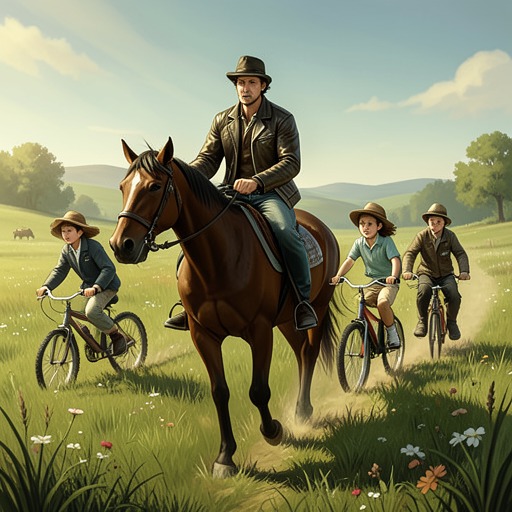
The calm changes when a group of boys leaps from the shrubbery beside the path, shouting and striking at the horses with switches. The narrator’s mare rears, loses control, and bolts down the path. The sudden movement leaves him scarcely secure in the saddle as the mare races across the park.
As the mare passes trees, a lake with small sailboats, and statues, people along the route shout instructions and warnings. The narrator later remembers those voices, but during the crisis his attention fixes on Holly: she is racing behind him, not quite able to catch up, and repeatedly calling encouragement. Her pursuit becomes the scene’s central counterforce to the horse’s flight; she stays with him even as the danger carries them farther from the riding path.
The runaway mare leaves the park and enters Fifth Avenue traffic, where taxis and buses swerve as she charges onward. The chase passes the Duke mansion, the Frick Museum, the Pierre, and the Plaza. The route’s rapid succession of landmarks marks the scale of the emergency: a ride that began within the park has become a public street pursuit, with the narrator unable to bring the horse under control.
The Rescue and Its Immediate Aftermath
Holly gains ground, and a mounted policeman joins the pursuit. The policeman and Holly flank the mare, using their horses in a pincer movement that brings her to a halt. Only then does the narrator fall from her back. He gets up, uncertain where he is, while a crowd gathers; the policeman records the incident and says he will arrange for the horses to be returned to their stable.
Holly puts the narrator into a taxi and asks how he feels. At first he says he is fine, though he feels ashamed. Holly insists that the situation is serious and asks him to look at her; his vision is blurred enough that he sees several versions of her face. She presses him to tell the truth because he might have been killed. His answer acknowledges both the danger and its outcome: he was not killed, and she saved his life.
The narrator’s thanks is also a declaration of affection. Holly calls him a fool and kisses his cheek; the moment of tenderness is followed by his fainting. The sequence moves from uncontrolled flight to coordinated rescue, then from physical danger to the narrator’s recognition of what Holly has done. Her concern, rather than any public account of the chase, gives the event its personal meaning.
Narrative Significance
The birthday coincidence gives the episode a clear chain of contingency: the narrator waits for the postman, Holly finds him there, and her invitation places him on the horse that later bolts. The narrator’s retrospective account explicitly links those circumstances to the rescue, making chance part of the event’s structure without implying that the birthday itself changes what happens.
The accident also makes the friendship between Holly and the narrator visible through action. During the ride, he is content to share her happiness; during the runaway, she remains close behind him and urges him onward; after the mare stops, she focuses on whether he is truly safe. His response shifts from embarrassment to direct gratitude and love. The scene’s emotional turn rests not on a change in their circumstances, but on the narrator’s recognition of Holly’s care under pressure.
That recognition is followed the same evening by a sharply different public image of Holly. Newspapers publish her photographs in connection with a narcotics scandal, not the runaway horses. The contrast separates the narrator’s intimate knowledge of her conduct during the rescue from the headlines that frame her through an arrest. The riding accident therefore stands at a hinge between a private act of loyalty and the public crisis that soon takes over the story.