Holly Golightly and Fred
Breakfast at Tiffany'sHolly Golightly and Fred are siblings whose bond persists across years of separation and radically different lives. Holly leaves home when Fred is still a boy, but she continues to remember him with tenderness and to use his name as a point of connection; his death later becomes the loss that interrupts her usual manner and leaves a visible mark on her life.
Identity and Childhood
Holly describes Fred as her brother and recalls that she had not seen him since she was fourteen, when she left home. He was already six feet two inches tall, while her other brothers were closer to her own smaller stature. Her account makes Fred memorable through affectionate, concrete details: he ate large quantities of peanut butter, cared about horses, and was considered odd by others. Holly rejects that judgment, remembering him instead as sweet, vague, and very slow. He had remained in the eighth grade for three years by the time she ran away.
The story later confirms the family connection through an old photograph shown by Doc Golightly, Holly’s father. The worn snapshot depicts the family on the porch of a wooden house. Doc points out Holly as a plump, fair-haired child and identifies a tall, thin boy as Fred, providing an image of the siblings together before Holly’s departure. The narrator recognizes a resemblance between the child in the photograph and Holly as he knows her, while Fred’s height recalls the childhood description she had given.
Separation and Continuing Attachment
Holly’s departure from home separated her from Fred during their youth, and the evidence does not show them reuniting in person. Doc explains that Fred remained with the family until he entered the Army. He did not understand why Holly had left her husband, brother, and children, but after joining the Army he began hearing from her. In a letter, he sent Doc Holly’s address, prompting their father to travel to New York City in hopes of bringing her home. Fred thus becomes an indirect link between the separated members of the family: his correspondence makes Doc’s search possible, even though the account does not establish that Fred intended to reconcile them.
For Holly, Fred’s memory recurs in the way she addresses the narrator. She tells him that she wants to help him because he looks like her brother, only smaller. Later she calls the narrator Fred, and after the news of her brother’s death she stops doing so. The repeated name makes her attachment tangible, but the shift after his death also marks a boundary: the resemblance that had invited the identification can no longer sustain it once Fred is gone.
Fred in Holly’s Imagination
Holly’s language about Fred can sound teasing, especially when she says that he is a soldier but doubts he will ever become a statue, and repeats the idea that people call the brave stupid. When another character applies that word to Fred, Holly corrects him: her brother is not stupid but yearning. She imagines him wanting to be on the inside, looking out, and likens the appearance of foolishness to that of someone pressing his nose against a pane of glass. Her defense recasts what others might dismiss as slowness or foolishness as longing and exclusion.
That distinction matters to the relation. Holly is willing to joke about Fred’s limitations, but she does not accept an outsider’s reduction of him to a joke. Her blunt answer that he would be stupid if he were stupid does not cancel the protective force of her correction; she has already supplied a more compassionate account of what his apparent awkwardness means. The contrast between affectionate teasing and serious defense gives the remembered brother more dimension than a purely idealized figure.
Death and Grief
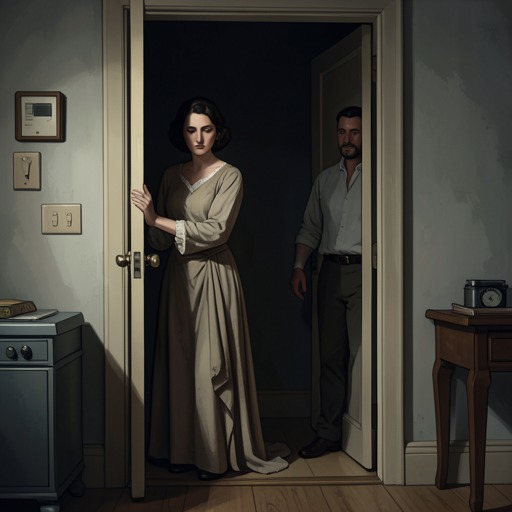
The decisive change in their relationship comes in a telegram from Tulip, Texas, reporting that young Fred has been killed in action overseas. The message is addressed to Doc and refers to the family’s shared loss. The narrator finds the telegram among the debris on Holly’s apartment floor, where it helps explain the destruction that followed the news. Fred’s death is therefore disclosed through an object and its aftermath, rather than through Holly narrating the loss directly at the time it occurs.
Later, in the hospital after her arrest, Holly explains what she saw in the period after learning of Fred’s death. She describes an imagined figure holding Fred and laughing, and connects that vision to why she went crazy and broke everything. Her account presents the destruction as a response to bereavement and to the frightening thought of death, not as a detached act of mischief. The remembered scene is recounted later, when the narrator visits her; it gives the reader a belated explanation for the earlier wreckage.
After the telegram, Holly no longer mentions Fred except once, and she ceases calling the narrator by his name. For a time she withdraws from much of her social life, remains largely at home, and appears changed in her habits and appearance. Yet the narrator also observes that she seems more content than before, so her grief does not yield a simple or wholly visible account of her inner state. Fred’s death remains the clear turning point: his name and memory persist, but the easy repetition of their bond through the narrator ends.
Narrative Significance
Fred is present for much of the story through recollection, correspondence, a photograph, and the telegram rather than through direct scenes with Holly. This mediated presence gives the sibling bond a structure of distance: Holly left him behind, Doc searches for her with news Fred helped convey, and the reader learns of Fred’s death through a message discovered after the event. The sequence makes the loss both personal and narratively delayed, with the telegram first identifying the death and Holly’s later hospital account revealing its psychological consequence.
The relationship also complicates the freedom Holly associates with leaving home. Her life in New York City is separated from the family she left, but Fred’s name continues to shape her intimacy with the narrator and her response to the past. The final change—from calling the narrator Fred to no longer doing so—does not erase the earlier attachment. It registers that the real brother cannot be replaced by resemblance, and that his death has altered how Holly carries the bond.