Holly Golightly leaves Doc Golightly and Texas
Breakfast at Tiffany'sHolly Golightly leaves Doc Golightly and Texas as a child bride, but the later reunion reveals that the departure cannot be undone by Doc’s love or by his conviction that home is waiting for her. The story frames her escape through two incompatible accounts: Doc remembers a cherished wife who had no reason to leave, while Holly recognizes in herself the frightened, restless child she once was and still refuses to return. Their parting turns the language of wildness and freedom into a measure of love’s limits.
Identity and Background
Doc identifies the woman he has been seeking not as Holly but as Lulamae Barnes, the name she had before marrying him. He introduces himself as her husband, a horse doctor and animal man who also farms near Tulip, Texas. His account makes the gulf between their shared past and Holly’s New York identity immediate: to him she remains his wife, while the narrator knows her by the name and life she has made since leaving.
Lulamae and her brother Fred had been impoverished and neglected before they came to Doc’s household. Doc recalls that his oldest daughter, Nellie, found the two children stealing milk and turkey eggs. Their parents had died, and the siblings had been sent to live with different harsh families. Doc says that Lulamae had good reason to run from that earlier home, but no reason to leave his. His distinction between the two homes is central to his bewilderment: he understands escape from cruelty, not departure from a place he believes was loving and secure.
Doc married Lulamae in December 1938, when she was almost fourteen. He acknowledges that she was a child, but insists that she understood the promise she made to become his wife and the mother of his children. The four children in his family picture were not her biological children; their mother had died on Independence Day in 1936, the year of the drought. Doc’s account therefore places Holly’s departure within a marriage formed when she was exceptionally young and already expected to assume an adult family role.
Life in Doc’s Household
Doc remembers Lulamae as lively, talkative, and increasingly healthy after arriving at the farm. He describes a household with cows, a garden, chickens, and pigs, where his daughters did the housework and Lulamae could spend time combing her hair, looking in mirrors, and reading magazines. He presents this ease as evidence that she was cared for; the same details also show the distance between his definition of a good life and the life she eventually wanted.
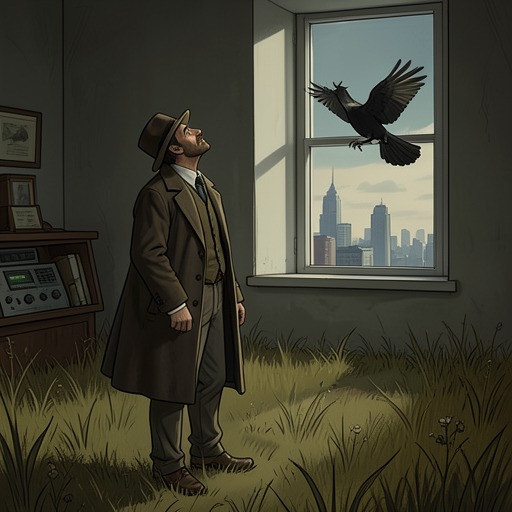
His memories dwell on small acts of tenderness. He picked flowers for her, taught her to play the guitar, and tamed a crow that learned to call her name. He recalls crying when he proposed and being delighted when Lulamae accepted. For Doc, these memories establish that she was loved and happy. They also give the later absence a sound and shape: after she walked farther and farther from the house and finally did not come back, the crow went wild and spent the summer calling her name around the yard, garden, and woods.
Doc offers a theory for her departure, though he cannot know its full cause. He suspects that the magazines brought into the house—he estimates they were worth a hundred dollars—showed Lulamae other possible lives and started her walking down the road. At first she returned after a mile, then after two; eventually she kept going. His explanation joins domestic comfort to an expanding horizon: the home he thought should satisfy her also became the point from which she could imagine leaving.
The Search and the Reunion
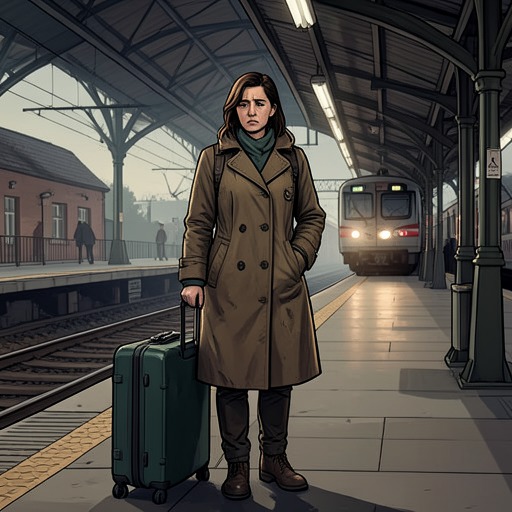
Doc says he spent five years looking for his wife. After Fred, who had remained with the family until he entered the Army, wrote to him with Holly’s address, Doc bought a Greyhound ticket and came to New York. He believes that Holly is sorry and wants to go home. Because he does not want to surprise or frighten her, he asks the narrator to let her know he is there and to act as a friend.
The request places the narrator between Doc’s hopeful expectation and Holly’s independent life. Doc waits at the bottom of the stairs, brushing his sleeves and tightening his tie before she arrives. Holly, alone and dressed for an evening out, is on her way to leave; she greets the narrator playfully and says she is in too much of a hurry to make up. The contrast is plain without a confrontation: Doc has prepared for a reunion, while Holly has not yet been told that her former life has come looking for her.
After spending the night with Doc, Holly explains that she and he roamed around a bus station until morning. He continued to think she might go with him, although she repeatedly told him she was no longer fourteen and no longer Lulamae. The repetition marks the conflict more sharply than a simple refusal would. Holly distinguishes the name and age attached to their marriage from her present self, yet admits that the past has not disappeared inside her.
Refusal and Parting
Holly’s account of the encounter is not a denial of affection. She says that Doc truly loves her and that she loves him. She remembers his sweetness and the confidence he could give to birds, children, and fragile things, and says she has always remembered him in her prayers. Her defense of him is also a defense of the reality of their bond: she does not need to portray him as cruel in order to explain why she cannot return.
The refusal rests instead on a painful recognition. Holly says that while standing with Doc she realized she was still the girl stealing turkey eggs and running through a brier patch, even though she now calls that feeling the “mean reds.” The memory connects her present fear and restlessness to the childhood Doc remembers, but it does not make her consent to resume the role he offers. She can recognize the continuity between Lulamae and Holly without accepting that the child bride remains her whole identity.
Holly describes their parting as a handshake in which they held on to each other and Doc wished her luck. She later asks Joe Bell and the narrator to wish Doc luck too, saying he must by then be in the Blue Mountains. The gesture makes the separation mutual in tenderness, but not in outcome: Doc travels away, and Holly stays in New York rather than returning with him to Texas.
Wildness and the Meaning of Home
Holly’s warning never to love a wild thing draws directly on Doc’s care for animals. He brought home injured creatures, including a hawk with a hurt wing and a full-grown bobcat with a broken leg. In her image, affection helps the wild creature grow strong enough to leave: first to the woods, then to a higher tree, and finally to the sky. The principle fits Holly and Doc’s history without reducing their marriage to a simple betrayal. His care was real; it could not make her stay.
The sky becomes the final image of the separation. Holly says that it is better to look at the sky than live there, because it is empty and vague, a country where thunder goes and things disappear. Her words acknowledge the loneliness and uncertainty of the freedom she chooses rather than presenting departure as an uncomplicated triumph. Doc’s home offered attachment and care; Holly’s escape preserves her ability to go, while leaving both of them with the distance that choice creates.