Holly abandons her cat and the narrator later finds him
Breakfast at Tiffany'sHolly Golightly abandons her cat during her flight from New York, then recognizes too late that their attachment was mutual; the Unnamed Narrator’s promise to find him becomes the action’s only repair. The cat’s later appearance in a welcoming home gives the episode a qualified resolution, while Holly’s absence leaves open whether she, too, has found somewhere to belong.
The Abandonment in Spanish Harlem
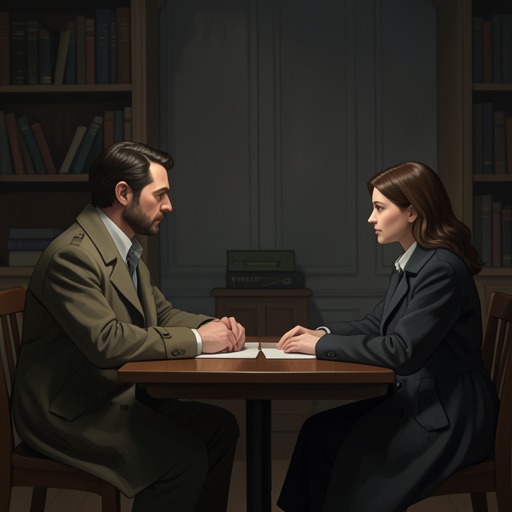
As the limousine carrying Holly and the Unnamed Narrator moves uptown through a lessening rain, Holly asks the driver to stop in Spanish Harlem. She steps out with the cat in her arms and tries to make the place sound suitable for him: there are garbage cans, rats, and other cats with which he might associate. Her words present the abandonment as a practical separation between two independents, not as a rupture of attachment. But the cat does not take the invitation to leave. He rubs against her leg, and Holly’s repeated commands grow harsher until she jumps back into the car and orders the driver to go.
The contrast between the language of independence and the cat’s physical response makes the scene’s conflict visible before Holly can admit it. The cat stays close; Holly insists that he go. The Unnamed Narrator, stunned by what he has witnessed, calls her a bitch. A block passes before she attempts to defend herself, explaining that she and the cat had met by the river and had never promised anything to each other. Her sentence breaks off. A tic and a sudden whiteness seize her face as the car pauses at a traffic light, and she runs back down the street.
Recognition and the Search
The cat is already gone from the corner where Holly left him. With the Unnamed Narrator following, she searches up and down the block, calling for him, while children and women watch from doorways and windows. A boy approaches with an old tomcat held by the scruff and offers to sell it; the offered animal is not the one Holly seeks. The moment gives the loss a concrete shape: her effort to undo the abandonment begins only after the cat has vanished from the place where she expected to leave him.
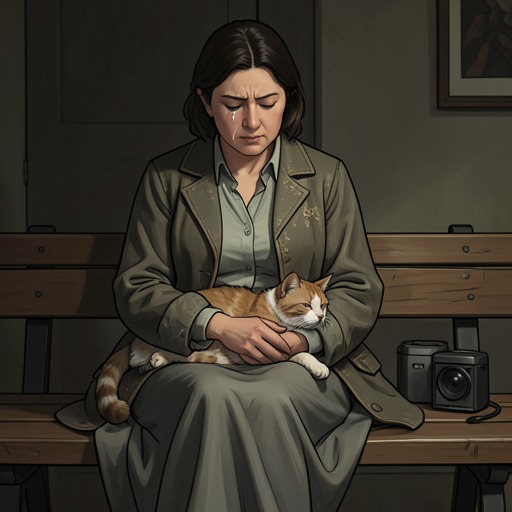
The limousine catches up with them. As the Unnamed Narrator guides Holly toward it, she looks past him toward the boy still offering the other cat, and must grip his arm to remain standing. She acknowledges that she and her cat did belong to each other, and that he was hers. This recognition reverses the claim she had just made about their independence. Her decisive discovery comes not through an exchange of promises but through the cat’s absence and the bodily force of her reaction.
The Unnamed Narrator promises to return and find the cat, adding that he will take care of him. The promise is not merely a consolation to Holly: it creates a practical obligation after her attempt to leave without one. Holly asks what will happen to her, whispers that she is frightened, and describes the terror of not knowing what belongs to her until she has thrown it away. The cat’s abandonment has become inseparable from a broader fear of loss and dislocation. She gets into the car and leaves, but the episode ends its immediate search with the narrator’s pledge rather than with a reunion.
The Narrator Keeps the Promise
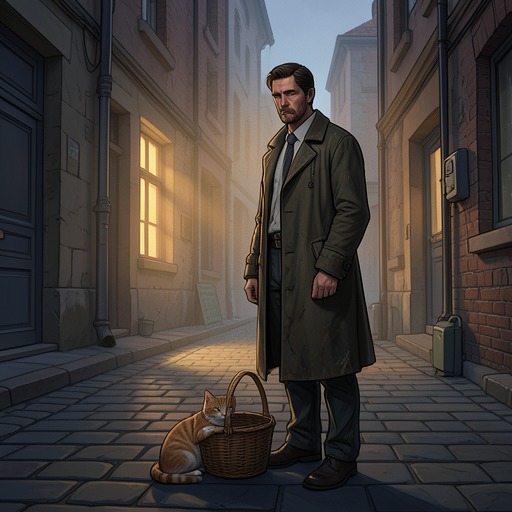
After Holly is gone, the Unnamed Narrator spends weeks searching the streets of Spanish Harlem after work. The search yields false alarms: flashes of tiger-striped fur that prove, on inspection, not to be the missing cat. This delay matters. The promise is fulfilled by sustained effort rather than by an instant rescue, and the narrator’s memory of Holly’s hurried departure becomes a continuing responsibility toward the animal she left behind.
At last, on a cold, sunny Sunday afternoon in winter, the narrator sees the cat seated in the window of a warm-looking room, framed by clean lace curtains and flanked by potted plants. The setting differs sharply from the garbage cans and rats Holly had invoked as a place for him. Nothing in the scene identifies the people who took him in, and the narrator does not know what name they have given him. What he can see is that the cat appears to have arrived somewhere he belongs. The search thus ends not with the cat returned to Holly, but with evidence that he has found a home independent of her.
Departure and the Open Ending
The cat’s fate unfolds alongside Holly’s continuing disappearance. A postcard arrives in the spring, written in pencil and signed with a lipstick kiss. It reports that Brazil was unpleasant, Buenos Aires was much better, and Holly has attached herself to a wealthy man who already has a wife and seven children. She says she is looking for somewhere to live and will send an address when she knows it herself. No address follows. The postcard confirms that she has kept traveling, but offers no corresponding certainty that she has found a lasting home.
The narrator had wanted to tell Holly that he had found the cat, but the promised address never arrives. His final image of the animal, settled behind the clean curtains, therefore supplies a resolution that their human relationship cannot receive: the cat’s whereabouts are no longer unknown, but Holly remains out of reach. The narrator hopes that she, too, has found a place, yet cannot know whether that hope is fulfilled. The episode’s closing contrast is gentle but unsentimental: the cat has been left behind and then located; Holly has left and is still missing from the narrator’s life.