José Ybarra-Jaegar
Breakfast at Tiffany'sJosé Ybarra-Jaegar is a Brazilian official whose romance with Holly Golightly develops into her most explicit fantasy of marriage and domestic belonging, then ends when scandal makes that future incompatible with his career and family obligations. Seen chiefly through the Unnamed Narrator and Holly’s own accounts, José is intelligent, presentable, and serious about his obscure government work; he is also cautious and concerned with respectability. When Holly is arrested, he leaves New York and sends a farewell letter that presents his retreat as a failure of courage rather than a denial of his affection.
Identity and Introduction
José first appears in the Unnamed Narrator’s account of Holly’s social circle. He is described as handsome, intelligent, and presentable, with a serious connection to government work that takes him to Washington several days a week. His mother is German, and his job is only vaguely explained: it seems governmental and important, but its exact nature remains obscure. The narrator finds José markedly out of place among Holly, Mag Wildwood, and Rusty Trawler, whose nightlife and conversation he appears to endure rather than share.
That mismatch gives José a distinctive position in the group. The narrator compares his presence to a violin in a jazz band: José seems to belong to a different social and professional world from the people around him. The explanation remains tentative. Perhaps, as a foreigner, he cannot easily sort Americans into familiar social categories and therefore accepts his companions as tolerable examples of local character. Whatever the reason, Holly’s determination helps sustain the unlikely quartet.
Romance and the Future Holly Imagines
Holly’s early account of her feelings makes clear that José’s nationality and political ambition are not incidental details. She wonders aloud about marrying a Brazilian and becoming Brazilian herself, picturing the change as a six-thousand-mile leap across language and culture. She considers learning Portuguese, but rejects the suggestion of formal lessons and instead imagines that the more urgent task is to persuade José to give up his ambition to become president of Brazil and become American. Her questions about whether she is madly in love reveal both her excitement and her uncertainty about what that love requires.
After José moves into Holly’s apartment, her language turns steadily toward marriage and relocation. She repeatedly speaks of what will happen after their wedding and when they move to Rio, although José has never proposed. Holly admits this mismatch between her certainty and his explicit commitments, but treats it as no obstacle: she believes that he knows she is pregnant and assumes they will marry. She says she is six weeks pregnant, is delighted, and wants at least nine children. Her imagined future is therefore not just a romance or a move abroad; it is a large family and a domestic identity she has not previously seemed to seek.
Holly’s preparations make that imagined life concrete, if not necessarily secure. She spends time trying to master Portuguese through Linguaphone records, and her apartment fills with books, classical records, museum reproductions, furniture, and kitchen equipment. She experiments with homemaking and cooking, even while the narrator notes that ordinary dishes remain beyond her. The contrast between the grand destination of Rio and her awkward attempts at domestic competence gives her plans both comic energy and pathos: she is rehearsing a life she expects José to share, though he has not promised it.
José as Holly Describes Him
Holly does not describe José as her ideal man. She finds him too prim and cautious, worries that he cares too much about what others think, dislikes his habit of turning away to undress, and complains that he bathes frequently and makes too much noise when he eats. She says that if she could choose anyone alive, she would not choose him; she names other people and even allows that love should not be restricted by gender or by the species of the beloved. Yet she insists that she loves José, and says she would stop smoking if he asked.
This account makes the relationship more complicated than Holly’s marriage plans suggest. She can identify José’s traits as incompatible with her own romantic ideal while still distinguishing him from the men she calls “rats” and declaring him her first non-rat romance, apart from Doc Golightly. Her stated love is neither a perfect match nor a simple bargain. It coexists with irritations, doubts, and a real commitment to the future she believes they can build together.
Holly also connects José to a broader argument about love and sexual respectability. She rejects the idea that a woman’s sexual history alone defines her, and says she has tried to believe she loved the men with whom she became involved rather than merely accept their money. Her wish that she had been a virgin for José registers her awareness of the standard she thinks he may value, even as she challenges the judgment attached to it. In her account, José is both a particular man she loves and the imagined audience before whom she measures her past and hopes to begin anew.
Domestic Life and the Unsettled Engagement
During the months after the Unnamed Narrator learns of Fred’s death, José’s name replaces Mag Wildwood’s on Holly’s mailbox and he moves into her apartment. He is away in Washington three days a week, leaving Holly alone for much of that time. The narrator observes that she is nevertheless happier and more content than before, and that she becomes absorbed in homemaking: she buys a hunting tapestry, Gothic chairs, a complete Modern Library, classical records, museum reproductions, and cooking equipment. These changes accompany, but do not confirm, the marriage she expects.
Holly’s pregnancy and the future she imagines remain distinct from any commitment José has actually made. She acknowledges that he has not proposed, yet speaks as if marriage and the move to Rio are settled. Her confidence is also visible in her belief that the wedding will take place in church, with José’s family present, once they reach Brazil. The promised ceremony is a picture of public recognition and family inclusion, not merely a private escape from New York. The gap between that picture and José’s silence foreshadows how much of their shared future exists, at this point, in Holly’s expectation.
José also becomes part of Holly’s contact with Sally Tomato. When Holly tells Sally she is leaving the country, she remembers him as an angel who seemed pleased that she was going, because trouble might eventually arise if the authorities discovered that she was not his real niece. Sally’s lawyer, Oliver “Father” O’Shaughnessy, sends Holly five hundred dollars in cash as a wedding present from Sally. The gift shows that Holly’s departure and proposed marriage are recognized within her existing circle, but it does not provide evidence that José himself has agreed to the wedding Holly describes.
Arrest, Departure, and the Farewell Letter
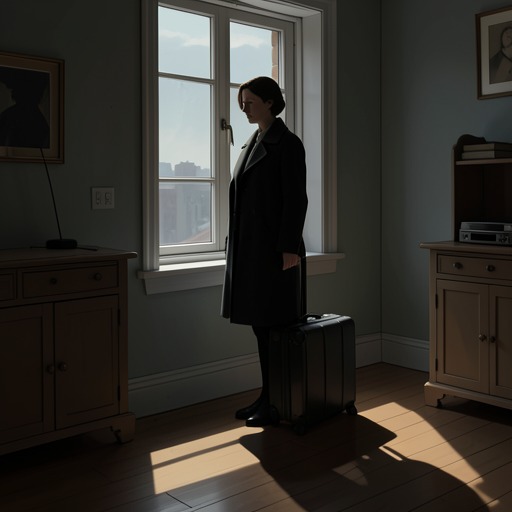
After Holly is arrested in connection with Sally Tomato’s case, the Unnamed Narrator expects José to help secure her release. Instead, he finds a cousin packing José’s clothes and belongings at Holly’s apartment. The cousin is crouched over a suitcase containing the suits and shoes Holly had habitually taken to cleaners and repairers. The Unnamed Narrator initially mistakes him for a burglar, then asks whether José sent him; the cousin confirms his relation and the narrator asks where José is. The packing makes José’s disappearance tangible before the narrator receives an explanation.
José’s farewell letter describes the discovery of Holly’s public disgrace as decisive. He writes that he had loved her knowing she was different from other women, but could not imagine making her his wife after the scandal became public. He says he does not wish to add his condemnation to the condemnation around her, asks her not to condemn him, and explains that he has a family and a name to protect. His parting blessing for Holly and her child does not erase the choice he has made: he has gone home and left her behind.
The letter makes the conflict between private affection and public respectability explicit. José does not claim that he never loved Holly. Rather, he presents his family and reputation as institutions he is too cowardly to risk. Holly’s envisioned church wedding with his family present is thus overturned by the very family and public standing she had imagined incorporating into their future. His tenderness toward her and the child remains in the letter, but it cannot substitute for the marriage or shared life she had expected.
Narrative Role and Significance
José’s arc is chiefly visible in the difference between Holly’s projections and his actions. She imagines becoming Brazilian, learning Portuguese, raising a large family, and marrying in church with his relatives present; he is shown as a government-connected man with a demanding Washington schedule, a concern for appearances, and finally a willingness to leave when scandal threatens his established life. The novel does not give him an independent account of the courtship or a detailed description of his work, so his character emerges through the narrator’s observations, Holly’s judgments, and the letter that explains his departure.
His relationship with Holly exposes how easily a hoped-for future can acquire the shape of a settled fact before both people have agreed to it. Holly’s preparations are visible and energetic, but her repeated references to marriage do not make José’s promise real. Once her arrest places the relationship in public view, the distinction becomes decisive. José’s farewell preserves an acknowledgment of love while making clear that affection, in his case, does not overcome the claims he assigns to career, family, and name; Holly’s proposed life in Rio ends not with a wedding but with his departure.