José Ybarra-Jaegar abandons Holly
Breakfast at Tiffany'sJosé Ybarra-Jaegar abandons Holly Golightly after her arrest, converting their romance into a parting conducted through a packed suitcase and a letter. The scene makes his departure concrete before his explanation arrives: José is gone, his cousin is clearing his wardrobe from Holly’s apartment, and the man who had loved her is now asking her to forget him.
The Departure Discovered
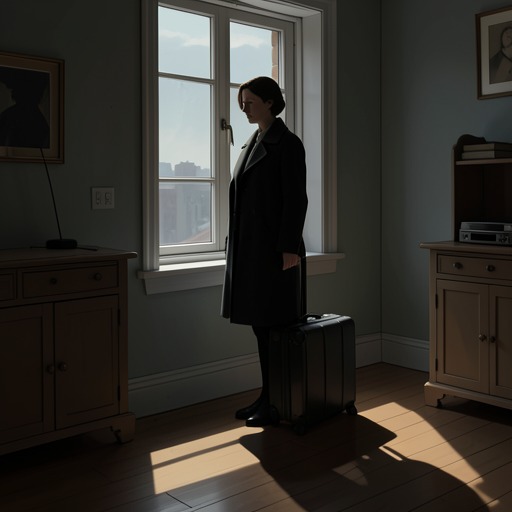
The morning after Holly’s arrest, the Unnamed Narrator goes to her apartment to feed Holly’s cat. With no key, the narrator enters through a window reached from the fire escape. Inside, a man crouches over a suitcase; each takes the other for a burglar. The suitcase contains the shoes and suits José had kept at Holly’s place, clothes she had repeatedly fussed over and carried to menders and cleaners. Their removal turns an absence into an unmistakable departure.
The Unnamed Narrator asks whether José sent the man. The stranger identifies himself as José’s cousin, then explains that José is waiting elsewhere. The narrator understands that the diplomat is preparing to disappear and reacts with anger at the manner of it. The cousin, however, is not there simply to take the clothes: after shutting the suitcase, he produces a letter and asks the narrator to deliver it to Holly’s friend. Its envelope is addressed to Miss H. Golightly, with delivery entrusted to the bearer. The cousin’s errand therefore gives José’s withdrawal a message, but leaves Holly to receive it in his absence.
A Letter of Retreat
When the Unnamed Narrator brings the letter to Holly, she first prepares herself to read it. She asks for her purse because, as she puts it, a girl should not read this kind of letter without lipstick. Guided by a compact mirror, she covers the traces of the child in her face: she powders, paints her cheeks and lips, pencils her eyes, blues her lids, adds perfume and pearls, and puts on dark glasses. She notices that her manicure is shabby before opening the envelope. The ritual is not incidental decoration; it is the armor she chooses before exposing herself to José’s words.
Holly asks the narrator to assess the handwriting, recognizing it as José’s from its buttoned-up, constipated appearance. Then she has the letter read aloud. José says he loved her while knowing she was unlike other women, but that discovering the public circumstances of her arrest made him despair of making her the wife his faith and career could accept. He expresses grief for her disgrace and declines to add his condemnation to the condemnation already surrounding her. At the same time, he asks her not to condemn him: he has a family and a name to protect, and calls himself a coward when those institutions are at stake. He says he has gone home, tells her to forget him, and closes with a blessing for Holly and her child.
The letter thus gives his abandonment two distinct dimensions. José presents it as a consequence of the conflict between his feelings and the public, familial, and professional identity he needs to protect; he does not claim to have stopped loving Holly. Yet his admission of cowardice also identifies the choice plainly: when love and his established life come into conflict, he leaves her to face the consequences alone. His appeal for her understanding cannot undo the practical fact of his absence.
Holly’s Response
Holly rejects the narrator’s description of the letter as touching, mocking its stiff language and the formal, constrained character she hears in José’s handwriting. But the ridicule does not erase the hurt. Though her cosmetics disguise her face, it confesses that she understands why José has fled. She grants that he is not a rat without reason, distinguishing him from the more monstrous men she compares him with, but that qualification cannot make the departure painless. Her blunt admission that she loved him gives the letter its force: what she loses is not an imagined romance but a real attachment whose limits have now become public and unavoidable.
Her response moves between performance and exposure. The lipstick, powder, pearls, and dark glasses let her approach the letter on her own terms; the hardening of her small smile as she reads registers the blow those defenses cannot prevent. She asks for a cigarette after crying out, thanks the narrator, and turns to jokes about the arrest and possible legal claims. The shift to comedy does not mean the rupture is settled. The narration observes that treating her troubles as a joke reveals how poorly she is recognizing the bleak reality in front of her, while the Unnamed Narrator tries to turn the conversation toward plans.
Significance in the Plot
José’s withdrawal leaves Holly confronting arrest and its aftermath without the future she had attached to him. His cousin’s suitcase makes the separation material, and the farewell letter confirms that José will not stand beside her. The episode also sharpens a contrast between Holly’s instinct to turn pain into a performance and the circumstances that performance cannot change: she can dress for the reading, mock the prose, and call José a rat, but she still acknowledges that she loved him.
The letter’s careful balance of tenderness and self-protection prevents the separation from being reduced to a simple denial of affection. José acknowledges love and wishes Holly well, yet chooses family, reputation, faith, and career over remaining with her. Holly sees that logic without accepting it as consolation. The scene’s decisive outcome is therefore emotional as well as practical: a relationship ends through an act of retreat, and Holly is left to absorb both the man’s declared love and his refusal to share her danger.