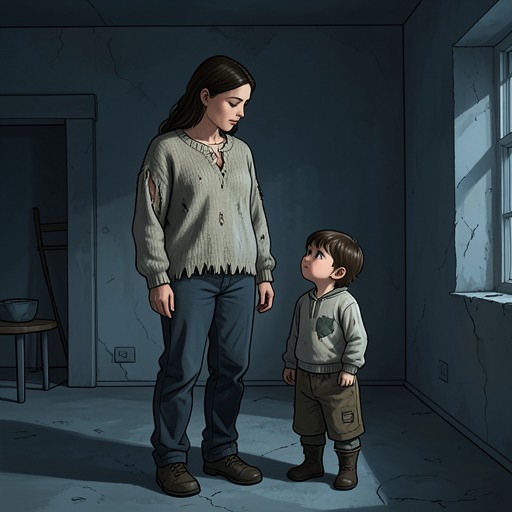
Billie's father
Cœur de slushBillie’s father is a physician and a steady, affectionate presence in Billie’s life, but his care exists alongside a grief he cannot quite conceal. After Billie’s mother leaves, he continues to work, tend to his daughters, and preserve the small domestic rituals that bind the family together; at the same time, the neglected garden, his private journal, and the fatigue in his eyes register the cost of that separation. His character is defined by this contrast: practical devotion on the surface, loneliness underneath.
Identity and Background
Billie’s father works as a doctor, treating patients at the hospital and carrying a demanding schedule of serious injuries, diagnoses, and new illnesses. His work is not merely a profession mentioned in passing: Billie imagines him returning to it after sleeping at home, and describes how even his scarce free time is crowded by overtime and difficult medical news. The hospital routine helps explain why he is often occupied, but the narrative also shows him trying to slow down and spend more time with his daughters after the family’s rupture.
His household bears the marks of that change. The garden in the backyard has become sad and nearly dead, and Billie attributes its neglect to her father no longer having the heart to care for it. The house is large and full of memories; in Billie’s imagination, her father is left there to read, cook only for himself, wait for the telephone to ring, care for the sick, and play video games. That picture is affectionate rather than dismissive: she recognizes that beneath his adult responsibilities, he retains something adolescent and in need of companionship.
Care in Everyday Life
Billie’s father expresses affection directly as well as through routine. After she returns home, she sends him a text saying that she loves him; he replies immediately, apparently between patients, that he loves her too, and adds a smiling face with hearts for eyes. The quick response gives Billie reassurance even while he is working. His tenderness is not grand or ceremonious: it appears in a message sent during the demands of an ordinary day.
He also maintains a summer ritual by making pink lemonade according to the same recipe each year. When he brings a pitcher to Billie and Annette as they sit on the swing, he asks whether it is too sweet. Billie knows it will be the familiar, perfectly pink lemonade she associates with summer. The drink, repeated each season, makes a small domestic continuity visible at a time when the family itself has changed.
The scene on the swing also shows the care he takes in presenting himself to his daughters. He arrives dressed neatly in a polo, a blue-white-red Tommy Hilfiger swimsuit, and Ray-Ban sunglasses, with sunscreen imperfectly spread across his nose. He smiles, yet Billie wonders whether the smile is habitual because his eyes remain tired and sad. His appearance therefore holds two truths at once: he continues to perform ordinary sociability, but the expression does not erase his sorrow.
Work, Community, and Recognition
His work makes him a familiar figure in the community. Billie observes that he cannot even shop for groceries in peace because people recognize him and come over to shake his hand. They address him warmly as their good doctor, sometimes with tears in their eyes. Their gratitude and respect suggest that his medical work has made him a valued presence beyond the household, even as that same work takes up much of his time.
A red bow tie Billie chose for him two years earlier links that public identity to his role as a father. He wears it each morning at his office or the hospital and is proud to tell people that his youngest daughter, his Billie-fairy, picked it out and has good taste. The bow tie is both a habitual piece of workwear and a keepsake from Billie. In his account of it, his professional appearance carries an intimate trace of his daughter.
Billie, meanwhile, knows the physical demands of long summer work herself. She spends eight hours at a water park blowing a whistle, applying sunscreen to herself and others, watching children swim, and disinfecting their scrapes. Her father’s medical work and her own lifeguard duties are not equivalent, but both are framed through care for other people’s bodies. His professional labor is serious and ongoing; her repetitive summer shift leaves her sunburned and longing for something to change in her life.
The Separation and Its Aftermath
Billie’s mother has left the family, and Billie understands her father as having been left behind with the consequences. She imagines that her mother took his happiness with her and never sent it back from the Bahamas. This is Billie’s figurative interpretation, not an account of a literal exchange, but it conveys how she reads his persistent sadness. The absent mother is also associated with the garden’s decline and with the change in the family’s daily life.
Billie imagines that her father blames himself for the separation, while insisting in her own thoughts that he is not at fault. She believes her mother felt uncomfortable in her own skin as she grew older and watched her daughters grow away from her; she also resented his overwork. Billie notes that he has since slowed down, spending more time with the family, relaxing, reflecting, and becoming bored. Her explanation remains her own interpretation of her parents’ marriage, but it shows her trying to protect her father from blame while making sense of her mother’s departure.
The father’s journal gives this private aftermath a material form. He has kept it since her mother’s midlife crisis and departure. Billie once tries to read it but cannot decipher his handwriting, which she imagines is distorted by his troubled thoughts. She assumes its pages are full of tenderness and self-reproach, though she cannot actually read them. The unreadable journal marks both his inward life and the limit of Billie’s knowledge of it: she can see his sadness, but she cannot fully enter the thoughts he records.
The Daughters and the Unanswered Letter
Billie’s father remains connected to his daughters through ordinary exchanges and family memory. In the swing scene, Billie puts an arm around Annette’s shoulders as they walk toward the garden and sit together; their father brings them lemonade. The scene gathers the three of them into a family tableau, while the neglected garden and Billie’s description of him as nostalgic keep the absent mother’s place visible within it.
His care also includes passing along communication from Billie’s mother, without forcing Billie to accept it. He tells Billie that a letter from her mother has arrived and that he has placed it on her bedside table, adding that it may contain good things. Billie refuses, saying she does not feel like reading it and that he knows this. He rubs his beard in discouragement. The moment makes his position delicate: he serves as the intermediary between an absent mother and a daughter unwilling to hear from her, but he does not compel reconciliation or demand an explanation.
The letter remains unread in this exchange, and Billie’s refusal does not resolve the estrangement. Her father’s subdued response shows that his care cannot repair every fracture; he can make the letter available, offer his daughter a choice, and stay beside her, but the decision to open it belongs to her. His role in the family is thus neither a simple substitute for the absent mother nor a solution to the separation. He provides consistency while living with what cannot be restored by routine alone.
Characterization and Narrative Significance
Billie’s father is presented through Billie’s affectionate, observant perspective. She notices his clothes, his imperfectly applied sunscreen, his bow tie, the smile that may be habitual, and the handwriting she cannot decipher. These details make him vivid without granting direct access to his private thoughts. Even her belief that his journal expresses self-blame is explicitly an inference, shaped by her wish to reassure herself that he is not responsible for the family’s break.
That partial knowledge matters to the portrait. Billie sees a father who answers a loving text at once, keeps making the same lemonade, and remains proud of a gift from his youngest daughter; she also sees a man who appears tired, works too much, and is left alone in a house full of memories. The narrative does not make his melancholy cancel his warmth, or his public respect erase his loneliness. Instead, the two sides remain together, as they do in the pink lemonade scene: a familiar summer ritual can still be sweet, even when the garden behind it is nearly dead and the family’s old shape has changed.