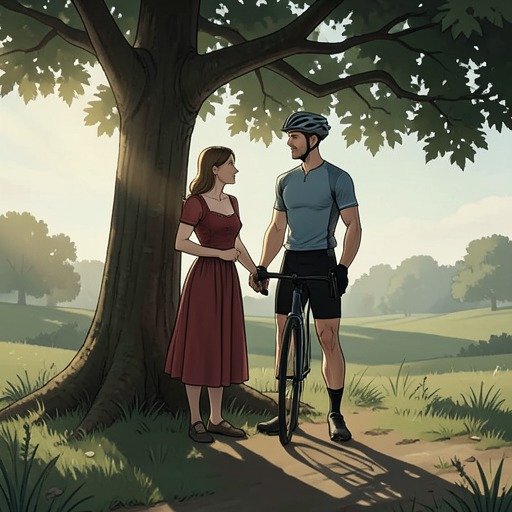
Billie-Lou Fay
Cœur de slushBillie-Lou Fay is a seventeen-year-old narrator caught between the girl she recognizes and the woman she hopes to become. Her story gives that transition a bodily, unsettled texture: she longs for romance and attention, measures herself against other girls, and discovers that wanting intimacy does not mean being ready for it. By the end, she is not remade into someone else; she feels only a little larger at heart, still recognizably herself, and still longing for her mother to return.
Identity and the wish to change
At the beginning of the summer, Billie-Lou treats growing up as a transformation she can almost prepare for. At seventeen, she believes she has the right to feel too large for her own skin and to want to stretch and change. Her imagined signs of adulthood are concrete and chosen: cutting her hair, painting her nails dark, speaking more slowly, selecting her words, laughing less loudly, and letting her eyes shine more. She wants to leave behind the private-school world of uniform skirts shortened with craft scissors, but she does not want to become a woman all at once. The in-between state matters to her; she hopes to become nearly a woman, not to leap past girlhood in a single step.
Her desire for change is also a desire to be seen. She asks “Madame la Vie” to make her cool and noticeable that evening, as a woman, and imagines being caught by a boy as she falls through the summer air. The fantasy makes romance feel like rescue: someone else’s hands would keep her from hitting the ground, and the long loneliness of summer would end. But the wish is hers before any boy answers it. She is trying to give shape to a future self, even as she borrows some of its cues from attention, beauty, and the promise of being wanted.
A self measured against others
Billie-Lou’s sense of herself develops through comparison, especially with her sister, Annette. While Billie-Lou tends sunburn with aloe cream, paints her nails colors she considers too pale and young, and draws poems about Simon and Étienne inside crayon hearts, Annette seems to shine without effort. Billie-Lou describes the sisterly bond as both intense love and gentle jealousy. She calls Annette a real woman, perfect from her body inward, and hopes that with age envy will give way to uncomplicated love. The comparison sharpens Billie-Lou’s own uncertainty: when she is sad she becomes a child-girl again; when she is no longer sad she feels almost like a woman, and the shifting categories confuse her.
Pierre’s attention intensifies this habit of reading herself through other people’s eyes. After he leaves, he stops at the far end of a long hallway to talk with a tall brunette. He tells the woman something at her ear, and she discreetly turns to look at Billie-Lou. Billie-Lou lowers her head and tries to forget him and his green Converse, but her body betrays how strongly the moment affects her: her palms are wet, she feels heat and cold, and she wonders whether the brunette is more beautiful than she is. She decides the woman probably is, because she seems almost grown. The scene links romantic jealousy to Billie-Lou’s larger question about adulthood: the rival’s apparent maturity becomes another measure against which Billie-Lou judges her own body and place in Pierre’s attention.
Desire, uncertainty, and boundaries
Billie-Lou’s attraction to Pierre does not settle into a simple account of what she wants. When she confides in Annette, her sister names the possibility that Billie-Lou is in love with Pierre and wants more than kissing. Billie-Lou answers with an emphatic denial, turns red, and begins searching Annette’s wardrobe for something suitable in case she decides to go. The blush, denial, and preparation sit side by side; the scene shows uncertainty in action rather than resolving it into a confident declaration.
Later, during an evening at the Pub du Mont with Daphné and her friends, Billie-Lou drinks a strong homemade cocktail mixed with pineapple juice. Daphné stays the designated driver and drinks grape juice instead. In the crowded car, the friends share the bottle, turn up the music, dance, and talk about girls’ affairs. Their company comforts Billie-Lou and helps her laugh; for a while, she says to herself that Pierre no longer exists. Then her phone vibrates. A message from Pierre addressing her as Billie-Lou cracks her heart and makes her head spin and her throat sting. She does not answer at first. When he later invites her to his home and says he wants to see her green eyes and beautiful legs, a shiver passes through her numbed body. She thinks she wants to make love with him for real and agrees to come.
That agreement is not the end of her deliberation. As she imagines the encounter, Billie-Lou becomes preoccupied with the ordinary, exposed details of her body: her wet hands, damp forehead, and sticky skin. She is afraid of looking ugly naked, does not know whether she is supposed to make sounds she would not enjoy making, and does not want to lie spread-eagled in an unfamiliar bed. Even the possible roughness or dirtiness of Pierre’s sheets and the possibility that he has only one pillow enter her thoughts. The list is not a rejection of desire so much as a record of its limits and conditions. She can want Pierre and still be anxious; she can have said yes and still imagine changing her mind. Her hesitation gives her a private language for what readiness is not.
Family bonds and the ending
Against the volatility of Pierre’s messages, Billie-Lou finds steadiness in her father. When he comes to her room, she answers his tender nickname, and later she thanks him for a burger. He tells her he loves her, calling her “ma Billie Fay.” She feels understood without having to explain everything and expects that reassurance to help her sleep. Their exchange is small, but its ease contrasts with the strained work of interpreting attraction: with her father, affection arrives plainly, and she does not need to prove that she is grown enough to deserve it.
The ending returns Billie-Lou to the same body and to a changed understanding of it. She is reassured that she is not very different from before, only a little larger at heart; she still has the same freckled face, arms, and legs. The blue of the season has become difficult for her because it recalls the blue slush of summer, her meeting with Pierre at the convenience store, his house of the same color, and his soft sweater that smells of an expensive bicycle tire, sport, and the outdoors. The memories make color carry the weight of a whole summer, but they do not erase her physical continuity.
Her hopes also turn toward her mother, whose absence remains an open wound in the family. Billie-Lou longs for her to come back with her little wheeled suitcase, knock gently, put clothes away in her drawers, and sit at the foot of the bed to advise her about blush, perfume, and brushing her hair. She imagines her mother untangling it as she did before, caring for the heart of a daughter who is growing up. Billie-Lou wants that tenderness partly for its practical help—fewer knots and less time drying her hair in the wind—and partly because it would let her look like an adult without having to become one alone. Her mother has told her that it was her big summer, and Billie-Lou recognizes that her mother missed it. The ending leaves both truths intact: Billie-Lou has grown, and she still wants the care that accompanied her earlier self.
Narrative significance
Billie-Lou’s first-person narration makes growing up a sequence of bodily sensations and acts of self-evaluation rather than a clean passage from innocence to maturity. Wet palms, heat and cold, a blush, sticky skin, freckles, and imagined hair all register feelings she cannot yet confidently name. Her body is at once her own and something she watches as though it might be judged by Pierre, the brunette, or an imagined audience of beautiful girls. The gap between desire and assurance is therefore central to her characterization: she is not simply waiting for romance to make her a woman, but learning to notice what she wants, what she fears, and what she is not ready to do.
The people closest to her offer contrasting forms of recognition. Annette’s effortless shine makes Billie-Lou conscious of rivalry within love; Pierre’s gaze and intermittent messages stir longing and self-doubt; her father offers affection without demanding a performance of womanhood; and her absent mother remains the imagined source of intimate, everyday guidance. Billie-Lou’s movement toward adulthood is consequently neither a triumphant escape from childhood nor a completed romantic transformation. It is a cautious enlargement of feeling, held together by the knowledge that she remains herself and by the hope that family care may yet return.