Billie-Lou and Pierre Forêt's Romantic Relationship
Cœur de slushBillie-Lou and Pierre Forêt's romantic relationship is shaped by a striking imbalance: Billie-Lou invests Pierre with the force of a first love, while the relationship offers her no secure promise of reciprocity. Its defining turn is their sexual encounter, which she actively desires but experiences as physically painful, emotionally complicated, and unlike the ideal she had carried toward him. Afterward, Pierre's silence leaves her trying to make sense of both what happened and what the relationship meant.
Identity and Early Attraction
Billie-Lou's attachment begins in fascination before it becomes a relationship she can define. When Pierre asks whether she has ever done anything grown-up, specifically whether she has made love, the question makes her heart sink. She interprets it as an attempt to unsettle her and takes refuge in the idea that she, too, could become hard-hearted, able to enjoy a body without falling in love. Her assurance to Daphné that she knows how things work is immediately undercut by her own admission that she does not know at all. Desire and inexperience coexist from the outset; neither cancels the other.
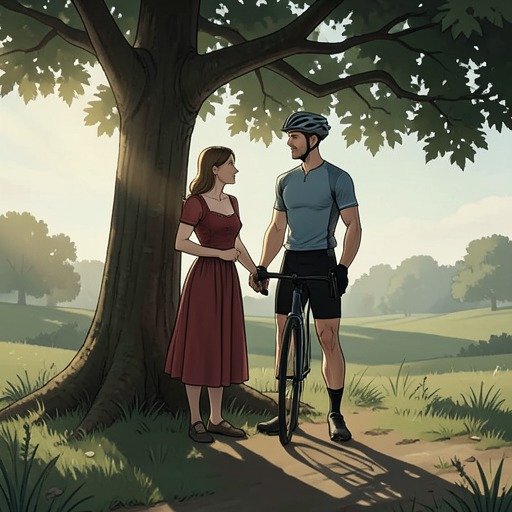
Pierre's appeal is intensely particular. Billie-Lou says she fell in love with colors: his blond hair and blue eyes become a vivid, almost landscape-like image, bound to the details that make him recognizable in her world. He serves burgers, rides a bicycle, and appears in newspapers; his beauty is joined in her imagination to an inward complexity. She pictures him as containing many kinds of hearts, some gentle and some hard. The image gives her a way to register both tenderness and distance, but it is still her interpretation of him, not a promise that he will meet her feelings on equal terms.
Desire, Uncertainty, and Pursuit
Billie-Lou can name her physical desire more clearly than she can predict its emotional cost. During a prolonged exchange of kisses, she wants to make love with Pierre even while recognizing that he may never love her. She tries to imagine holding the experience apart from her larger romantic longing, as a private chapter she could omit from a polished account of her first love. That imagined separation reveals the central tension in their intimacy: she hopes to be close to him without exposing herself to the full force of her attachment, even as she knows that the two are already entangled.
Before their night together, Pierre's messages revive that hope. While Billie-Lou is out with Daphné, the first message addresses her by name; ten minutes later, he says he misses her. She does not answer at first, though part of her wants to respond, see him, and touch him. Later, when they speak, Pierre invites her to come to his place because he wants to see her green eyes and beautiful legs. Billie-Lou agrees, wanting to make love with him. The invitation is both direct and personal, but its emphasis on her eyes and legs does not settle what Pierre feels about her beyond that night.
The Night at Pierre's Place
Billie-Lou arrives after drinking a strong cocktail mixed with pineapple juice. She realizes that she should have chosen something less potent: she is numb, walks in a zigzag, and worries that her thoughts and speech may do the same. In that condition she makes her way to Pierre's rented room in the blue house at the top of the mountain. The scene places her stated willingness alongside concrete signs of impairment and apprehension; the narrative does not erase either side of that situation.
At first, she does not know what to do with her body. She rests her chin against Pierre's bare torso, and the closeness seems to stretch beyond its actual duration. Pierre suggests that they might start by kissing. They do: their mouths meet, their hands remain still at first, and their feet touch. As the kissing intensifies, their hands begin to move through each other's hair and across Pierre's skin. The scene advances through physical gestures rather than confidence or fluency; Billie-Lou's narration records nervousness, bodily excitement, and uncertainty together.
Pierre pauses and asks whether he is the person she wants, explaining that he does not want to spoil things because she is a flower. Billie-Lou finds the interruption foolish and says yes, that it is all right; she does not want to hesitate. His question makes room, at least briefly, for her to confirm her wish, while her impatience to proceed remains visible. The exchange does not make the encounter emotionally simple: her desire is real, but so are her inexperience and the effects of the alcohol she has consumed.
When they have sex, Billie-Lou feels pain and asks for it to be complete, partly wanting to get through an experience that has become awkward. She is sore in her thighs, jaw, and lower abdomen, and does not know how to become aroused in the way she expects. Her account refuses to equate wanting Pierre with finding the act pleasurable. The contrast between anticipation and bodily discomfort is central to how she understands their intimacy, rather than a detail that the romance can smooth away.
Aftermath and the Unequal Relationship
Afterward, Billie-Lou imagines writing that she is no longer a virgin, but she would also record that the experience was not especially pleasurable and that Pierre was gentle. She believes he wanted it to be as beautiful as possible in his own way, while recognizing that he may not know how awkward he is. She forgives him. At the same time, she feels happy to be with him, proud of their intimacy, and comfortable with his body against hers; she also wants to cry. These responses remain side by side instead of resolving into uncomplicated happiness or regret.
She dresses in her green clothes and leaves without speaking, walking down the old wooden-floored corridor with tears gathering at the corners of her eyes. Outside, the cool air, mosquitoes around the entry light, the mountain, and the view of the city give her something concrete to attend to. She decides that the mountain, the night, and the city feel more real than love seen through Pierre's eyes. The departure marks a change in scale: what she had imagined as a defining romantic moment becomes an experience she must interpret for herself, away from him.
A later message makes the asymmetry harder to ignore. A week after burgers with her father, Billie-Lou writes to invite Pierre for blue raspberry slush, but he does not reply. She longs for a clear explanation—even a letter that would tell her he does not love her, has no time, or has no heart for the relationship—because silence leaves her unable to follow his intentions. The invitation and the unanswered message echo the earlier contact: Pierre can draw her toward him with a sudden expression of desire, yet the relationship does not give her the sustained communication she seeks.
Narrative Significance
The relationship's emotional pattern turns on a difference between what Billie-Lou feels and what she can know about Pierre. She describes herself as falling in love with his colors and imagines many hidden hearts within him, but the concrete evidence of mutual attachment remains uncertain. His messages say that he misses her and wants to see her; they do not answer the larger question of whether he loves her or intends to remain close. The contrast makes her romantic projection legible without dismissing the sincerity of her desire.
Billie-Lou's first-person account also gives her a language for the parts of intimacy that a conventional romantic summary might conceal: not knowing what to do, feeling pain, finding sex awkward, feeling proud, and wanting to cry. Her imagined future version of the story would omit the chapter of her overwhelming love for Pierre, yet the narrative preserves that very excess alongside the physical facts of the encounter. Their relationship therefore becomes less a secure love story than a formative experience through which Billie-Lou distinguishes desire from pleasure, tenderness from reciprocity, and a romantic ideal from what she has actually lived.