Pierre's Visit to Billie's Water Park Workplace
Cœur de slushPierre’s Visit to Billie’s Water Park Workplace interrupts the punishing sameness of Billie’s summer job with two encounters that leave her both exposed and intrigued. First, Pierre appears among the tourists while she is sunburned, overheated, and dressed for work; later, he is waiting beside her car, reading a novel she loves. The visit matters less as a declaration than as a small reversal: the person she wishes could see her at her most romantic instead sees her in the ordinary, uncomfortable reality of her working summer, and she discovers an unexpected point of affinity in the book he carries.
The workday Pierre interrupts
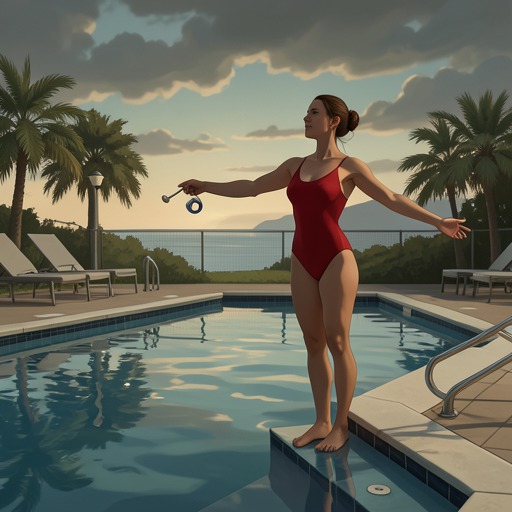
Billie’s life at the water park is structured by repetition and heat. During an eight-hour shift she blows her whistle, applies sunscreen to herself and other people, watches children swim, and disinfects their scrapes. She is so preoccupied with wishing for something to change her life that she spends much of the day mentally elsewhere, but the work continues: the sun burns her skin, and the demands of the pool keep returning her to the present.
The job is not a passing summer inconvenience. Billie drives fifteen minutes to work each morning with the windows open, using the journey to invent possible lives and imagine what might fill the gaps in her thoughts and heart. She knows that this daydreaming is largely a way to avoid another shift at a water park that smells of old hot dogs and leaves her cooking on a chair that burns the backs of her thighs. On cold, gray days she writes tiny unsigned poems on the wooden chair; other lifeguards read them and wonder who the secret poet is. Her work therefore contains its own modest imaginative counterlife, even as its routine and discomfort wear on her.
By the hottest day of the summer, Billie has applied so much sunscreen that her skin looks white and water beads on it, yet she still cooks beneath a Budweiser umbrella. She has twisted her T-shirt into a turban to keep her hair off her face and is waiting for Antoine to replace her so she can eat her sandwich. The encounter unfolds against this specific bodily fatigue, not in the fresh, carefully imagined version of herself Billie would prefer Pierre to meet.
The first encounter: directions and rejection
A visitor asks Billie how to get to the Tornado. She emerges from her daydream because her work requires her attention, and gives him the familiar directions: walk thirty metres, turn right, cross the bridge, climb six steps, and jog for about forty seconds. She adds a reminder to use sunscreen. She has repeated this sort of instruction a hundred times a day, every summer for three years; she knows the park’s routes and routines as thoroughly as the practiced script of her job.
The visitor asks her to show him exactly where the ride is. Billie tells him to follow her directions. When he remains beside her elevated wooden chair, she lowers her sunglasses and recognizes Pierre. He is fully dressed among bathing-suit-clad visitors, with a sunburn on his forehead and a thin black wool toque despite the heat. His appearance makes him conspicuous, and Billie, already uncomfortable in her work clothes and turban, has no wish to smile at the inconveniently persistent visitor.
She tells Pierre to go away. When he asks why, she points to the forty-two-degree heat, his toque, and his blond hair, which makes him stand out; she calls the situation irritating. Pierre accepts the dismissal and walks off without arguing. His literal compliance catches Billie off guard. Once he has gone, the heat seems to lessen for her: she gets goosebumps and cold fingertips despite the blazing sun. She covers her shoulders with a beach towel and regrets having panicked and spoken harshly. What troubles her is not only that she has been rude; Pierre has seen her sweaty and awkward in her workday appearance, whereas she had wished he could see her fresh, in a dress moving in the wind.
Waiting by the car
The visit continues in the parking lot. After a break in which Billie jokes privately with Suzie, she is told that rafting is overstaffed and she may leave if she wants; Billie welcomes the chance because her sunburn hurts. In the parking lot, cars shine in the strong sun while a large cloud gathers over a golf course across the way. Billie searches for her Subaru and initially cannot remember where she parked it. Pierre is there, leaning his long athletic body against the front of her car and reading.
Billie has a tightness in her throat as she approaches. Pierre does not look up, so she calls his name. He closes his book, folding down the corner of a page, and answers that he was reading. When Billie points out that the car is hers, he shrugs and walks toward her without looking at her. The book hangs from his long fingers as he passes close enough to brush her shoulder. She catches his arm before he can go by, and he stops.
The gesture changes Billie’s hesitation into a question. Her heart squeezes and her grip is so tight that her knuckles turn white; then her fingers loosen as she asks what he is reading. Pierre holds the cover close to her face. It is Le Petit Sauvage by Alexandre Jardin, her favorite story. She barely has time to look into his eyes before he begins walking away again, silent and apparently ready to leave the exchange there.
A small point of recognition
Billie calls after Pierre to ask which passage is his favorite. He answers that he has not even started the book. She has seen, however, that he folded a page corner at the very end of the novel. The discrepancy leaves his reading—and what the marked page means—unexplained; the scene does not establish why he has the book or why that page is folded. Billie smiles to herself and thinks of the novel’s characters, the Little Savage, Tout-Mama, and Manon de Tonnerre.
The book offers Billie a way to interpret Pierre without claiming to know him. She thinks of him as a kind of little savage and immediately allows that he might say the same about her. The thought ends on the limit of her knowledge: Pierre is too secretive for her to know. Their connection is therefore real but slight, rooted in a shared reference rather than a conversation that resolves anything. His unexpected presence unsettles her, his manner frustrates her, and the sight of her favorite novel gives her a reason to regard him with renewed curiosity.
Significance of the visit
The two encounters turn routine service into an intimate test of appearances. Billie can deliver the water park’s directions smoothly and repeat the sunscreen warning as part of a practiced summer script, yet she is unprepared when Pierre appears as the person asking for her attention. Her first response is rejection; its consequence is a sudden bodily chill and regret, a physical reversal that makes visible how sharply his presence has affected her.
The car-park encounter offers no neat romantic resolution. Pierre’s silence, the folded page, and his walk away preserve the secrecy that Billie recognizes in him, while her attempt to hold him back and ask about the book exposes her own interest. In the middle of a summer defined by heat, repetitive labor, and imagined alternatives, the visit leaves her with one concrete, unfinished connection: Pierre has read—or at least brought—the novel she loves, and neither of them explains what that coincidence means.