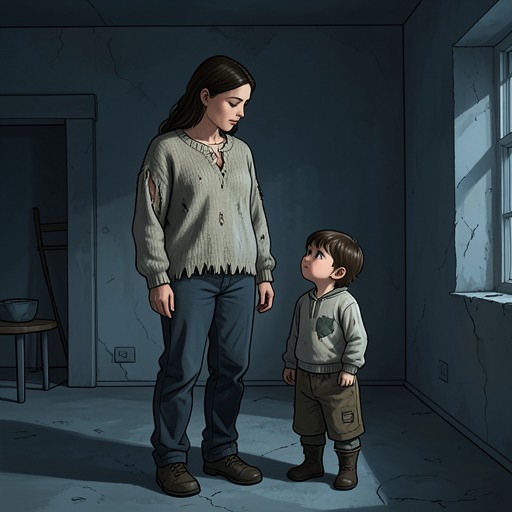
The Fay family’s state after the parents’ separation
Cœur de slushThe Fay family’s state after the parents’ separation is a quiet, ongoing reorganization of home rather than a clean break. Their mother has left to pursue a different life, while Billie's father remains in the family house, caring for his daughters and carrying on with routines that preserve the feeling of a family even as its old shape has gone. Billie sees both his tenderness and his loneliness; as she considers adulthood and independence, the house he keeps becomes at once a place of safety and a reason she hesitates to leave.
The separation within the family’s history
The parents’ divorce is part of the sisters’ shared past, woven into the history of Annette and Louis’s long relationship. Billie remembers Louis being present through major changes in Annette’s life, including the parents’ divorce, and recalls the couple as gentle and seemingly destined for a happy ending. That memory gives the family rupture a place among the events the sisters have lived through together, rather than presenting it as a fact detached from their daily lives.
Their mother’s departure is described as an attempt to escape the prospect of aging, her daughters growing up and away from her, and the adult life she felt ill at ease inhabiting. Billie also understands that her father’s heavy workload had become a source of resentment. He has since slowed down and spends more time with his daughters, but Billie imagines him as someone left to reflect, feel bored, and carry on without the partner who had shared the house. Her account is sympathetic to both parents, even though she does not know where her mother is or what she is doing.
The father who stays
Billie’s father remains in the old family home, where its memories and neglected garden make absence visible. The garden is nearly dead, and Billie connects its condition to her father’s loss of heart for tending it. When he brings the sisters lemonade, his neat clothes and smile contrast with the sadness and fatigue she sees in his eyes. The image of the mother leaving with his happiness, without sending it back from the Bahamas, gives Billie’s impression of his grief a domestic, almost childlike concreteness.
His public identity as a doctor does not cancel that private sadness. People recognize him while he shops and greet him as Doctor Fay; at work, he continues to wear the red bow tie Billie chose for him two years earlier. He is proud to say that his youngest daughter picked it, calling her his Billie-fairy who has good taste. The bow tie is a small but enduring link between father and daughter, and the repeated summer lemonade recipe similarly gives the household a ritual that survives the family’s changed circumstances.
At home, the father’s life includes work, extra hours, sad diagnoses, and new illnesses, but also reading, cooking for himself, waiting for the phone to ring, and playing video games. Billie describes him as still an adolescent in the rare free hours left between his responsibilities. The description holds affection and unease together: he is a parent and a doctor, yet in the quiet left by separation he seems to her to have an unfinished, solitary life of his own.
The absent mother and the life elsewhere
Billie’s mother is not present in the home, and Billie does not claim to know where she has gone. She pictures her jogging on a beach or braiding tourists’ hair, an image that offers Billie enough comfort without resolving the uncertainty. Earlier, the mother’s life is associated with the Bahamas and with a reinvention that Billie sees as an effort to attract attention elsewhere and become an adolescent again in a warm country.
That imagined freedom differs sharply from the father’s rootedness. He remains among the house, the garden, and the family’s seasonal customs; the mother is associated with beaches and movement away. Billie’s account does not turn either parent into a simple villain. She recognizes her mother’s discomfort with her changing body and her daughters’ growing independence, while also recognizing that the father had worked too much. The separation therefore registers in Billie’s mind as a family wound with causes on both sides, though her daily sympathy often settles on the father left behind.
Billie’s divided feelings about leaving
As Billie begins to imagine studying in the city, the separation becomes part of her own decision about independence. City life once seemed frightening; now she can picture doing her own shopping, cleaning a bath, cooking, and taking the metro. Having Annette there would make leaving easier. But Billie immediately imagines her father alone in the large, old house, waiting for the phone to ring after work and cooking only for himself. Her concern for him complicates the attraction of departure.
Annette’s life in Montreal supplies a vivid alternative. She celebrates, dances on tables, drinks expensive coffee, speaks with what she calls a Montreal accent, and finds clothes in second-hand shops. She shares a brightly painted apartment with two school friends near the university. Billie admits that if she had gone with Annette, she would soon have regretted it: she values her own white house, sunlit bedroom, clean-smelling queen bed, and the coffee-scented presence of her father. She would miss the untended garden and his summer lemonade as well. Her ambivalence is not simply fear of growing up; it is attachment to a home whose ordinary comforts have become more precious since the family changed.
The separation also touches Billie’s emerging sense of herself. At seventeen, she wants to move beyond the private-school skirts she shortened with craft scissors and become something between a girl and a woman. She imagines changing her hair, wearing dark nail polish, speaking more slowly, and choosing her words. Yet her longing for maturity coexists with the wish to remain in the familiar house and with her father. The family’s altered state makes growing up feel like both a personal transformation and a possible departure from the people who have stayed.
Private feeling and outward appearances
Billie’s observations of her father are shaped by the gap between what he shows and what she believes he feels. He smiles when he brings lemonade, but she suspects that the smile may be habitual because his eyes remain tired and sad. Later, she sees him writing in a journal on the veranda. He has kept it since her mother’s midlife crisis and departure, and Billie has tried to read it, though his handwriting defeats her. She imagines that its pages are full of tenderness and self-blame, while insisting that the separation was not his fault.
This is Billie’s interpretation, not a disclosure of the journal’s contents. Her inability to decipher his writing leaves his private thoughts inaccessible, but it does not stop her from imagining what he might be carrying. The scene captures the limits of a daughter’s knowledge: she can recognize the signs of grief, remember his bow tie and lemonade, and picture his loneliness, yet cannot enter his account of the marriage or know what he writes to himself.
The family’s state after the separation is therefore expressed less through confrontation than through what remains: a house kept by the father, a garden neglected, a seasonal recipe repeated, a journal whose words cannot be read, and daughters weighing their futures against his solitude. For Billie, home is neither untouched nor simply broken. It is a place made newly meaningful by absence, and the emotional tie that makes independence possible also makes leaving harder.