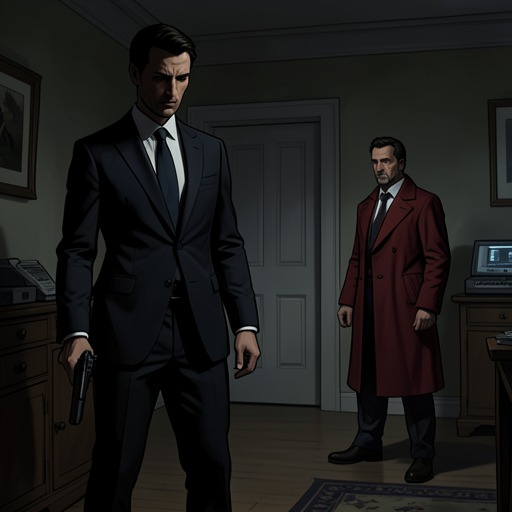
Double O qualification
Casino RoyaleDouble O qualification is the Service’s designation for an agent who has killed someone in cold blood during an assignment. James Bond’s account connects the formal credential to two past operations and, after his ordeal with Le Chiffre, to a deeper question: what the status means when the categories of hero and villain no longer seem clear.
Definition and Qualification
Bond explains that earning a Double O number means having killed a person in cold blood in the course of a job. The qualification thus records an action, not simply an agent’s reputation for toughness or skill. Bond remembers feeling clever and acquiring a reputation after receiving his number, but the story later unsettles the confidence attached to that recognition.
The rule is presented through Bond’s personal history rather than as a full account of the Service’s procedures. He describes two qualifying operations: a distant, relatively clean killing and a later, silent operation in Stockholm. The latter involved a Norwegian who had been working against the British and had helped lead to the capture of two British agents. Bond says he chose a knife and the man’s bedroom, but the killing did not happen quickly. The contrast between the two jobs makes the credential’s underlying act harder to reduce to a neat professional distinction.
Bond’s Qualification and Its Cost
Bond relates his reconsideration of the qualification to his experience under Le Chiffre’s torture. He recalls that Le Chiffre used the phrase “playing Red Indians,” and that it prompted him to wonder whether his own heroic self-image had been a kind of game. The thought arrives while Bond is recovering, with his hands bandaged, and leads him to ask Mathis whether he should resign.
Bond describes how the moral categories that once seemed straightforward have become unstable with age. At school, he says, it was easy to distinguish heroes from villains and imagine that a hero’s task was to kill the villains. But when Le Chiffre turns the same violence against Bond, Bond finds himself confronting the other side of the medal: the supposed villain is not, in his own understanding, a villain at all. The qualification can certify that an agent has killed for the Service, but it cannot settle the moral meaning of the killing.
Patriotism and Changing Categories
Bond also challenges the idea that national allegiance permanently resolves the moral problem. Patriotism, he admits, can make an act seem acceptable, yet he argues that political labels change over time. A movement treated as an enemy in one period might, in another historical setting, have been described differently; the identities of heroes and villains shift along with the causes they serve.
This reflection gives Double O qualification significance beyond its practical definition. The number stands for an institutional threshold Bond has crossed, while his doubts expose the limits of treating that threshold as proof of moral certainty. In the aftermath of Le Chiffre’s violence, Bond does not deny his past actions; instead, he questions the heroic narrative that once made them seem uncomplicated.