Hôtel Splendide
Casino RoyaleHôtel Splendide serves as James Bond’s base in Royale-les-Eaux, but its apparent privacy is repeatedly unsettled. A room key, a hair left in place as a telltale, and an electric fire concealing a radio pickup turn the hotel into a setting where safety must be tested rather than assumed; later, the same room is comprehensively ransacked by Le Chiffre’s agents.
Setting and Bond’s Base
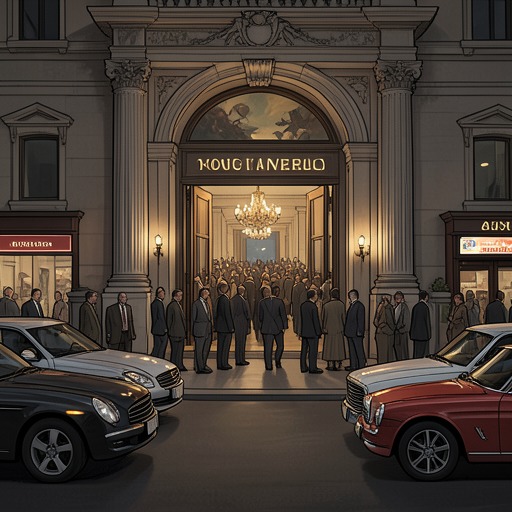
Bond stays at Hôtel Splendide during the operation against Le Chiffre. Returning from the casino, he crosses the gardens to the hotel, gives a thousand francs to the cloakroom attendant, and collects key number 45 from the concierge. The practical details establish a temporary headquarters rather than a home: Bond is alert to the possibility that someone has entered his room, and his first concern is to find out whether it has been searched while he was away.
The hotel also anchors Bond’s cover in Royale-les-Eaux. He arrives two days before the baccarat confrontation, registers as James Bond of Port Maria, Jamaica, and receives no apparent scrutiny from the hotel or its staff. M has advised that the cover should withstand ordinary public attention, even though Bond expects his conspicuous play against Le Chiffre to draw notice. The hotel therefore offers the ordinary surface of a public resort while Bond uses it as the staging ground for covert work.
A Room Under Surveillance
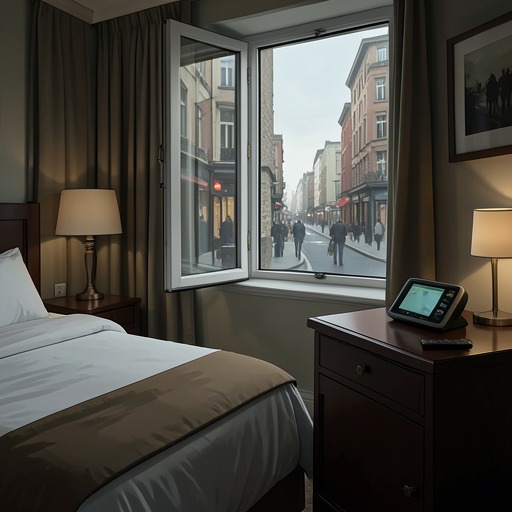
The apparent privacy of Bond’s room proves false. Mathis, liaison man for the Deuxième Bureau, explains that the Muntzes in the room above have been listening to Bond for several days. Disused chimneys behind the electric fires provide a route for the wires: a powerful pickup is suspended above Bond’s panel fire, connected to an amplifier behind the Muntzes’ fire, and used with a wire recorder and earphones. Madame Muntz’s supposed illness and her husband’s constant presence in their room are part of the explanation for why the pair remain there while the resort’s other attractions go unattended.
Mathis reports that the French service had partly suspected the arrangement and confirmed it by unscrewing Bond’s electric fire before Bond arrived. Bond examines the fastening screws himself and sees minute scratches in their grooves. The small marks make surveillance materially legible: the threat is not an abstract suspicion but an intrusion into the room’s fittings, detectable only by close inspection. The hotel’s old-fashioned construction, with its disused chimneys, has made the listening device possible.
Security Checks and Countermeasures
Bond treats the hotel as a place that must be searched through procedure. After receiving a cable from Jamaica, he considers the concierge a possible security risk: the man’s employers might bribe a copy from the local post office, or he might already have opened the envelope or read its contents upside down. Bond hands over his reply, pockets the cable signed Dasilva, and avoids the lift, which he regards as an obliging danger-signal. He goes upstairs quietly, opens his room door in one motion with the light on and a gun in hand, and checks that the room is empty.
His inspection relies on a simple telltale rather than confidence in the hotel’s staff. Bond finds one of his own black hairs still wedged in the writing-desk drawer where he had left it before dinner. Its undisturbed position reassures him that the room has not been entered in his absence. The hair is a fragile instrument of control, and its significance is sharpened by the listening device elsewhere in the room: Bond can test for a physical search, but he cannot assume that a room apparently untouched has remained private.
The hotel also supports Bond’s liaison with Mathis. After Bond has spent time observing Le Chiffre at the casino, a telephone call from the concierge announces that a director of Radio Stentor has arrived with a wireless set ordered from Paris. The radio equipment provides the cover for the Deuxième Bureau’s contact, whom Bond hopes will be Mathis. The arrival makes the hotel room both an operational meeting point and a place where surveillance and counter-surveillance overlap.
From Temporary Safety to Exposure
After the baccarat game, Felix Leiter accompanies Bond back to Hôtel Splendide at three in the morning. Both men keep their hands on their guns during the walk through the moonlit shadows, but the journey itself is uneventful. Leiter insists on going up with Bond; the room appears exactly as Bond left it. He remarks that there is no reception committee, while warning that the opposition might still try one last move. Bond answers that without the money he is no longer an attractive target and says he has an idea for protecting it. The moment gives the room a brief, conditional return to safety, with vigilance still governing even this quiet arrival.
That reassurance is overturned when Le Chiffre later describes the search carried out by four of his men after Bond left for a nightclub. They found a codebook inside the lavatory ball-cock and papers taped to the back of a drawer. In the process, they dismantled the furniture and cut up Bond’s clothes, curtains, and bedclothes, removing the fittings and searching every inch. They did not find Bond’s cheque, a failure Le Chiffre calls unfortunate; had they found it, Bond would be in bed rather than in his captor’s power. The room’s earlier signs of intrusion thus lead to an explicit account of its destruction as a secure base.
Narrative Significance
Hôtel Splendide’s importance lies in the tension between its familiar functions and its use as an intelligence environment. A concierge, a key, a lift, a writing desk, a bathroom fixture, and an electric fire are ordinary features of a hotel stay; here each can carry information, expose a vulnerability, or conceal a threat. The progression from Bond’s hair test and the scratched screws to the later search makes the room’s security feel provisional at every stage.
The hotel also concentrates the novel’s contrast between appearance and knowledge. Bond’s cover passes without comment, yet the enemy has already been listening; a room that seems untouched after a dangerous night can still be part of a wider surveillance operation. Later, the agents’ search reveals how much intelligence Bond has hidden in small, makeshift places, while the missing cheque preserves the one object Le Chiffre most wants. Hôtel Splendide is consequently more than accommodation: it is a contested workspace in which concealment, observation, and exposure repeatedly change the meaning of privacy.