Honglan Photographic Box Bomb
Casino RoyaleThe red and blue camera-case bombs are a matched pair of high-explosive devices used in an attempt to kill James Bond at Royale-les-Eaux. Disguised as camera equipment and distinguished by bright colors, they turn an apparently practical escape plan into a trap for the Bulgarian attackers as well as their intended target. Their later explanation recasts the explosion: what appeared to be a coordinated attack was also an attempt by the plot’s organizers to erase the people carrying it out.
Appearance and Setup
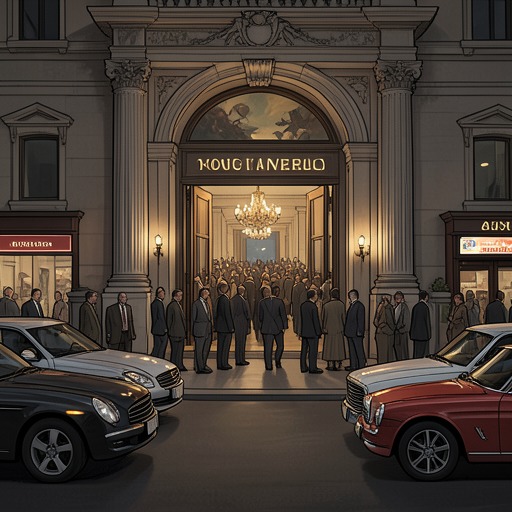
The two men carrying the devices wait across the boulevard from the Hôtel Splendide. They are dressed alike in dark suits and straw hats, and each has a square camera case slung from a shoulder: one red, the other blue. The cases’ vivid colors stand out against the men’s otherwise similar appearance, making the pair easy for James Bond to distinguish even before he understands their purpose.
Bond notices the men as he approaches and considers the range of possible weapons and available cover. The camera cases initially remain ambiguous objects: their appearance suggests ordinary equipment, while Bond’s tactical attention registers them as a possible danger. The narration withholds what they contain until the blast, making the cases’ everyday disguise part of the suspense rather than an explanation of the threat.
Detonation
As Bond comes within fifty yards, the red-case carrier gives a short nod to his companion. The man with the blue case unslings it, bends over it, and appears to manipulate something inside. A plane-tree briefly blocks Bond’s view of the action. The explosion follows before he can determine exactly what the man has done.
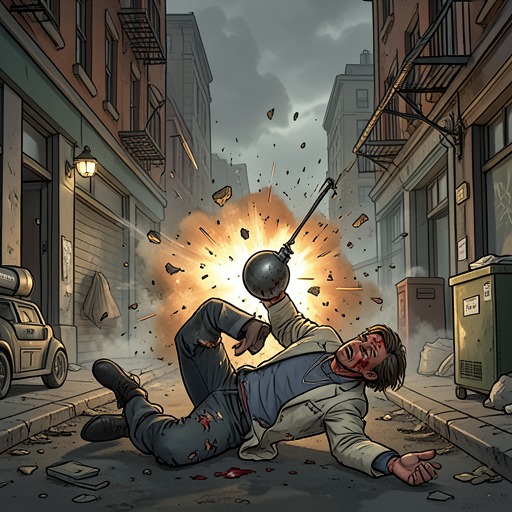
The blast throws Bond to the pavement despite the protection of a tree trunk. Its effects reach beyond the two carriers: the boulevard’s trees are charred, two opposite Bond have broken near their bases, and a smoking crater remains between them. The blast kills both men; fragments of clothing and other debris are scattered through the area. Bond is left dazed and begins to vomit. The cases thus function not as separate tools in a visible exchange, but as concealed components of a single explosive attack whose full arrangement is initially obscured.
The Double-Cross Revealed
Later, Vesper explains the plan to Bond. The Bulgarians had been told that they would receive two million francs for killing him and that the bright colors of the cases would make their roles easier to coordinate. According to the instructions given to them, the blue case contained a powerful smoke bomb, while the red contained the explosive; one man was to activate the blue device as the other threw the red case, allowing them to escape under cover of smoke.
That account was itself a deception. Both cases contained identical high-explosive bombs; there was no smoke bomb and no functional difference between blue and red. The promise of concealment was meant to persuade the Bulgarians that they could escape, while the actual arrangement was intended to destroy Bond and the bombers together. The cases’ contrasting colors therefore marked not different capabilities but a false division of labor imposed on the attackers.
The Bulgarians did not follow the instructions exactly. They decided that the smoke bomb should be triggered first, so that the explosive could be thrown from within the cloud. The man with the blue case pressed its lever, and the cases detonated together. Their attempt to improve the plan instead brought about the explosion that killed them, while also exposing the device’s true nature through the unexploded fragments of the red bomb later found by police.
Aftermath and Significance
A third Bulgarian, who had been waiting behind the Hôtel Splendide to collect the other two, survived. On the road to Paris, he was stopped while travelling in a Citroën with two English hikers as protective colouring. When asked for his papers at a roadblock, he drew a gun and shot one of the motorcycle patrol; the other patrolman stopped him from killing himself. Taken to Rouen, he eventually gave an account of the operation.
The surviving man’s account reveals the camera-case scheme but does not establish a direct link to Le Chiffre. Vesper says the Bulgarians had been recruited through an intermediary, who might have been one of Le Chiffre’s guards; the survivor did not identify Le Chiffre as the person behind the attack. The bomb plot consequently clarifies the method and intended double-cross without resolving who ultimately commissioned it.
As objects, the cases move from visual clue to weapon, then to evidence. Their ordinary camera-like form helps conceal danger; their bright red and blue surfaces lend the attackers’ instructions a misleading clarity; and their supposed difference is exposed as a fabrication after the blast. The reveal makes the attack more than a failed assassination attempt: the men carrying the bombs had been promised an escape that the devices could never provide.