James Bond
Casino RoyaleJames Bond is a British secret agent and a Double O whose capacity for calculated risk is inseparable from the personal costs of his work. At Royale, he commits his resources to breaking Le Chiffre’s baccarat bank and is cleaned out; later, after surviving Le Chiffre’s attempt to extract information from him, he questions the easy division between heroes and villains. Vesper’s death leaves him grieving, but also gives his conflict with SMERSH a new and explicit direction: he resolves to hunt it down.
Identity and Professional Background
Bond’s judgment depends in part on recognizing when he has reached his limits. At the casino, he realizes that he is tired and acts on that awareness, moving away from roulette rather than letting exhaustion turn into mistakes. The moment presents self-command not as a denial of bodily or mental limits, but as the ability to notice them and respond.
The decision to send him against Le Chiffre follows a discussion among senior officials about the risks and possible value of the operation. The Head of S says that M considers the proposal worth trying if the Treasury will provide the money, and that M wants to test the man selected for the job. The chosen agent is one of the Double O’s, identified as 007. His earlier experience in Monte Carlo helps explain the choice: before the war, he spent two months watching a Romanian team use invisible ink and dark glasses, and he and the Deuxième Bureau eventually exposed them. Bond won a million francs at chemin de fer during that operation and handed the money in. His interview with M is brief, but the decision places him in an assignment where gambling expertise and the possibility of violence are both relevant.
The Baccarat Contest
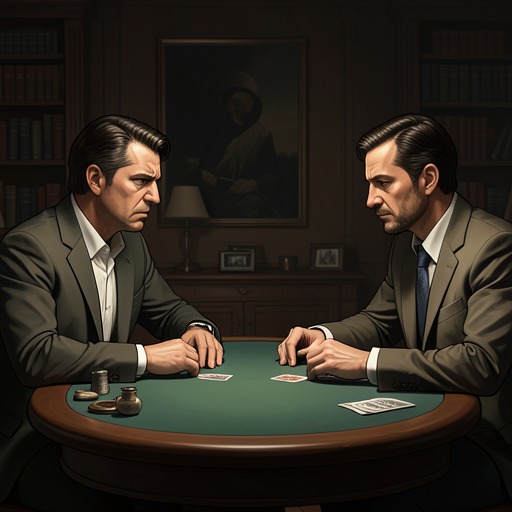
Before the game, Bond explains its structure and his plan. Le Chiffre has bought the baccarat bank from the Egyptian syndicate for one million francs, leaving him with twenty-four million in capital; Bond has approximately the same amount. Le Chiffre will act as banker at a single tableau, rather than dividing play between two sides of the table. Although the banker has a slight advantage, Bond intends to accept the bank whenever he can and keep attacking until one of them is broken. The other players may affect the balance in the meantime, but Bond frames the decisive contest as a test of their competing reserves.
Bond’s explanation makes the game a contest of information as well as money. The banker can take account of a player’s decision to draw or stand, while the player’s third card is dealt face up. Bond describes five as the problem count: drawing or standing on it carries even chances, so his choice depends on intuition. Natural eights and nines, he explains, matter most. The account shows how he thinks under uncertainty: he knows the rules and the odds, but no system removes the risk of a decisive turn.
That risk becomes concrete when Bond loses twelve million francs in two coups. He has only sixteen million left, exactly enough to meet the next banco, and his capital seems to have melted away. He continues to follow rather than withdrawing. When Le Chiffre’s bank later stands at thirty-two million, Bond reasons that Le Chiffre needs only one more coup to reach the fifty million he requires. Bond believes that Le Chiffre will not expect anyone to cover the whole bank, and that he cannot know about the money in the envelope. On that calculation, Bond chooses to challenge the bank rather than take only a smaller share.
The contest ends in Bond’s defeat: Le Chiffre wins the final coup, and Bond is cleaned out. The loss is more than a reversal at the table. Bond has committed himself to a contest in which the eventual outcome will break one opponent or the other, and he has no remaining capital with which to continue. His defeat also sets up the next phase of the conflict, in which Le Chiffre has power over him outside the casino.
Capture, Survival, and Moral Doubt
During Le Chiffre’s torture, Bond’s prospects change abruptly when a third voice interrupts the encounter. His senses, which had been dulled, return sufficiently for him to see Le Chiffre’s astonishment give way to fear. The interruption brings the immediate ordeal to an end and leads into Bond’s recovery, but it does not restore his former confidence unchanged.
Afterward, Bond identifies the mark cut into the back of his hand as the Russian letters for SH, rather than a personal initial. He connects it to SMERSH, explaining that the name abbreviates the Russian phrase meaning Death to Spies and that the mark labels him as a spy. The mark turns his physical survival into evidence of a continuing threat: Bond expects that treatment for his hand may involve another hospital stay and a skin graft, and he tells Mathis that he has decided to resign.
Bond explains that the idea of being alive became newly important while he was being beaten. He recalls Le Chiffre’s phrase playing Red Indians and considers the possibility that he has been acting out the role of a hero hunting villains. As he sees it, childhood offers a clear division between heroes and villains, but adulthood complicates that distinction. His account does not deny that Le Chiffre has done evil things; it questions whether Bond’s own intention to kill him would have been grounded in justice. Bond admits that, if Le Chiffre were present, he would kill him out of personal revenge rather than for an elevated moral purpose or simply for his country. That distinction exposes the gap between duty as an outward role and the motives Bond can honestly claim.
Vesper, SMERSH, and the Ending
After Vesper’s death, Bond reads her letter and reacts with grief before turning to action. He throws the letter down, brushes his fingers together mechanically, strikes his temples with his fists, and looks out toward the sea. His eyes are wet; after drying them, he dresses and shuts himself in a telephone booth. The sequence marks a change from private shock to deliberate movement, without making the grief disappear.
Bond’s thoughts connect Vesper’s betrayal to the larger machinery of espionage and to his own past conduct. He pictures her carrying documents while he, the agent with a Double O number, was occupied with playing Red Indians. The image makes his earlier self-questioning newly consequential: the posture of the roaming, efficient secret agent has not prevented the harm he now sees in what happened. Bond’s shame is part of the immediate context for his next decision, not a separate resolution of his doubts.
He decides that he will take on SMERSH and hunt it down. In his analysis, SMERSH is the coercive instrument that gives the MWD its force; without it, the organization would be a spy service like those of the West, neither better nor worse. He describes its principle as a demand for loyalty enforced by death: spies must remain faithful, because betrayal or retreat brings punishment. This conclusion redirects Bond’s grief into a campaign against the institution he believes has shaped Vesper’s fate and marked him as an enemy. His resolve is not presented as a return to uncomplicated moral certainty: it follows his recognition that motives can be personal and that espionage works through fear, concealment, and revenge.
Narrative Significance
Bond’s arc joins professional competence to vulnerability rather than treating them as opposites. At the table, he understands the odds, reads Le Chiffre’s financial position, and makes a reasoned decision to risk everything; knowledge does not guarantee victory. In the aftermath, physical survival does not simply restore the agent who entered the contest. The SMERSH mark, his doubts about heroism, and Vesper’s death alter what the conflict means to him.
The repeated image of playing Red Indians links Bond’s moral crisis to the ending. First it gives him language for questioning the heroic part he has imagined himself playing; later, the same phrase returns as he remembers Vesper and the documents she carried. By deciding to hunt SMERSH, Bond does not erase that contradiction. He converts it into a new objective, carrying forward grief and self-reproach alongside the resolve that has defined his work.