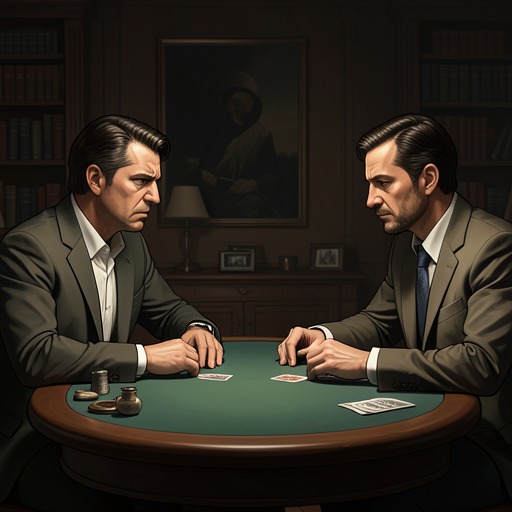
Le Chiffre
Casino RoyaleLe Chiffre is a Soviet agent whose cover as a powerful union treasurer conceals a fifty-million-franc hole in the funds entrusted to him. The collapse of his investments drives him to stake his remaining capital on baccarat at Royale, where James Bond tries to bankrupt him; when the contest ends, SMERSH kills Le Chiffre in front of Bond. His arc binds financial desperation to espionage and makes the casino table the arena in which his private failure becomes a public defeat.
Identity and Position
Known by aliases including The Number, Herr Nummer, and Herr Ziffer, Le Chiffre is described in a British intelligence memorandum as one of the Opposition’s chief agents in France. He is also the undercover paymaster of the Syndicat des Ouvriers d’Alsace, a Communist-controlled trade union in Alsace’s heavy and transport industries. The memorandum regards the union as a potential fifth column in the event of war: its estimated 50,000 members could control a substantial sector of France’s northern frontier. Le Chiffre’s role therefore combines covert political influence with the management of money on a scale that makes his personal solvency a matter of strategic concern.
The intelligence assessment distinguishes his professional effectiveness from the vulnerability of his private life. In most respects, it considers him an admirable Soviet agent, but identifies his physical habits and predilections as an exploitable weakness. A mistress under French intelligence control has supplied insight into his private affairs. The account presents this information not as incidental gossip but as one source of leverage against a man whose official position and financial conduct are otherwise concealed behind layers of cover.
Financial Collapse and the Counter-operation
Le Chiffre’s crisis begins with the closure of his commercial investments after the implementation of the Marthe Richard law. His houses of ill repute and underground blue cinemas had formed the basis of a lucrative enterprise; when that business was disrupted, he tried to convert the open houses into clandestine rendezvous and continued operating some cinemas underground. These evasions could not cover his overheads, and attempts to sell the investment, even at a heavy loss, failed. The police closed more than twenty establishments, while inquiries into his finances exposed a parallel dossier concerning his role as union treasurer and paymaster.
The scale of the resulting exposure is stark: nothing remained of his original investment, and a routine inquiry would uncover a deficit of about fifty million francs in union funds. British intelligence judged that suspicion had not yet reached Leningrad, but feared that SMERSH might already be following the trail. A report that a senior Soviet official had travelled from Warsaw toward Strasbourg raised the danger without confirming it. Le Chiffre’s headquarters in Strasbourg were covered by a double agent, but the memorandum emphasizes that the intelligence picture remained uncertain. If Le Chiffre discovered that SMERSH suspected him, the assessment was that he would have no alternative but suicide or escape.
His planned remedy offered the opportunity for a counter-operation. Royale was expected to attract Europe’s highest gambling that summer, after its casino leased the baccarat and top chemin-de-fer tables to the Mahomet Ali Syndicate, a group of émigré Egyptian bankers and businessmen competing with established Greek operators. Le Chiffre intended, on or after 15 June, to make fifty million francs at baccarat using twenty-five million in working capital—enough both to cover his deficit and, as the memorandum puts it, save his life. British intelligence proposed defeating him at the tables rather than assassinating him. Killing him would allow Leningrad to conceal the embezzlement and turn him into a martyr; bankruptcy, by contrast, could discredit him, ruin the Communist union, and weaken its cohesion.
The Baccarat Contest
When the game begins, Le Chiffre has bought the baccarat bank from the Egyptian syndicate for one million francs, leaving him with twenty-four million. Bond estimates that he has roughly equal capital and plans to attack the bank whenever an opportunity arises, continuing until one of them breaks the other. The contest is therefore not simply a succession of lucky hands: the size of the bank, each player’s remaining funds, and the strain of facing a committed opponent shape the decisions as much as the cards do.
The game’s structure gives Le Chiffre a slight advantage as banker. At the unusually small single tableau, he controls the size of the stakes, while the banker’s decisions can be informed by whether Bond stands or draws. A six-pack shoe is shuffled by the croupier and cut by a player in full view; Bond’s explanation stresses that the cards cannot readily be tampered with and that the staff have been checked. Yet this procedural transparency does not remove uncertainty. Bond describes the five as the pivotal card, where drawing and standing have even odds, and says he relies on intuition. Le Chiffre’s small informational advantage and control of the bank are set against Bond’s willingness to accept the wagers and his effort to unsettle the banker.
That pressure becomes material when Bond loses twelve million francs in two coups. He has scraped together exactly sixteen million, enough for the next banco, while Le Chiffre taps his fingers and watches him across the table. Bond continues rather than withdrawing. The scene makes the game’s information imbalance intimate: Le Chiffre can see that his opponent is under pressure, but cannot know the full extent of Bond’s resources or what reserve he may still possess.
Later, Bond sees thirty-two thousand pounds in front of Le Chiffre and reasons that the banker needs only another eight million to meet his target. Bond’s remaining hope, as he assesses it, is to challenge the whole bank rather than share it with the table or take a smaller part. The move depends on what Le Chiffre believes: the banker may imagine Bond has only small reserves after his losses, but cannot know about the envelope Bond has kept from him. Bond’s analysis correctly identifies the amount Le Chiffre still needs, turning the opponent’s financial objective into a point of pressure.
The contest reaches its sharpest physical tension when Bond decides to continue under the threat of a gun pressed against his body. At the table he edges his buttocks back and grips its edge, feeling the gun sight grind into his coccyx, while the croupier arranges the notes and the chef de partie prepares to announce that the game is made. Bond then says banco directly to Le Chiffre. The call converts the contest from a strategy of selective attacks into a commitment to meet the bank in full, with the risk of the attack made bodily present even as the casino’s formal procedure continues around them.
Exposure and Death
The force behind the immediate threat is finally named in Bond’s presence. Le Chiffre’s face registers incomprehension and terror; his mouth works, but he can manage only a high-pitched sound. His hand makes a tentative movement toward his pocket and falls back, while Bond guesses that a gun is trained on him. In the silence, Bond says, “SMERSH.” The single word supplies the explanation Le Chiffre’s predicament had made possible throughout the financial crisis: the danger is no longer merely that his deficit will be discovered, but that the organization he serves has reached him.
Le Chiffre begins to answer, then falters. A sharp, quiet shot strikes him in the forehead, leaving what the narration describes as a third eye above the nose. His head and upper body slump over the arm of the chair; his heels rattle briefly against the floor, and then he does not move. The abruptness of the killing stands against the long, carefully calculated baccarat contest. The casino’s measured announcements and the play of stakes give way to an execution that ends not in a negotiated retreat or financial recovery, but in the death the earlier intelligence warning had anticipated.
Narrative Significance
Le Chiffre’s downfall is built from the collision of two ledgers. One records the balance of the bank at the baccarat table; the other records the missing union money that makes each hand consequential. His effort to repair the second through the first leaves him vulnerable to Bond’s sustained attack, while the same financial exposure attracts the attention of SMERSH. The game’s small differences in capital and information thus carry consequences beyond the casino: a run of losses threatens a political organization and the life of its paymaster.
The ending also reverses the terms of the proposed operation. British intelligence wants Le Chiffre defeated publicly enough to ruin his standing and the union’s credibility, but the final blow comes from the Soviet security organization he served. Bond’s word identifies the authority behind the unseen gun, and Le Chiffre’s death closes the contest without resolving the wider institutional damage that his concealed deficit represented. His character is defined less by a settled portrait of private motive than by this tightening chain of dependence: investments fail, union funds become exposed, baccarat becomes his last financial recourse, and the organization he feared arrives to kill him.