Malacca Silent Stick Gun
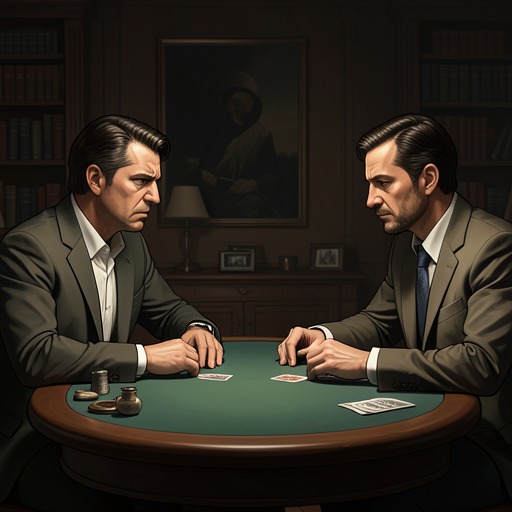
Casino RoyaleThe Malacca silenced cane-gun is a concealed firearm disguised as a walking stick, brought into Casino Royale by one of Le Chiffre’s gunmen. It turns the furniture and rules of a baccarat table into part of an assassination attempt: the cane is permitted into the room as a supposed medical aid, then aimed at James Bond to force him to withdraw his stake. When Bond throws himself backward and snaps the chair against it, the disguised weapon ceases to be a hidden threat and becomes the material evidence of the plot.
Appearance and Concealment
The cane is first visible beside Le Chiffre’s second gunman, a short, dark man who appears to be physically impaired. It is described as a chunky Malacca cane with a rubber tip, resting on the brass rail near him. Because Casino Royale forbids sticks and other objects in its rooms as a precaution against violence, the cane’s presence is conspicuous enough to invite an explanation: Bond infers that its bearer obtained permission to bring it inside.
That permission rests on a cover story. After the attempted shooting, Felix Leiter reports that the man had presented a certificate for a war-wound pension to obtain authorization for the stick. What looks like an exception made for a disabled visitor has thus been exploited to smuggle in a weapon. The account supplies no independent details about the bearer’s condition; the cane’s narrative function is clear, but its supposed medical justification belongs to the gunman’s access strategy.
The Threat at the Table
The concealed weapon becomes active while Bond’s baccarat winnings are being counted. As the notes are arranged, Bond catches a quick exchange of glances between Le Chiffre and the gunman positioned behind him. A hard object then presses against Bond’s lower back. The gunman tells him that it is a gun, threatens to shoot if Bond calls for help, and orders him to withdraw his bet before a count of ten is complete.
The threat is designed to make a killing appear to be an accident. Bond is told he will seem to have fainted, while the gunman will leave without attracting notice. Bond recognizes the weapon as a silenced firearm: its barrel uses soft-rubber baffles to absorb the sound of the shot while allowing the bullet to pass. His familiarity with such devices gives him reason to take the threat seriously, rather than treat it as a bluff.
Bond’s Escape and the Cane’s Exposure
Bond waits until the countdown reaches seven, then grips the table and shifts his weight against the weapon. He suddenly heaves backward with all his strength. The movement tips the chair’s crossbar down and breaks it across the cane-gun, wrenching the weapon from the gunman’s hand before he can fire.
Bond falls among the spectators, and the chair splinters. The people around the table recoil, then gather again when it is clear that he has survived. Bond maintains the appearance of confusion and embarrassment, helping to keep the incident from becoming an open scandal. He sits in a replacement chair and sees fear on Le Chiffre’s face. The gunman has disappeared, but the cane remains: it appears undamaged, though its rubber tip is gone.
Rather than claim the stick as his own, Bond directs the casino attendant to give it to Felix Leiter, identifying it as the property of an acquaintance of Leiter’s. The gesture preserves the distinction between the abandoned weapon and Bond while ensuring that it can be taken away and examined. The cane has shifted in a few seconds from a seemingly harmless accessory, to an unseen threat, to a conspicuous object that no longer conceals its role.
Evidence and Consequences
After the game, Leiter tells Bond that he gave the gun to Mathis, who removed it. Mathis had been watching from the crowd with one of his men and, like Leiter, had initially been puzzled by Bond’s fall. The gun’s presence explained the apparent accident. Leiter also shows Bond a .45 bullet whose nose has been cut with a dumdum cross, making the danger of the shot concrete without establishing who ordered the attack.
The attempt is not conclusively tied to Le Chiffre. Leiter says that the gunman entered alone and that the form used to obtain his entry card was presumably false. Casino staff have his fingerprints and are sending them to Paris for identification, but the account does not report the result. The cane therefore provides evidence of a carefully arranged intrusion and attempted killing, while leaving the attacker’s identity and the link to Le Chiffre unresolved.
Narrative Significance
The cane-gun’s disguise depends on an object being treated as ordinary and permitted: a walking stick associated with a claimed war injury. Its material purpose only becomes fully legible when Bond’s chair breaks against it and strips away the rubber tip. In that reversal, the casino’s effort to exclude dangerous objects is shown to be vulnerable to an authorized exception, and a seemingly accidental fall becomes an escape from a planned shooting.
The sequence also makes the weapon’s concealment part of its method. The threat is first communicated by pressure and a quiet ultimatum, not by a public display of the gun; the intended shot is meant to pass as a collapse. Once Bond disrupts that plan, however, the cane cannot disappear with its bearer. Its removal, the bullet shown afterward, and the unanswered fingerprint inquiry carry the danger beyond the table, even as Bond’s survival and his victory in the game bring the immediate episode to a close.