Royale-les-Eaux
Casino RoyaleRoyale-les-Eaux is a French seaside resort whose history of fashionable ascent, decline, and commercial revival makes it more than a backdrop to James Bond’s mission: its polished Casino and hotels display a carefully manufactured promise of prosperity, while the decayed villa associated with Le Chiffre exposes the ruin beneath that performance. The town’s public elegance and its private menace occupy the same landscape, giving the setting a defining contrast between spectacle and danger.
Setting and Identity
Royale-les-Eaux lies near the mouth of the Somme, where the flat coast of southern Picardy rises toward the cliffs of Brittany and Le Havre. At midday, as Bond leaves the Hôtel Splendide, the mairie’s clock sounds its carillon; pine and mimosa scent the air, and the Casino gardens, freshly watered and arranged with gravel paths and formal beds, lend the scene a quality of ballet rather than melodrama. Sunlight and apparent gaiety make the town seem poised for a new era of fashion and prosperity.
That bright impression is set against a long and uneven history. Royale began as a fishing village and, during the Second Empire, rose rapidly into fashion as a watering-place, much as Trouville did. Its fortunes later ebbed when Le Touquet displaced it, leaving the resort to alternate between memories of former prestige and the narrower demands of seasonal tourism.
Decline and Revival
At the turn of the century, Royale tried to reinvent itself around a spring in the hills, whose diluted sulphur was said to benefit the liver. The town adopted the name Royale-les-Eaux, and its mineral water, Eau Royale, appeared in a torpedo-shaped bottle on hotel and restaurant-car lists. The venture could not withstand the larger Vichy, Perrier, and Vittel combines. Lawsuits followed, investors lost money, and the water’s sales became local again.
The town then depended on French and English families visiting in summer, its fishing fleet in winter, and the modest spillover from Le Touquet’s success. Its Casino retained an air of grandeur, but it was an elegantly dilapidated institution living on the remnants of a more prosperous age. In 1950, however, a Paris syndicate with large funds belonging to expatriate Vichyites took an interest in Royale. The postwar revival of Brighton and Nice suggested that nostalgia for grander times might itself become a source of revenue.
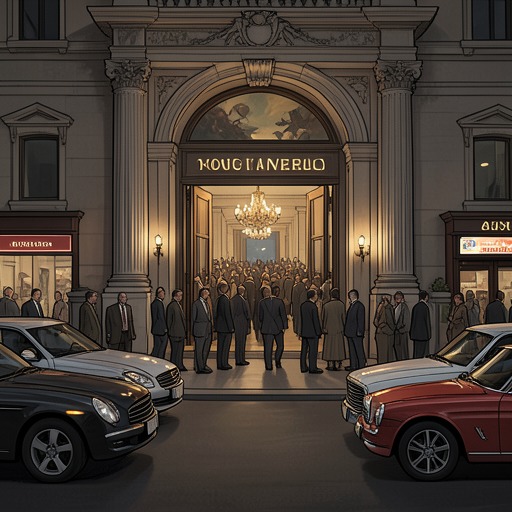
The Casino was restored to white and gilt, its rooms finished in pale grey with wine-red carpets and curtains, and vast chandeliers returned to its ceilings. The gardens were tidied and their fountains set playing again. The Hôtel Splendide and Hermitage were refurbished, restaffed, and made ready to support the resort’s renewed ambitions. The Mahomet Ali Syndicate was then persuaded to establish a high-stakes game at the Casino, while the Société des Bains de Mer de Royale hoped that Le Touquet might at last return some of the wealth it had drawn away.
Bond’s Mission in the Resort
The newly luminous resort sharpens Bond’s sense of estrangement. Standing in the sunshine against a setting designed for leisure and display, he feels his mission to be remote and incongruous, his profession an affront to the other participants in the scene. He puts aside that unease and walks around the back of his hotel to the garage, preparing to inspect Le Chiffre’s villa before a rendezvous at the Hermitage. Royale thus links the public theater of the Casino to the covert work unfolding beyond its formal gardens and hotels.
Bond arrives in Royale-les-Eaux under the cover name James Bond, Port Maria, Jamaica. The hotel register raises no curiosity, and M has shown no interest in the details of the cover. M’s warning is practical: once Bond begins making a play against Le Chiffre at the tables, his presence will be noticed, so his assumed identity must withstand ordinary public scrutiny. In this way, the resort is both a destination and a stage on which Bond’s cover will be tested amid the visibility of the Casino’s high game.
The Resort’s Dark Counterpart
The contrast between Royale’s renewed polish and its neglected margins becomes stark at Les Noctambules, Le Chiffre’s villa. At dawn, Bond realizes that Vesper has been used as bait to catch him. The car turns onto a side road partly overgrown with grass, passes between dilapidated stucco pillars, and enters an unkempt forecourt enclosed by a high wall. The peeling white door bears the villa’s name in small zinc letters above a rusty bell-push.
Bond recognizes the building as a typical French seaside house, its apparent seasonal respectability a thin cover over abandonment. In his imagination, dead blue-bottles are swept out for summer lets, stale rooms are briefly aired by a cleaner, and a fresh coat of whitewash disguises the decay for a few weeks before winter rain and imprisoned flies reclaim the place. The villa’s isolation suits Le Chiffre’s purpose: Bond knows they have passed no other house since his capture, and his earlier reconnaissance established that only an occasional farm lies for miles to the south.
Royale-les-Eaux therefore holds two versions of the resort in view. Its refurbished Casino and hotels promise recovered wealth through carefully arranged luxury; its remote villa offers concealment and coercion behind an overgrown road and high wall. The setting’s movement from the bright town to the neglected house turns its history of revival and decline into a physical contrast, while placing Bond’s mission inside a landscape where elegance never quite erases decay.