Summer
Casino RoyaleSummer frames a sharp contrast in the novel: at Royale, sunlight accompanies a hopeful public revival, while later, the light of a summer day continues to move across the aftermath of violence. The season is therefore more than a date on the calendar. Its brightness makes the town’s promise visible, then throws the consequences of Bond’s mission into unsettling relief.
Royale in the Summer Sun
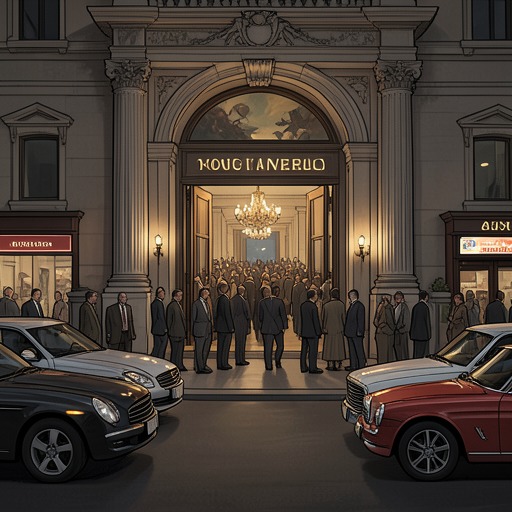
When Bond leaves the Splendide at noon, the town is presented in a moment of deliberate prettiness. The clock at the mairie sounds its midday carillon; pine and mimosa scent the air; and the Casino’s freshly watered gardens, gravel paths, and orderly flower beds give the scene a formal, almost theatrical quality. Sunlight and a sense of gaiety make Royale appear ready to begin again.
That optimism has a history behind it. Royale began as a fishing village and rose to fame as a fashionable watering place during the Second Empire. Its fortunes later declined as Le Touquet eclipsed it, much as Deauville had eclipsed Trouville. The summer scene thus belongs to a resort trying to recover from a long reversal, not to a town whose prosperity is secure.
The restoration is visible in specific details: the Casino has been repainted white and gilt, its rooms redecorated in pale grey with wine-red carpets and curtains, and its gardens and fountains revived. The Splendide and Hermitage have been refurbished and restaffed; Parisian jewellers and couturiers have brought their displays to the main street. These preparations turn the town into a stage for the season’s visitors and for the hoped-for return of wealth.
A Season of Public Promise and Private Purpose
The Mahomet Ali Syndicate’s decision to establish a high-stakes game at the Casino gives the revival its financial hope. The Société des Bains de Mer de Royale expects that the game may draw back some of the wealth that Le Touquet has taken from its older rival. Summer is not simply pleasant weather in this account: it is the season in which the town’s commercial ambitions are put on display and tested.
Against that bright setting, Bond feels out of place. In the sunshine, his mission seems remote from the resort’s effort to welcome prosperity, and his profession appears at odds with the people sharing the scene. He pushes aside that unease and goes on with his plans, including a drive to inspect Le Chiffre’s villa before a rendezvous at the Hermitage. The contrast establishes a recurring tension: the town presents itself as a place of leisure, while Bond reads it as a landscape of surveillance, risk, and work.
Summer and Bond’s Return to the Casino
Summer also marks Bond’s physical and professional preparation for the gambling session. After a masseur works on his tense body and he sleeps, Bond wakes in the evening refreshed. He takes a cold shower and heads to the Casino, aware that he has lost the mood of the tables and must recover the concentration he considers essential to winning.
The seasonal setting meets Bond’s own attachment to gambling. He values the cards’ dry riffle, the quiet drama of the players, the comfort of the card room, and the suspended decision represented by a bet. For him, the casino makes a spectator into an actor: he watches other people’s choices until it is his turn to say yes or no. The summer resort supplies the polished public setting, but the gamble draws him into a more private drama of judgment and chance.
Daylight After Violence
Later, summer daylight takes on a far darker function. After an attack leaves Bond unconscious, the closed room does not keep the day outside. Small sounds from the summer day filter through the window, while June sunshine casts two pink reflections on the wall from separate pools of blood. As the hours pass, the patches of light move along the wall and grow larger.
The scene reverses the earlier association between summer and renewal. At Royale, sunlight had seemed to promise fashion, prosperity, and a fresh start; here, the same season’s brightness registers the aftermath of violence without interrupting its ordinary passage through the day. That quiet continuation is part of summer’s significance in the novel: its beauty and warmth do not protect Bond from danger, and the world’s seasonal rhythms carry on even when his private crisis has reached its most severe point.