Victorian era
Casino RoyaleThe Victorian era functions as an aesthetic reference point in Royale: its remembered elegance helps turn a faded seaside resort into a stage for modern gambling. The same appeal to ceremony and studied comfort recurs at the tables, where precise procedures frame chance as both private calculation and public drama.
A Recalled Style of Luxury
The Casino Royale is described as carrying a strong trace of Victorian elegance within its baroque appearance. In 1950, a Paris syndicate with funds belonging to expatriate Vichyites saw commercial promise in this older style, treating nostalgia for more spacious, prosperous times as a possible source of revenue. The reference is not simply historical decoration: it gives the casino a carefully revived identity, suited to attracting visitors and high stakes.
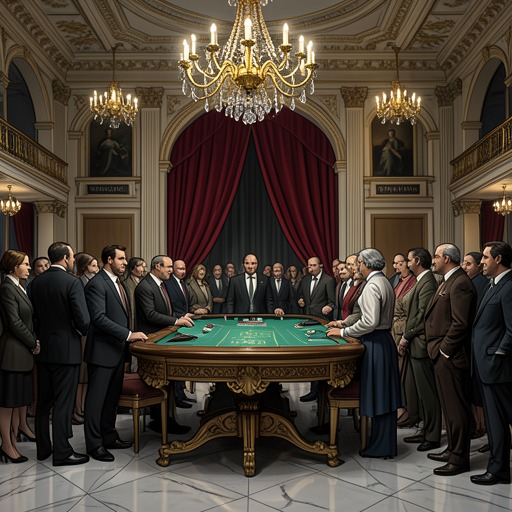
The restoration made that appeal visible. The casino was repainted in white and gilt; its rooms were given pale grey decor with wine-red carpets and curtains, and large chandeliers were hung from the ceilings. The gardens and fountains were renewed, while the Splendide and the Hermitage were refurbished and restaffed. The revival extended into the town and vieux-port, whose shops and main street were arranged to welcome a wealthy seasonal clientele. The resort’s theatrical polish thus presented an old-fashioned image of abundance as a contemporary attraction.
Leisure as a Formal Performance
The novel also connects cultivated leisure with the conduct of gambling. Bond enjoys the quiet furnishings and attentive service of card rooms and casinos, as well as the position of both spectator and participant: he can observe other players’ decisions until his own turn to choose arrives. This combination of comfort, observation, and personal risk gives the gaming room a social form in which individual decisions are displayed before others.
That form depends on a contrast between chance and procedure. At roulette, Bond studies the recorded sequence of the ball even though he recognizes that each spin is independent of the last. The croupier’s controlled movements and the engineered wheel are designed to prevent skill or mechanical bias from determining the result; nevertheless, Bond follows the players’ convention of noting patterns. He does not defend the practice as a reliable prediction. For him, effort and ingenuity belong to the experience of gambling, even when they cannot command its outcome.
The Baccarat Table as Public Ceremony
The baccarat game makes the ceremonial dimension especially clear. Bond collects twenty-four million francs against his receipt, divides the notes into equal packets, and places one half in each coat pocket before crossing the crowded room to the table. There, cards are mixed face down in the croupiers’ shuffle, and a velvet-covered chain controls entry through the brass rail. These details establish a sequence of preparation and admission before the contest begins.
When Le Chiffre takes the banker’s chair opposite Bond, the game proceeds through measured movements and formal declarations. After the Greek accepts the opening bank, Le Chiffre settles the cards in the shoe and deals them out. Bond’s quiet decision to follow a later stake intensifies the attention around the table: the word spreads through the casino, people gather, and the thirty-two-million-franc amount is understood by onlookers as a fortune. The stakes become a spectacle not merely because of their scale, but because the table’s rules make the contest legible to a watching crowd.
Nostalgia and the Limits of Control
The Victorian reference helps bind architecture and gambling together. The restored casino offers an image of established luxury, while the table supplies an ordered ritual through which risk can be watched and measured. Yet neither setting abolishes uncertainty. Bond’s careful attention to roulette patterns coexists with his recognition that each spin begins afresh; in baccarat, formal procedure contains the contest without guaranteeing its result.
The resulting atmosphere joins polished leisure to consequential exposure. The resort’s revival converts nostalgia into a commercial attraction, and the gaming ritual converts private fortunes into public drama. The Victorian era therefore matters less as a period reconstructed in detail than as a selective ideal of elegance and ceremony, invoked to lend the casino’s modern risks an air of permanence.