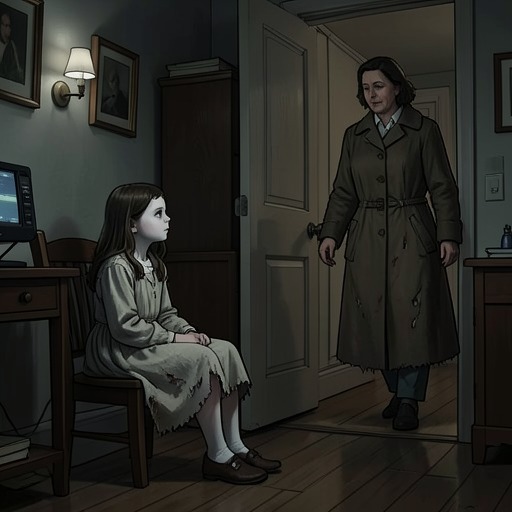
Anne Rouvier
Chanson douceAnne Rouvier is Hector Rouvier’s mother and one of Louise’s former employers. Her place in the novel is defined by a double perspective: she remembers Louise as a patient, tender caregiver who mattered profoundly to her son, while a later police interview turns that intimacy into evidence in an inquiry about Louise. Anne’s unease in the interview contrasts with her calm account of why she hired Louise, and with Hector’s grief over the nanny’s departure.
Identity and Background
Anne appears in the recollection of Hector’s childhood as a mother whose patience could fail during the bedtime routine. When Hector cried, pleaded for the door to remain open, asked for another story or a glass of water, claimed to have seen a monster, or said he was hungry again, Anne lost patience. The memories do not establish her as cruel; instead, they show the ordinary strain of a parent confronting a child’s repeated fears and requests, against which Louise’s seemingly inexhaustible gentleness stands out.
The adult Anne is presented as anxious and self-conscious when faced with authority. At the police station, she searches the officers’ questions for an accusation and worries that some old fault may be held against her. The narration describes this suspicion as habitual: she has never crossed a border checkpoint without sweating, and once, while sober and pregnant, she blew into a breathalyzer convinced she would be arrested. This comic disproportion gives her fear a recognizable pattern, but in the interview it also shapes how she occupies the room: careful, compliant, and eager to satisfy the police.
Louise as Hector’s Nanny
Louise had been recommended to Anne by a friend, who spoke highly of her. Anne says she, too, had always been satisfied with the nanny. Her clearest measure of Louise’s success is Hector’s attachment to her: she points out to the police that her son had been very fond of Louise. The remark is both an endorsement of the caregiver and an introduction to the emotional history the interview will reopen.
Hector’s childhood memories supply the detail behind that endorsement. His parents’ bedtime ceremony could become a struggle, but Louise treated his fears with patience. She told him that she, too, was afraid to fall asleep, and she could stroke his temples for hours as he made his way toward sleep. She persuaded her employer to leave a lamp on in the child’s room rather than subject him to needless terror. In Hector’s recollection, care is not a general promise but a succession of small accommodations to a frightened child.
That tenderness made Louise’s departure painful. Hector missed her intensely and resented the young woman who replaced her, a student who picked him up from school and spoke English, whom his mother said would stimulate him intellectually. He also felt betrayed by Louise: she had made ardent promises of enduring affection and told him that he was the only one, yet one day she was simply gone. At eight, he did not dare ask questions or openly mourn her. He sensed that adults might find such grief ridiculous, and that even those who pitied him might only be pretending. Anne’s positive testimony thus sits beside a loss Hector could scarcely admit.
The Police Interview
More than a year after Louise gave Anne as a reference, Myriam Massé called to ask what Anne thought of her. A police captain brings up that January phone call during the later interview, asking Anne how she came to know Louise and why she hired her as a nanny. Anne answers calmly. She wants to be helpful, to put the officer on a useful track, and above all to learn what Louise is accused of. Her account remains favorable: a friend had recommended Louise, Anne had been pleased with her, and Hector had been attached to her.
Hector’s silence and the atmosphere of the interview place a limit around that account. He lowers his head while Anne sits beside him; she puts a hand on his shoulder and tells him that he is doing well. The captain, a woman with thick brown hair tied in a ponytail, sits on her desk facing them and consults a file. The room is cold and orderly, with no photographs or posters to distract them. The officer repeatedly leaves to take a call, speak quietly to a colleague, or drink coffee, while Anne and Hector sit side by side without speaking. Hector looks at his phone; Anne holds a black leather bag in her arms. Both are tired, submissive, and too polite or frightened to show impatience as they wait to be released.
Relationships and Narrative Significance
Anne’s relationship with Hector is rendered through restrained gestures rather than extended explanation: he lowers his head, and she lays a hand on his shoulder. Her reassurance meets his silence, while his memories disclose the depth of his attachment to someone Anne once employed. The interview makes their shared past newly consequential without undoing its tenderness: a reference given for a nanny is revisited as police seek to understand the woman Louise became in another household.
Anne also acts as a link between Louise’s successive positions in family life. Louise’s work for Anne furnished the recommendation that led Myriam to call her; in turn, Hector’s devotion helps Anne explain why she considered Louise exceptional. Yet the scene does not make affection proof of innocence or wrongdoing. It gives the reader a narrower, more unsettling truth: the same Louise remembered as patient with a frightened child is now the subject of an investigation, and Anne, despite her favorable experience, cannot tell from the questions what the accusation is.