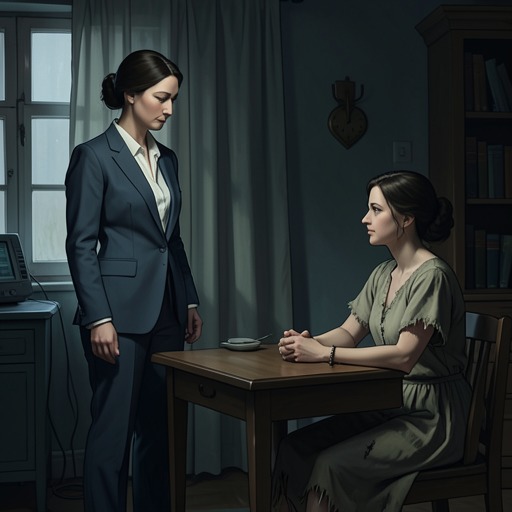
Domestic workers’ invisible labor and exploitation
Chanson douceDomestic workers’ invisible labor and exploitation is a defining structure of the Massé family’s life, not a background service. Louise makes their cramped apartment orderly, their children calm, and their careers and social plans workable; the more successfully she performs this labor, the less clearly the family sees its cost. The novel traces how childcare becomes an unbounded domestic role, sustained by praise and apparent intimacy but marked by unequal control over time, space, and recognition.
Hiring and the terms of care
Before Louise enters the household, Paul and Myriam approach hiring as a practical exercise. They set aside a Saturday afternoon, prepare questions, and allot thirty minutes to each interview. Paul’s requirements expose the exclusions beneath that apparent neutrality: he rules out undocumented workers, as well as applicants who are too old, wear a veil, or smoke, and says that the nanny must be lively and available so that the parents can work. He distinguishes the risks he associates with childcare from the more acceptable employment of a cleaner or painter, even as the family’s own need for care is urgent.
Myriam recognizes the discriminatory logic but does not challenge Paul. Emma has advised her to prefer a nanny whose children are “back home,” since a caregiver with children nearby may be unable to stay late or babysit. Myriam is troubled by the standard: she knows that she and her friends would object if an employer spoke about them in the same way. Yet she keeps the disagreement from Paul, whom she sees as a pragmatist who puts family and career first. The hiring process therefore establishes a central imbalance: the parents’ work is treated as a priority to be enabled, while a worker’s own family obligations are framed as an inconvenience.
The Massés prepare their home for the interviews as if they were presenting themselves to prospective judges. After a family trip to the market, they tidy the apartment, gather scattered books and magazines, put away the children’s toys, fold clothes, change bedding, and try to air out the rooms. They want applicants to see them as serious, orderly parents who offer their children the best. The scene ends with the recognition that they are the employers. Their anxiety about being judged coexists with the authority their position gives them over the person they hire.
Domestic skill made indispensable
Louise’s entrance is remembered by Myriam as an instant connection, especially because Mila responds to her playful search for a vanished princess. But the enduring transformation is material. Myriam calls Louise a fairy: she seems to push back the walls of an oppressive, cramped apartment, make its cupboards deeper and drawers wider, and bring in light. The metaphor captures the family’s astonishment while making practical labor seem almost magical—as though order simply appears, without time, effort, or a worker’s hands.
The work quickly exceeds the narrow idea of childcare. Louise repairs buttons on jackets the adults have neglected, hems skirts and trousers, mends clothes Myriam had been ready to discard, washes curtains yellowed by tobacco and dust, and changes the sheets every week. She imposes her exacting standards on the disorderly home, rearranges cupboards, hangs lavender sachets among the coats, and makes flower arrangements. The parents enjoy the results and Paul compares her to Mary Poppins, though he is not sure she understands the compliment. Their delight rests on a widening set of tasks whose domestic value is obvious precisely because the household had previously left them undone.
She also creates a system for remembering and coordinating family life. In a small flower-covered notebook, she records dance lessons, school outings, pediatric appointments, the children’s medicines, the price of an ice cream bought at the amusement park, and the exact words Mila’s teacher used. This record-keeping makes her a custodian of the household’s practical knowledge as well as its cleanliness. It also reveals how care is built from small, repetitive acts that can disappear into the smooth functioning of a family day.
At the end of the workday, Myriam finds dinner ready and the children calm and combed. Louise teaches Mila to hang up her coat, a small act that amazes her parents and seems to confirm the possibility of the ideal family life Myriam secretly wants. The apartment no longer accumulates dirty dishes, unwashed clothes, unopened envelopes, or spoiled food. Louise’s labor benefits everyone, but its success is expressed as the disappearance of disorder: the work is visible in its results and increasingly invisible as work.
Availability, intimacy, and the expanding workday
The boundary between paid care and additional domestic labor erodes gradually. When Myriam tells Louise that she can go home after a late evening, Louise continues cleaning the bathtub, folding towels, emptying the washing machine, preparing the children’s beds, and then starting dinner. She gently insists that Myriam should rest and enjoy her children. Myriam lets her take over more tasks each day, while Louise presents the extra effort as simply what she is there to do.
The change is also temporal. Louise arrives earlier and leaves later; Myriam stops calling to announce delays, and Mila no longer asks when her mother will return. The family’s routine depends on Louise’s presence, yet her work takes place like stage labor behind a performance: she shifts the scenery while the audience sees a settled domestic world. The narration describes her as both indispensable and unseen, an intimate presence who never becomes fully familiar. When Myriam encounters her naked after a shower, she reassures herself that Louise has no concern for her body or the usual boundaries of modesty. The episode shows how the employer’s home becomes Louise’s workplace, while the intimacy of that space can make professional limits harder to maintain.
The pattern reaches into the night. After Paul and Myriam return from a party at about four in the morning, they find Louise asleep on the sofa, curled up with her hands clasped. Paul covers her and says not to wake her. She begins sleeping there once or twice a week. No explicit agreement is made; instead, she gradually makes a place for herself in the apartment. Her presence enables the couple to go out, while the arrangement quietly extends the household’s claim on her time and space.
Paul sometimes worries that the couple could be accused of exploiting Louise because her hours keep lengthening. Myriam promises to set things straight, but she is also secretly pleased that Louise performs chores she never requested. She apologizes when she comes home late; Louise reassures her that she is there for that purpose. Myriam gives Louise inexpensive earrings, an orange cake, and clothes she no longer wears, trying not to hurt or make her jealous. She even hides new purchases in an old fabric bag until Louise has left. These gestures convey consideration, but they do not resolve the underlying question of work, compensation, or hours. The relationship is managed through gratitude and delicacy rather than a clear renegotiation of labor.
Service celebrated, worker sidelined
Louise’s work becomes a social distinction for the Massés. Her Friday dinners attract their friends: she spends the afternoon cooking while the children play at her feet, cleans the apartment, arranges flowers, and sets a beautiful table with a cloth she has sewn from fabric bought across Paris. When everything is ready, she slips out. Her skill is at the center of the gathering, but she is normally absent from the meal it makes possible.
On one exceptional evening, Paul insists that she stay because Myriam has landed a major case and he has been offered the chance to produce a singer’s next record. The celebration is presented as a moment when everything is going well. At dinner, Louise brings in her dish to applause, and the guests praise its sauce and ginger. Paul calls her “our nanny” and talks about her as one might talk about children or elderly people in their presence. The praise is genuine, but it does not grant her equal standing in the conversation. As the guests grow louder, crush cigarettes into their plates, and leave butts floating in the remaining sauce, no one notices Louise has returned to the kitchen to clean.
Paul then announces, while holding a stack of her dishes, that the family will take Louise on holiday. The proposal comes during a drunken evening, and he later recalls it as a potentially careless promise. Myriam, however, welcomes the idea as a chance for a real vacation and assumes Louise will be happy to go. The episode reveals the double meaning of the family’s generosity: taking the nanny along promises leisure for the employers because childcare travels with them. Louise’s labor is celebrated as the source of domestic comfort and still presumed available as part of the family’s plans.
Precarity, isolation, and the wider labor world
The unequal relation is not only a matter of long hours. A month before the disaster, Louise tells Rose Grinberg that she is in financial trouble: her landlord harasses her, she has accumulated debts, and her bank account is continually overdrawn. She offers to work for Rose in the evenings or early mornings, cleaning or ironing while the children sleep. Her proposal makes clear that the apparent security of her indispensable position in the Massé home has not removed her economic vulnerability. When Rose pulls away from the conversation, Louise’s attempt to find extra work ends without support.
Louise’s past also clarifies the contempt that can accompany domestic service. Her husband Jacques dismisses her work caring for children as picking up their excrement and vomit, and describes such labor in racist terms. He tells her she should demand reimbursement and refuse to work unpaid minutes, but these recommendations do not change the conditions of her work. As the children’s presence begins to irritate him, he orders Louise to work at her employers’ apartment instead. His account reduces childcare to repetitive, degrading bodily tasks; the novel, by contrast, shows those tasks as the work that sustains other people’s homes and careers.
The square offers a collective setting in which nannies share information and grievances that remain largely unspoken elsewhere. Their conversation is guarded because many carry painful memories and private secrets. Yet the square functions as a job network, a complaints center, and an informal union: employment offers circulate, disputes between employers and employees are discussed, and workers bring their problems to Lydie, its self-appointed leader. Louise’s friendship with Wafa belongs to this social world. Wafa speaks freely about her life, while Louise’s own silence reflects a broader pattern in which domestic workers’ experiences are not easily recorded or heard.
The contrast between the Massés’ busy life and Louise’s work makes the household’s dependence especially legible. Paul and Myriam describe their weeks as a succession of tasks and appointments; they hurry between locations, change shoes in taxis, and cultivate people important to their careers. Their home becomes, in effect, a functioning enterprise with goals, income, and expenses. The time they gain is inseparable from the labor Louise performs in their apartment and with their children.
When Louise becomes ill and fails to arrive, that dependence briefly comes into view. Myriam, unable to reach her, fears that she has disappeared and blames Paul for treating her like an ordinary employee; she concludes that they have humiliated her. Paul points out that something may have happened and looks for her address. Louise eventually calls to explain that she was too sick to get out of bed and had slept through the morning. Myriam is ashamed that she had imagined Louise as infallible, as if her body could not become tired or ill. The episode exposes the contradiction beneath the family’s reliance: Louise is treated as essential to the household’s functioning, but her own bodily limits become imaginable only when they interrupt that functioning.
Across these scenes, invisibility is not simply failure to notice a person. It is produced by the very effectiveness of care: clean rooms, prepared meals, organized schedules, quiet children, and parents able to work and go out. The Massés recognize Louise’s extraordinary service, praise her, and sometimes worry about exploiting her, yet the work continues to expand through unspoken expectations and emotional closeness. The novel’s critique lies in that uneasy coexistence: a household can feel lovingly sustained while depending on a worker whose time, labor, and need for care are persistently pushed out of sight.