Emotional exhaustion and love disability
Chanson douceEmotional exhaustion and the failure of love mark the point at which Louise’s capacity for care—once expressed through meticulous household labor, reassurance, and imaginative play—turns into estrangement and frightening resentment. Her decline is neither a single outburst nor a simple loss of affection: it unfolds through sleeplessness, isolation, the exhaustion of repetitive care, and the collapse of the stories through which she once connected with the children.
From Devotion to Estrangement
Louise’s early attentiveness makes the later depletion especially stark. On her first day in the Massé apartment, she listens quietly to Myriam’s instructions, including the warning to take care with treasured objects and to keep the children away from Paul’s record collection. She observes the rooms with an almost military composure. In time, her care extends far beyond the children: she prepares the evening meal, keeps Mila and Adam calm and neat, and helps create the ordered home Myriam longs for. Her attention is painstakingly recorded in a small flower-covered notebook, where she writes down schedules, medical appointments, medication names, expenses, and even Mila’s teacher’s exact words.
Such care makes Louise indispensable, but it also blurs the line between paid work and personal attachment. Myriam recognizes that Louise’s hours are growing too long and promises Paul she will set limits. Yet she is secretly pleased that Louise takes on chores she never requested, and repeatedly apologizes when she returns late. Louise answers that she is there for precisely that purpose. This exchange makes the exhaustion structural as well as personal: Louise’s devotion is welcomed as a benefit to the household, while the couple’s unease about exploiting her does not translate into an effective boundary. The more completely she tends their domestic life, the harder it becomes to distinguish her work from her need to belong within it.
Isolation and the Body in Distress
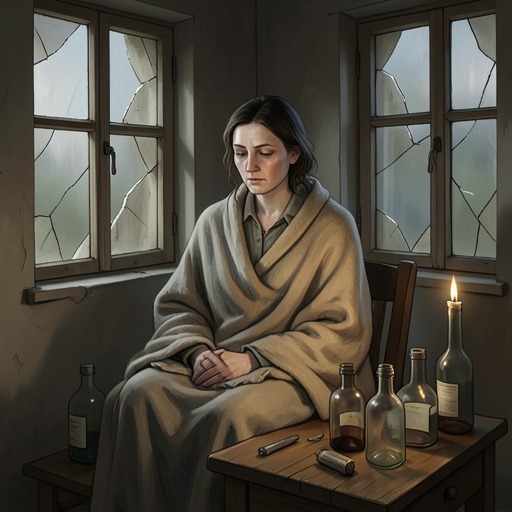
Louise’s distress becomes unmistakable during a three-day spell of nightmares and near-lethargy. Sleep does not restore her. She grinds her teeth, sweats through her shirt, and presses into the sofa bed as if pinned beneath a boot, her mouth full of earth. Waking to drink or use the bathroom, she returns to her narrow sleeping place. The physical imagery makes exhaustion feel like submersion: she struggles upward from a black, viscous depth toward air.
Her flower-covered notebook, previously a record of the Massé children’s routines, also holds a phrase she has taken from a doctor at Henri-Mondor Hospital: “Mélancolie délirante.” She finds the term beautiful, as though its sound offers a momentary poetic escape from sadness. But the note’s fragile, distorted handwriting is compared to the wooden constructions Adam makes only to watch them collapse. The image ties her private language of illness to the instability around her: even the words that briefly console her appear precarious.
The spell also turns Louise’s attention toward aging and bodily vulnerability. She obsesses over future illness, growing medical costs, and the possibility of being bedridden in her apartment with its dirty windows. The mold around the shower becomes an inescapable presence: she scrapes at the green growth, only for it to return more densely overnight. Her hatred of the apartment and her sense of having overheard too much of other people’s intimacy gather into a more fundamental deprivation. She has never had a room of her own. The contrast is sharp: she has helped make another family’s home calm and orderly, yet has no private space in which to secure a life of her own.
Care Without Consolation
After returning to work, Louise initially receives an embrace from Mila, who runs to her in a blue pajama suit and exclaims, “Louise, c’est toi ! Tu es revenue !” The welcome does not resolve the separation between affection and relief. Later, after taking Mila out, Louise returns with her to find Paul on the sofa listening to a record and Myriam already in bed. Louise has spent her last banknote and is cold and sore; the outing, meant to create a moment of family happiness, has changed nothing in her relationship to the household. A sudden melancholy settles over her.
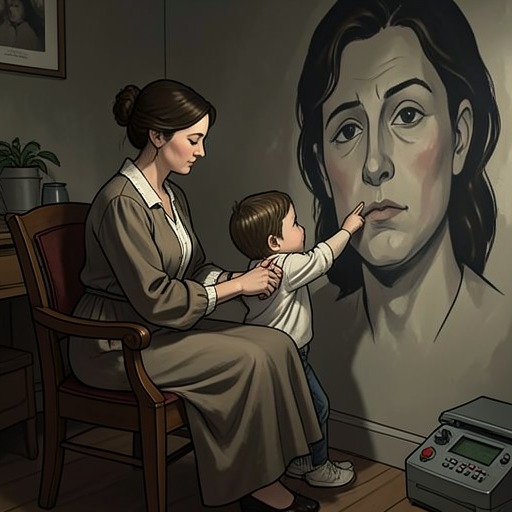
The children, once a source of consolation, now seem unreachable in their own world. Louise speaks to them and they turn away; she holds their hands and lowers herself to their height, but they have already found a game that lets them avoid listening. Her stories falter in parallel. Mythical creatures lose their vividness, and their battles no longer have a purpose the children can follow. Instead of adventures, she produces long, broken wanderings featuring impoverished princesses and sick dragons. Mila asks her to find something else, but Louise cannot. The failure is more than a lapse of invention: storytelling had given her a way to offer attention and to hold the children’s interest, and now even that intimate form of care has become an effort she cannot sustain.
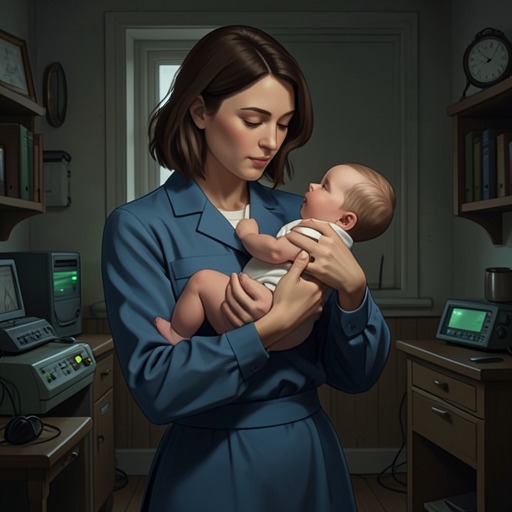
Louise still loves Mila and Adam and spends hours watching them. She is moved when Adam turns to her to share his progress, as if his gestures were meant for her alone. She longs to experience the children’s first discoveries through their eyes, before novelty gives way to repetition and fatigue. Yet the longing coexists with depletion. She laughs less and brings little energy to their games of small horses or pillow fights. The children’s dependence and their capacity to delight her remain, but they can no longer reliably replenish what care takes from her.
Repetition, Resentment, and the Failure of Love
The daily recurrence of care becomes oppressive. Mila asks the same question hundreds of times; songs, stories, games, and faces must be repeated without end. Louise can no longer meet the children’s crying, whims, or excited happiness with indulgence. Their voices and demands seem to split her head, and at times she imagines putting her fingers around Adam’s neck and shaking him until he faints. She drives the thought away with a sudden movement of her head, but its arrival reveals how thoroughly tenderness has been invaded by exhaustion.
The children’s world grows more difficult to enter as Louise withdraws. She leaves the television on throughout the day, watching programs she barely understands, despite Myriam’s instruction not to let the children watch it. Mila knows not to repeat in front of her parents the words she hears on the news, including “traque,” “terroriste,” and “tués.” While Mila watches silently and the siblings turn to pushing and fighting, Louise remains fixed on the screen. She also refuses to take them to the square, avoiding other caregivers and a neighbor before whom she has humiliated herself by offering her services. The children’s confinement and restlessness become part of a wider pattern: Louise is present in the apartment, but increasingly unavailable to them.
Against this background, the sentence “Il faut que quelqu’un meure. Il faut que quelqu’un meure pour que nous soyons heureux.” gives her depletion its most terrifying form. Morbid refrains accompany her as she walks, phrases that seem to come from elsewhere and whose meaning she herself does not fully grasp. The thought is not presented as a worked-out plan; it is a sign that happiness has become imaginable only through death. Louise hears her own heart as hardened beneath a thick, cold crust. Nothing moves her as it once did, and she admits that she no longer knows how to love: the tenderness in her has been used up, and her hands have nothing left to touch.
Her fear of punishment follows that admission. “Je serai punie pour ça, s’entend-elle penser. Je serai punie de ne pas savoir aimer.” Love’s failure is experienced not as freedom from obligation but as guilt for failing to feel what she believes she ought to feel. The sequence gives emotional exhaustion a grim double character: Louise is worn down by ceaseless demands, yet she also condemns herself for the emotional numbness that follows. What began as intimate, meticulous care ends in a condition where the children remain objects of longing and attention, but no longer provide consolation—and where the thought of happiness has been severed from the possibility of love.