Frugality, food waste, and anxiety over scarcity
Chanson douceThrift, food waste, and anxiety about scarcity are first treated as one of Louise’s eccentric habits, then become a fault line in her relationship with Myriam and Paul. Leftovers saved in tiny containers, coupons clipped from neighborhood advertisements, and a carefully cleaned chicken carcass make thrift visible as both a practical routine and a struggle over authority in the household. What the employers initially find charming eventually becomes a source of tension, and the chicken’s return transforms an argument about waste into a personal confrontation.
Scraps and the Practice of Saving
Myriam’s refrigerator holds the material record of Louise’s reluctance to throw food away: small stacked boxes and foil-covered bowls contain a few peas, three pieces of pasta, a spoonful of purée, and a shred of turkey too small to feed even a sparrow. Other shelves hold a piece of lemon, a withered bit of cucumber, a quarter of an onion, and a cheese rind. Louise has taken care to store even these remnants. The inventory is not abstract thrift but an accumulation of saved quantities that Myriam’s household might otherwise discard without a second thought.
Louise’s practices extend beyond leftovers. She scrapes food from cans and lets the children lick yogurt pots clean. The routines initially amuse Paul and Myriam, who regard them as ridiculous but touching. Paul teases Myriam when she takes the rubbish out at night, suggesting she is afraid Louise will scold her for discarding leftovers or a broken toy. The joke shows that Louise’s standards have started to influence her employers even when she is not present: Myriam’s disposal of household things has become something Paul can frame as an offense against the nanny’s rules.
Louise also studies neighborhood advertisements that Paul and Myriam habitually throw away. She collects discount coupons and presents them proudly to Myriam, who feels embarrassed by what she considers foolishness. Yet Myriam invokes Louise’s example in front of her husband and children, saying that wasting food is wrong because some children have nothing to eat. The household thus both patronizes Louise’s thrift and borrows its moral authority. Saving is at once a practice they find excessive and a principle Myriam endorses when speaking to her family.
From Amusement to Household Conflict
After several months, the employers’ amusement gives way to irritation. Myriam complains about Louise’s obsessions and rigidity; Paul, convinced that the family needs to free itself from Louise’s influence, encourages resistance to her authority. Myriam insists that Louise may search the rubbish if she wishes, but she has no right to control what the family does with it. The dispute is no longer simply about whether a scrap might be useful. It concerns the boundaries of Louise’s role in the home and whether her standards can govern her employers’ decisions.
Myriam makes one boundary explicit: Louise must not give the children expired food, even if it expired only a day earlier. The instruction exposes the difference between saving something and deciding that it is safe to serve. Louise’s refusal to waste and Myriam’s responsibility for the children now pull in different directions. A household habit that had once seemed harmless has become a question of trust, risk, and who has the final say over the children’s food.
That evening, Myriam returns late to a dark apartment and finds Louise waiting by the door with her coat on and her bag in hand. Louise barely says goodbye before hurrying to the elevator. Myriam is too tired to reflect on the departure. Her immediate detachment sits alongside the conflict that has been building: she registers Louise’s displeasure but does not yet engage with what it means.
The Chicken Carcass as Retaliation
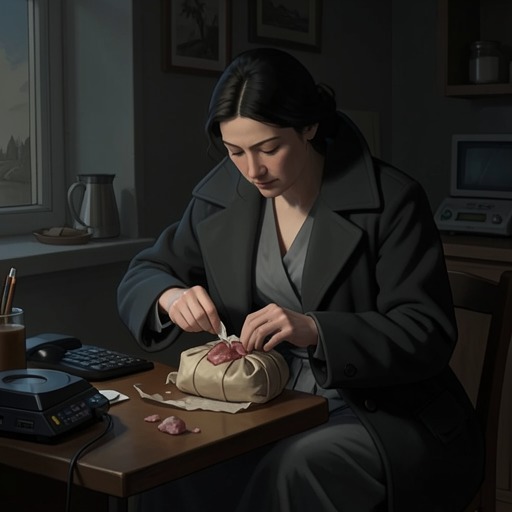
In the kitchen, Myriam finds the room exceptionally clean: the refrigerator door has been wiped, the counters are clear, the hood and cupboard handles have been cleaned, and the window shines. At the center of the small table where the children and Louise eat sits a chicken carcass on a plate. Myriam recognizes it as the chicken she threw away that morning because it was no longer fit to eat. She remembers emptying it into the rubbish with the congealed fat and recoiling from its smell.
The carcass has been washed with almond-scented dish soap. To Myriam, that cleaning rules out an accidental oversight: Louise has retrieved the discarded chicken, cleaned it, and placed it deliberately on the table. The neatness of the kitchen makes the object more conspicuous, not less. In a room restored to order, the returned carcass turns the act of throwing food away into something Myriam cannot ignore. She reads it as revenge, an ominous emblem of Louise’s grievance rather than a forgotten meal.
Mila later describes the children’s part in the episode. Louise had made eating from the bones into a game, instructing Mila and Adam to use their fingers and to scrape the meat away without damaging the skeleton. She allowed them large glasses of Fanta while they ate and rewarded them with two sour candies. Her close attention to the carcass and the rules of the game make the children’s meal part of Louise’s response to Myriam’s decision, not merely an attempt to salvage dinner. The episode joins thrift to play and reward, while revealing how a dispute between adults can be enacted through the children’s ordinary routines.
Blame, Scarcity, and Unequal Power
Myriam disposes of the carcass, plate, and cloth, takes the rubbish bags downstairs, and shuts the refuse-room door violently. Later, she calls Paul in tears to tell him what has happened. He treats the story as an overreaction and tries to make her laugh; Myriam ends the call and does not answer when he calls back. His dismissal leaves her alone with the unease the incident has produced.
During the sleepless night, Myriam first thinks of Louise as dangerous and imagines that the act expresses hatred and a desire for revenge. She also recalls a previous dispute over Mila’s blue school cardigan. Louise had searched persistently for it, speaking of it every day and pressing the teacher, caretaker, and cafeteria workers for help. When Myriam replaced the missing cardigan, Louise became uncontrollably angry: to her, buying another one meant accepting carelessness and waste instead of recovering what had been lost. The earlier argument gives the chicken incident a pattern. For Louise, a replacement does not necessarily settle the matter; it can confirm that others treat loss as inconsequential.
Myriam’s accusation turns inward. She considers that throwing away the chicken may have humiliated Louise, who may herself know financial hardship, and that the carcass was Louise’s way of accusing her of wastefulness and casualness. This is Myriam’s interpretation, not an explanation Louise gives directly, but it complicates the scene’s moral balance. The employers possess the power to set the household rules and dispose of food; Louise’s savings practices can be mocked, adopted as a lesson, and then forbidden when they conflict with Myriam’s judgment. The returned carcass makes that unequal arrangement tangible without resolving what Louise’s actions mean beyond Myriam’s reading of them.
At dawn, Myriam finds Louise sitting at the kitchen window with the cup Myriam bought her for her name day. Louise offers to make coffee and says Myriam looks tired. Myriam takes the hot cup. After the confrontation over waste, the offer of care does not erase the grievance or clarify it; the two women return to an ordinary domestic gesture while the conflict remains suspended. Thrift has become more than a disagreement about scraps: it exposes the distance between the employers’ ability to discard and replace, and the nanny’s insistence that things should not be treated as disposable.