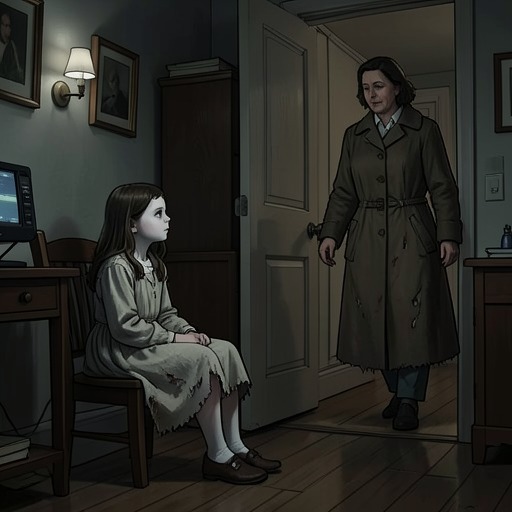
Hector Rouvier
Chanson douceHector Rouvier is a former child in Louise’s care whose testimony, years after she left his family, reveals how tenderness and possession could coexist in her attention. When police tell him that Louise is accused of killing two children, his response is not only shock but a painful relief: he recognizes, at last, a danger he believes he sensed as a child, though it had fallen elsewhere.
Identity and Background
Ten years after Louise’s departure, Hector is eighteen and living with the memory of a childhood spent under her care. The book introduces him through sensation rather than a settled portrait: the face of his former nanny has become indistinct, but her hands, scent, touch, and food remain vivid. This imbalance gives his recollection its particular force. He cannot be sure that he would recognize Louise in the street, yet he remembers in detail what it felt like to be close to her.
The memories are revisited in the setting of a police inquiry. Hector sits with his mother, Anne Rouvier, while a captain asks how Louise came to work for the family and what she was like as a nanny. Anne answers that a friend recommended Louise and that she herself had been satisfied with her. She points to Hector’s attachment as evidence. The police questioning therefore brings his private childhood bond into a new frame: what his family experienced as devoted care is now being examined in the light of grave accusations.
A Childhood of Care and Intimacy
Hector remembers Louise’s hands most clearly. They smelled of crushed petals, and her nails were always polished. She held his hands, washed him in warm water, soaped his hair, and cared for his body. At bedtime, when he lay face down with his face in the pillow and lifted his pajama top, she understood that he was waiting for her caresses. Her nails traced his back until he fell asleep, soothed but faintly ashamed of an excitement he could not understand.
Their physical closeness also accompanied ordinary routines. On the way to school, Hector held Louise’s hand tightly. As he grew, he worried that his widening palms might crush her small, fragile bones. Sometimes he even felt that the roles had reversed and that he was the one leading her across the street. The image makes his childhood attachment tangible: the child grows physically stronger, while his remembered Louise remains delicate enough to seem vulnerable in his grasp.
Hector’s memories of her affection include an edge he only partly understood. He recalls her soft cheek, face powder, beige tights against his face, and a peculiar way of kissing him, sometimes with her teeth, as if a sudden wildness had entered her love and meant to claim him wholly. He insists that Louise was never harsh with him and that he cannot remember her losing her temper or striking him. Yet these assurances sit beside his memory of being touched and kissed in ways that stirred an obscure excitement and left him ashamed. His account does not resolve that tension; it preserves the child’s limited understanding alongside the adult’s ability to name the disturbing quality of the remembered intimacy.
Patience, Domestic Memory, and Separation
Louise’s care also survives in Hector’s recollection as patience and practical kindness. He remembers the cakes she brought to the school gate, her pleasure in his appetite, her tomato sauce, peppered steaks cooked rare, and mushroom cream. These tastes belong to an imagined childhood world before the later habit of eating frozen meals in front of his computer. Food becomes one of the durable forms through which he remembers being cared for.
Bedtime offers a sharper contrast between Louise and Hector’s parents. With Anne, the routine often became difficult: Hector cried, asked for the door to remain open, demanded another story or a glass of water, said he had seen a monster, or claimed to be hungry again. Louise, by contrast, was patient with his nightmares. She told him that she too was afraid to fall asleep, stroked his temples for hours, and accompanied him toward sleep with her rose-scented fingers. She persuaded her employer to leave a lamp on in his room rather than subject him to what she considered needless terror.
When Louise left, Hector experienced the separation as a rupture. He missed her terribly and hated the young student who replaced her, a woman who collected him from school, spoke English to him, and was described by his mother as intellectually stimulating. Hector resented Louise for abandoning him and breaking promises of lasting tenderness, including the assurance that he was the only one and that no one could replace him. He did not ask why she had gone, and he did not know how to mourn her openly. Even at eight, he suspected that others would find his grief ridiculous and that those who pitied him did not entirely mean it.
The Police Interview and Revelation
During the interview, Anne sits beside Hector and rests a hand on his shoulder, telling him that he is doing well. She appears agitated before the police, searching their questions for some old fault they might be trying to make her confess. Her nervousness contrasts with her calm account of hiring Louise: a friend had recommended the nanny, and Anne had been satisfied with her work. She tells the captain that Hector was very attached to Louise, making his history part of the answer to the question of what kind of person Louise had seemed to be.
The captain eventually states that Louise is accused of killing two children. Hector leaves the station into the heat of June, with his eighteenth birthday weighing on him and a wish to be free, grown, and a man. The revelation first brings surprise and stupefaction, but those feelings give way to immense, painful relief, even jubilation. He feels as though he had always known that a threat hung over him, something white, poisonous, and unspeakable, perceptible only to his childhood eyes and heart. In his view, fate had directed the misfortune elsewhere.
The captain seems to understand the change in him. After studying his impassive face, she smiles at him as one might smile at a survivor. The scene does not establish that Hector knew what Louise would do, or that his memories amount to proof of a specific earlier crime. Instead, it shows how the accusation makes sense of a fear he had never been able to articulate. Relief becomes the adult form of a child’s unspoken sense that something in Louise’s closeness was dangerous.
Narrative Role and Significance
Hector’s recollection widens the account of Louise beyond the Massé household. The same caregiver who could make herself indispensable through practical attention also formed intensely intimate bonds with children in another family. His memories resist a simple division between kindness and menace: patience through nightmares, nourishing food, and tactile comfort are real in his account, as are the possessive undertones that made affection feel strange and the grief of being left behind.
His appearance during the investigation also changes the meaning of his childhood attachment. What Anne offers as a sign that Louise had been a good nanny becomes, under the shadow of the accusation, evidence of how deeply a child could depend on her. Hector’s silence at eight, his inability to grieve without shame, and his relief at eighteen trace the long afterlife of that dependence. The remembered hands that led him to sleep and held his own on the walk to school remain both the instruments of care and the most vivid trace of a relationship he cannot finally make innocent.