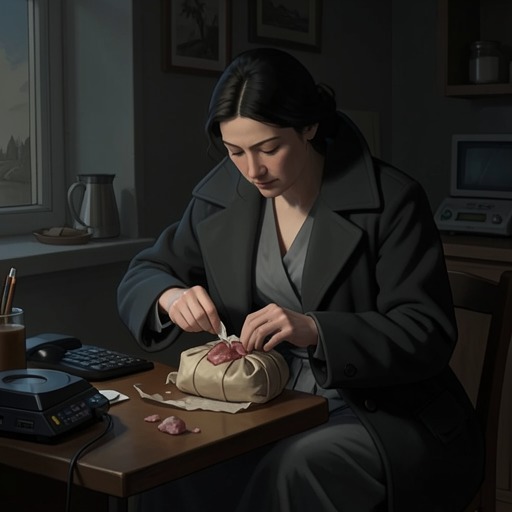
Interdiction de donner aux enfants des produits périmés
Chanson douceThe rule against giving the children expired food is a specific limit Myriam places on Louise’s care of Mila and Adam. It emerges from Louise’s concern with waste and scarcity, but Myriam makes the children’s safety non-negotiable: even food expired by a single day is forbidden. The dispute marks a shift from accepting Louise’s household habits to resisting her influence over family life.
Origins in thrift and scarcity
Louise’s attention to food waste first appears as part of a broader economy of saving. She studies neighborhood advertising leaflets, collects discount coupons, and proudly presents them to Myriam. Myriam initially treats this practice as an example for the household, telling Paul and the children that wasting food is wrong because some children have nothing to eat. Paul, meanwhile, jokes that Myriam is afraid Louise will scold her when she takes leftovers or a broken toy downstairs to the rubbish.
Over time, however, the same thrift becomes a source of friction. Myriam objects to what she sees as Louise’s rigidity and paranoia, and tells Paul that Louise may search the rubbish if she wants, but Myriam owes her no accounting. Paul agrees that the family needs to free itself from Louise’s power. Against this background, Myriam states the rule plainly: Louise must not give the children expired products, not even something that expired the day before. The emphatic limit distinguishes saving household provisions from deciding what the children should eat.
A boundary within an unequal care relationship
The rule matters because Louise’s role has expanded well beyond the tasks Myriam originally assigned. Louise increasingly arrives early and leaves late, stays in the apartment, and takes on domestic work without being asked. When Myriam tries to take a saucepan from her, Louise gently pushes her back and insists that Myriam rest and enjoy the children while she prepares dinner. Her care is useful and intimate, but it also makes it harder for Myriam to reclaim decisions and responsibilities.
That imbalance is visible in the couple’s response to Louise’s hours. Paul worries that she might one day accuse them of exploiting her; Myriam promises to clarify the arrangement, yet admits that she is secretly pleased Louise performs extra chores. She repeatedly apologizes for taking advantage of Louise’s kindness, and Louise replies that she is there for precisely that purpose. The prohibition on expired food is therefore more than a household instruction: it is one of the explicit limits Myriam asserts within a relationship in which Louise’s unpaid-for or unrequested labor has made her indispensable.
Conflict and consequences
The book shows how difficult it is for Myriam to hold that boundary without also feeling implicated in the conflict. After a quarrel involving a discarded chicken, she turns her accusations back on herself: she thinks that throwing it away may have communicated that she was wasteful and careless, and wonders whether it humiliated Louise, who may have financial problems. This self-reproach does not cancel the rule; it reveals the emotional pressure surrounding it. Myriam recognizes Louise’s vulnerability while also wanting to keep authority over the household and the children.
The conflict is sharpened by the contrast between Louise’s intense involvement in the family and her capacity to frighten the children. In a game of hide-and-seek, she stays concealed while Mila and Adam call for her, cry, and fear that she has abandoned them. Later, after Mila wanders away, Louise holds her so tightly that the child says she cannot breathe, then warns her that a stranger might take her away and no one would come to help. Mila bites Louise until she bleeds; neither tells Myriam what happened. These incidents do not concern expired food directly, but they illuminate the larger stakes of setting limits on a caregiver whose affection and protection can cross into control.
Significance
The prohibition gives a concrete form to the tension between thrift and parental responsibility. Louise’s habits make waste feel morally charged, while Myriam insists that economy cannot override a boundary she has set for the children. The conflict also exposes how dependence complicates consent and authority: Myriam relies on Louise’s labor, feels guilty about the burden placed on her, and nevertheless must insist that care has limits. In this household, a rule about what the children may eat becomes a measure of who is entitled to decide what care means.