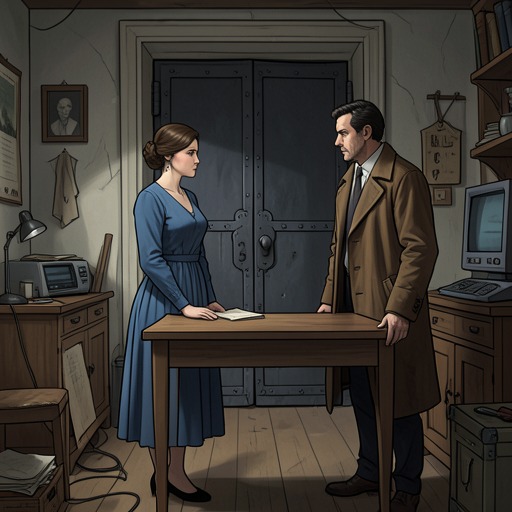
Louise
Chanson douceLouise is the Massé family’s nanny: a skilled, self-effacing caregiver whose work first seems to rescue an overwhelmed household, then becomes entangled with an increasingly desperate need to belong to it. Her trajectory turns the promise of domestic care into a study of dependence and possession, ending with the deaths of Mila and Adam and Louise found unconscious at the apartment with a small ceramic knife in her hand.
Identity and Introduction
Louise enters the Massé household after Paul and Myriam conduct a crowded Saturday afternoon of nanny interviews. Their search is shaped by explicit preferences: Paul rules out undocumented applicants for childcare, wants someone young enough, un-veiled and a non-smoker, and emphasizes availability. Myriam has already felt uneasy about Emma’s advice to avoid hiring a nanny whose children live in France, recognizing that such a standard would be discriminatory if applied to her own friends. She does not raise the disagreement with Paul, whom she regards as pragmatic and inclined to put family and career first. The couple tidy their cramped apartment before the interviews, keen to appear orderly and respectable to the women they are about to employ.
The first applicants are assessed through assumptions as well as qualifications. Paul dismisses Gigi after an interview conducted partly in English; she has left her children in her home country and has not seen her youngest for ten years. Myriam refuses to hire Malika, a Moroccan applicant with twenty years’ experience, despite Paul’s suggestion that she could speak Arabic with the children. Myriam fears that a shared language and religion would create an intimacy she could not control. Louise’s selection thus takes place within a hiring process where employers’ needs and the applicants’ family lives, migration status, age and origin are weighed unequally.
Louise makes an immediate impression by approaching Mila through a playful search for a vanished princess while taking Adam from Paul. Myriam later presents the encounter as love at first sight and says that Mila chose Louise. In the interview Louise explains that her husband is dead, that her daughter Stéphanie is nearly twenty, and that she is highly available. She provides the names of former employers and speaks of the Rouvier family, where she cared for two boys for a long time. When Myriam and Paul call the family that evening, the former employer praises Louise as a second mother to the boys and says it was heartbreaking to part with her; she had even considered having a third child to keep Louise. This recommendation confirms the impression of a caregiver whose value to a household can become difficult to relinquish.
Work and Transformation of the Household
From Louise’s first day, Myriam gives her instructions about appliances and possessions, including Paul’s record collection, which the children must not touch. Louise agrees quietly, while observing the apartment with a composure likened to a general surveying territory. Over the following weeks she alters the home through accumulated, precise labor: she mends buttons and hems, repairs Mila’s clothes that Myriam was ready to discard, washes smoke-yellowed curtains, and changes the bedsheets weekly. What had seemed cramped and disordered comes to feel brighter and more spacious. Paul compares her to Mary Poppins; Myriam calls her a fairy.
The transformation exceeds cleaning. Louise gradually takes on tasks that Myriam might otherwise have done, including preparing the children for bed and dinner. When Myriam tries to send her home after a late day, Louise continues cleaning the bath, folding towels, preparing the children’s beds and putting a pan on the stove. She gently tells Myriam to rest and enjoy her children, promising that she will hardly be noticed. The offer is caring, but it also marks an expanding claim on the household’s ordinary routines.
As the weeks pass, Louise becomes both invisible and indispensable. Myriam no longer calls to warn her when she will be late, and Mila stops asking when her mother will come home. The family’s ease rests on Louise’s unobtrusive work: she arrives earlier and leaves later, holding together a fragile domestic arrangement while Myriam increasingly accepts being cared for. The narrative compares her to stagehands moving scenery in darkness and to the hidden hands controlling the strings that make an illusion possible. The family sees the smooth performance; the labor sustaining it recedes from view.
Louise’s presence is intimate without becoming familiar. Myriam once emerges naked from the shower in front of her, then reassures herself that Louise does not have the same sense of bodily embarrassment. Louise also urges Paul and Myriam to go out and enjoy their youth. Her encouragement helps make leisure possible for them, while her own expanding role remains largely backstage. The more freely the parents pursue work and social life, the more their household depends on her availability.
Relationships and Social Position
Louise’s relation to the Massé family is built around care, but the terms are unequal: Paul and Myriam are her employers, and the household’s comfort depends on work that they can come to take for granted. She appears to the parents as reliable and nearly inexhaustible, while her own life remains less visible. That imbalance is echoed in the wider community of nannies, whose employers praise Louise’s cooking, total availability and the complete trust Myriam places in her. Other caregivers wonder where she worked before, whether she has a family waiting at home, and whether her employers treat her fairly.
The women who meet around the playground form an informal community shaped by shared work but marked by difference. They encounter one another after school, in shops, at the pediatrician’s and at the local carousel; their conversations and many languages circulate around children dressed in similar clothes, labels added to prevent mix-ups. Some caregivers are expected to be especially punctual, gentle and clean; others have worked in the neighborhood for years, while newer workers vanish after only a few months. The children may briefly acquire fragments of their nannies’ languages, but later forget the women and the words. Against this background, Louise is conspicuous as a white nanny whose employers use her as a standard of excellence, even as the details of her own life remain opaque to the other caregivers.
Wafa is the friend to whom Louise listens in the square. Wafa, an undocumented Ivorian woman, recounts how she came to France and found work with a French-American couple who pay for her room but, in return, leave her feeling unable to refuse them. Her story gives a concrete parallel to the constraints built into domestic employment: even kind treatment can coexist with a dependence that limits a worker’s ability to say no. Louise, who is usually silent, becomes a recipient of Wafa’s confidences, but her own isolation persists. When her fixation on having a baby turns against the women at the square, she deliberately tips over Lydie’s stroller. Lydie insists afterward that it was not an accident; the baby is unharmed, but the act makes Louise’s private obsession a public threat.
Dependence, Conflict, and Deterioration
Louise’s investment in the Massé household becomes especially visible in the crisis around a letter that Paul and Myriam have received. When Paul begins to say that they have learned something they cannot tolerate, Louise stops breathing and struggles not to cry. Unable to see the letter’s address or contents, she imagines that it comes from Mme Perrin, a lonely older neighbor, and fears that it accuses her of visiting Wafa or staying with the family during their holiday. This is her fearful interpretation, not a confirmed account of what the letter says. The scene shows how precarious her sense of belonging has become: the possibility of the employers’ judgment is enough to make her anticipate rejection and humiliation.
Afterward, Louise spends three days in a state of disturbed, exhausted sleep. In her flower-covered notebook she records the phrase “Mélancolie délirante,” a doctor’s term from Henri-Mondor Hospital. The notebook gives a name to her distress, but does not resolve it; her handwriting, described as twisted and heavily pressed, accompanies an image of unstable structures like the wooden constructions Adam makes for the pleasure of watching them fall. Her illness interrupts the appearance of seamless competence that has helped the family rely on her.
The strain also surfaces in disputes over food and waste. At first, Paul and Myriam are amused by Louise’s attention to supermarket leaflets and her collection of discount coupons. Myriam even invokes Louise’s objection to waste when speaking to her husband and children. After several months, however, she calls Louise rigid and paranoid. Myriam insists that she must not give the children expired food, not even food past its date by one day. Paul argues that the family should free itself from Louise’s influence. The disagreement exposes a reversal: habits first welcomed as proof of admirable care become signs of a nanny whose authority the employers feel they must limit. One evening after her illness, Louise waits in the dark with her coat on and bag ready, then leaves without much of a goodbye; Myriam is too tired to think through the change.
Fixation and Ending
Louise’s desire for a baby grows into a consuming answer to problems she cannot otherwise solve. She convinces herself that a child would silence the women who criticize her at the square, force her landlord to retreat, and secure her place in what she imagines as her kingdom. She also persuades herself that Paul and Myriam lack time for one another because Mila and Adam exhaust them and interrupt their intimacy. In this distorted logic, the children become obstacles to the couple’s happiness and to the arrival of the baby she wants them to have for her. The desire is not merely for a child: it is bound to Louise’s wish for protection, a secure place, and lasting membership in the family.
Her fantasy puts the Massé parents’ private relationship at the center of a plan she believes can bring about the child she wants. One evening she waits for Myriam, holds Mila by the hand, and appears intensely focused as she anticipates Myriam agreeing and falling into Paul’s arms. The arrangement casts Louise as someone trying to direct the couple’s life so that their future will answer her own need. Yet the children whose care has made her indispensable are also, in her reasoning, the barriers between her and that imagined future.
By the time Louise remains at home with Mila and Adam, she has stopped taking them to the square and ignores Myriam’s prohibition on television. Mila knows not to repeat the words she hears in news reports about pursuits, terrorists and people killed. Louise does not turn from the screen as the children become restless, push one another and plead to go outside. Their repeated questions, requests for songs and games, and ordinary demands for attention now feel intolerable to her. She recognizes an impulse to seize and shake Adam, pushes the thought away, and is nevertheless described as overtaken by a darkening state. Morbid refrains settle in her mind; she admits that she no longer knows how to love and that she has exhausted the tenderness she once had to give.
The final crime is disclosed through its aftermath and through the reconstruction of the scene. Captain Nina Dorval, who had arrived first after Rose Grinberg reported that the nanny had killed the children, decides to play Louise in a police reenactment at the Rue d’Hauteville apartment. When police arrived, Mila was being taken to hospital, while Louise was unconscious upstairs, holding a small white ceramic knife. The ending makes the earlier dependence newly terrible: the caregiver who had seemed to hold the family’s domestic world together becomes the person whose actions destroy it. Her collapse does not erase the classed conditions of her employment or the family’s reliance on her, but neither does that context soften the consequence of her violence.