Louise's Chicken Carcass Revenge on the Massés
Chanson douceLouise’s Chicken Carcass Revenge on the Massés transforms a discarded chicken carcass into a message of retaliation. After Myriam throws away spoiled meat to protect the children, Louise retrieves and washes the bare skeleton, then stages a game in which Mila and Adam scrape its bones. The act brings the hidden conflict between employer and nanny into the immaculate kitchen: what Myriam had removed as dangerous waste returns as a carefully prepared, unsettling display.
Background and Domestic Setting
When Myriam enters the kitchen, the room looks cleaner than usual. The air carries a strong smell of soap; the refrigerator door, counter, range hood, and cupboard handles have all been wiped down, and the window shines. This exceptional tidiness frames the object at the center of the episode. On the small table where the children and their nanny eat, an empty chicken carcass sits on a plate.
The contrast makes the scene more than an instance of untidiness or a forgotten leftover. Myriam had thrown the chicken away that very morning because the meat was no longer fit to eat and might make the children ill. She remembers tipping it into the trash with its gelatinous grease, hearing it land with a dull thud, and reacting with disgust to its smell. The carcass therefore returns to the kitchen after Myriam has deliberately removed it, reversing an act of household care and turning her own decision into the occasion for Louise’s response.
What Happens
The narrative lingers on the carcass as Myriam looks at it. No meat remains; the brown backbone, pointed bones, twisted wings, and stretched joints are exposed. The cartilage gleams yellow, and the hollow chest appears black and bloodless. Although nothing putrefying is left on the skeleton, Myriam sees it as a filthy cadaver still decomposing in her kitchen. The detailed inspection slows the scene and makes an ordinary piece of refuse strange and repellent, so the object seems to carry the violence of a message without any spoken explanation.
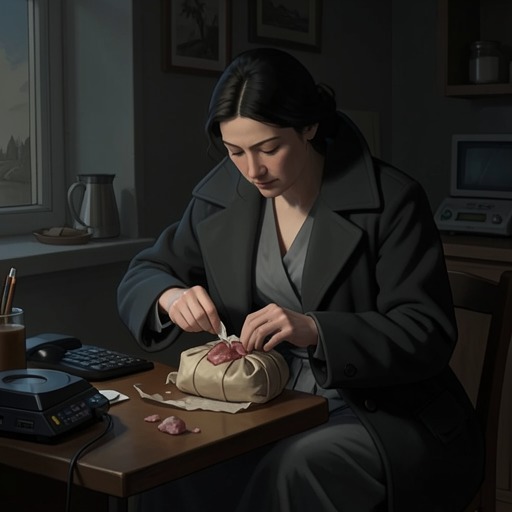
Myriam approaches but does not dare touch it. She concludes that the carcass cannot be a mistake, an oversight, or a joke. It smells of almond-scented dishwashing liquid: Louise has thoroughly washed it and placed it there deliberately, like revenge, like an evil totem. The cleaning is crucial to the gesture. Louise has not simply returned the discarded food; she has transformed it into an object that looks prepared and displayed, set apart from the spotless surfaces around it.
The Children’s Game
Later, Mila tells her mother what happened, laughing and jumping as she explains that Louise taught the children to eat with their fingers. Standing on their chairs, Mila and Adam scraped the bones. The meat was dry, but Louise allowed them to drink large glasses of Fanta while eating so they would not choke. She watched the carcass closely and took care that they did not damage its structure.
Louise presented the meal as a game with rules, promising a reward if the children followed them carefully. At the end, they received two sour candies, a rare permission that makes the episode feel at once playful and unnerving. The children experience a supervised game; Myriam encounters its disturbing object and recognizes it as revenge. That difference in perspective keeps the carcass’s meaning divided between an entertaining event for Mila and Adam and a deliberate challenge to their mother.
Meaning and Consequences
The episode makes domestic labor legible through a rupture in its usual routines. Louise’s cleaning leaves the kitchen immaculate, but the carcass placed on the children’s table unsettles the very order that the cleaning appears to maintain. The object connects food, care, disgust, and discipline: Myriam discarded the chicken to protect her children, while Louise makes the same chicken the center of an activity she controls, complete with instructions, supervision, and rewards.
The retaliatory force lies in the contrast between what Myriam sees and what the children report. To Myriam, the bare bones form a corpse-like, almost accusatory presence; for the children, they are the material of a game. Louise’s close attention to the skeleton and her careful preservation of it distinguish the event from casual play, while the children’s laughter and candy reward allow the act to pass as play in their account. The scene does not resolve the conflict. Instead, it gives that conflict a physical form: a carcass that Myriam had thrown away is washed, returned, and made impossible to overlook.