Louise’s Conflict with Her Landlord, Alizard
Chanson douceLouise’s Conflict with Her Landlord, Alizard is a tense confrontation in her studio, where a collapsed shower gives Bertrand Alizard grounds to accuse her of neglect even as the scene reveals that he built the faulty installation himself. The dispute over repairs unfolds alongside the threat that Louise must leave: the broken floor, the boxes in the entrance, and Alizard’s promise to return with a workman all make the precariousness of her home tangible.
The Visit and the Threat of Departure
One Thursday evening, at about eight, Louise returns to find her landlord waiting in the corridor beneath a bulb that no longer works. Alizard turns his phone screen toward her face, and she raises a hand to shield her eyes. He says he has come several times, in the evening and during the afternoon, without finding her. His approach is physically intrusive: he leans toward her as though he might touch her or take her arm, while staring through yellowing eyes behind glasses attached to a cord.
Louise lets him into the studio. Alizard looks around as though he has not seen the place before, touching the immaculate skirting boards, the sofa cover, and the Formica table. The room appears empty and uninhabited to him. He might have criticized Louise for paying rent late and failing to care for the place, but the studio is exactly as it was when he first showed it to her. His inspection therefore establishes a contrast between the accusations he is prepared to make and the visible condition of the room.
Alizard waits for Louise to speak, pay him, or apologize for failing to answer his letters and messages. She remains by the door, silent. The scene’s stillness gives the exchange an uneven pressure: Alizard expects her to make the first move, while Louise does not offer the explanation or submission he appears to anticipate.
The Boxes and the Collapsed Shower
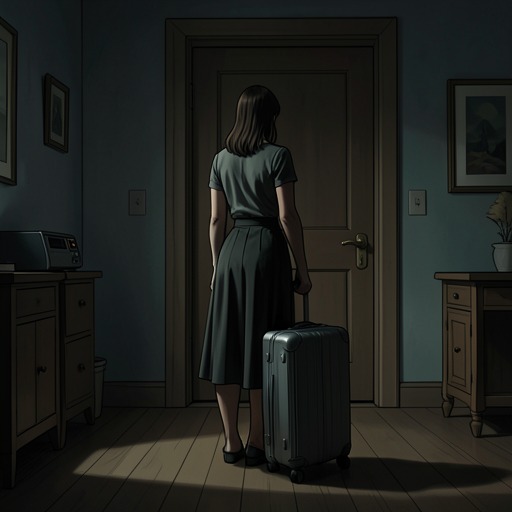
Alizard points to the few boxes in the entrance and remarks that Louise has started packing. He says this is good, because the next tenant will arrive in a month. The boxes turn his expectation of her departure into an immediate fact of the room, even before the argument over the shower begins. They also frame the inspection as more than a routine visit about maintenance: Louise’s tenancy is already being displaced by the prospect of another occupant.
He then pushes open the shower cubicle door. The porcelain basin has sunk as the boards beneath it have rotted and given way. Alizard asks what happened, and Louise says she does not know: it happened a few days earlier, and she thinks the installation is old. His inspection makes the damage visible, but not its cause. The broken shower interrupts the ordinary usefulness of the studio and becomes the object around which landlord and tenant contest responsibility.
Alizard rejects Louise’s explanation. He says he built the shower cubicle himself and that, in the past, people washed on the landing; he insists she should consider herself lucky to have the installation. Louise answers simply that it collapsed. He then calls the damage an obvious failure of maintenance and objects to paying for repairs when, in his view, she let the shower rot. The exchange puts his authorship of the installation directly beside his attempt to assign its failure to her.
Responsibility and Unequal Power
Alizard asks why Louise did not call him and how long she has been living with the damage. He crouches to examine it again, sweating, while Louise stands behind him. His questions could lead to a practical account of when the shower failed, but the encounter does not produce one. Louise has said only that the installation is old and that the collapse occurred a few days before; Alizard turns that limited information into an accusation of neglect.
The dispute takes place within an unequal relationship. Alizard controls the flat and can speak of the next tenant’s arrival, while Louise’s response is confined to a brief account of the failure. Her silence leaves him uncertain about what her closed expression means, but it does not change his power to set the terms of the visit. The material evidence in the room—the collapsed basin, rotten boards, and boxes—allows the scene to hold two problems together: a repair whose cost is disputed and a home whose continuation is already under threat.
The Promise to Return
After the inspection, Alizard goes to the sink, washes his hands, and says he will return in eight days with materials and a workman. He tells Louise that she should finish packing her boxes. His promise to arrange work does not amount to an assurance that she can remain: the repair is paired with a renewed instruction to prepare for departure.
The encounter consequently ends without an agreement about who caused the damage or who will pay for it. Alizard’s announced return gives the broken shower a practical next step, but his earlier statement about the incoming tenant continues to define Louise’s situation. The studio is at once a place he can inspect and repair, and a temporary space from which he expects her to move.
Narrative Significance
The collapsed shower makes a hidden material condition impossible to ignore. The basin has sunk; the boards have rotted; the room’s apparent neatness cannot conceal the failure beneath its fixtures. That physical breach sharpens the conflict over responsibility: Alizard claims that the tenant neglected the shower, while Louise points to the age of the installation and Alizard acknowledges that he made it himself.
The scene also uses ordinary details—the dead corridor bulb, the phone screen raised to Louise’s face, the boxes by the entrance, the basin giving way—to render housing insecurity as a concrete imbalance rather than an abstract threat. Alizard can inspect, accuse, promise repairs, and name a future tenant. Louise stands silent in the studio he owns, with packing already begun and no resolution secured by the end of the visit.