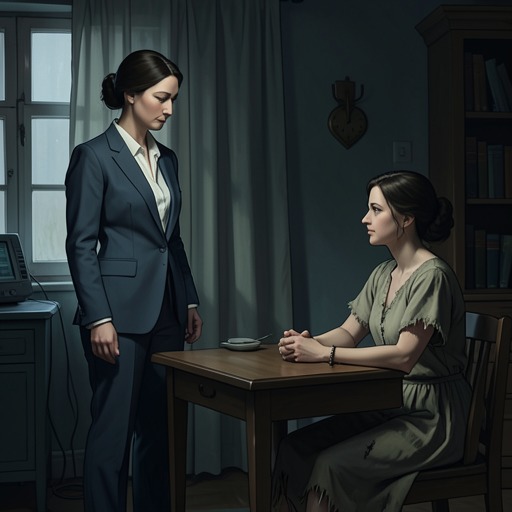
Louise's economic difficulties and debts
Chanson douceLouise’s economic hardship and debt are not a passing difficulty but a force that narrows her choices and deepens her dependence on work, housing, and the Massé family. Behind her composed manner lies a history of displacement, unpaid obligations, and fear: letters accumulate unanswered, her landlord presses her, and even the apartment where she lives feels conditional. Her financial precarity helps explain why employment in the Massé home becomes more than a job, while the household’s growing reliance on her never removes the imbalance between employer and employee.
Housing, work, and accumulated insecurity
After her husband Jacques dies and she is expelled from their home, Louise spends weeks without a settled place before finding a furnished studio in Créteil. An Henri-Mondor nurse who has taken a liking to her helps her find it; the landlord asks for few guarantees and accepts cash. The arrangement provides shelter, but it is founded on limited options rather than security. Louise changes none of the furniture or decoration, and the studio remains a borrowed-looking refuge, a place she has rented because she needed a nest quickly.
Her financial trouble follows her from the home she shared with Jacques to the studio and, eventually, into the Massé apartment. A month before the tragedy, she tells Rose Grinberg that she is in debt, that her landlord is harassing her, and that her bank account is always overdrawn. She offers to work in the evenings or early mornings, when the children are asleep, and names cleaning and ironing among the jobs she could do. The request exposes how little financial margin she has: she is prepared to extend her working hours into the time when other people rest.
The novel sets that need against the arrangements that make domestic employment possible for the Massés. When they recruit a nanny, Paul has prepared interview questions and allotted thirty minutes to each candidate. The couple’s stated requirements include an energetic, available worker who can work so that they can work; Paul also says he does not want an undocumented person caring for the children, while Myriam is disturbed by Emma’s suggestion that a nanny with children of her own would be less convenient. The employers’ search for dependable, flexible care is thus framed by assumptions about who can offer availability and whose family responsibilities count. Louise’s later offer to Rose makes the other side of that arrangement visible: financial need can make early, late, or additional labor seem like the only available answer.
Debt made visible
Louise’s debt is brought into the Massé home through an official letter from the French Treasury. Paul tells her that the agency is asking them to deduct from her salary an amount she apparently owes, and that she has failed to answer its reminders for months. He recognizes that the procedure is humiliating for her, but adds that it is unpleasant for the employers too. The notice turns a private financial crisis into a matter the household can administer through her wages, making the employer-employee relationship a channel through which institutional debt is collected.
The letter’s arrival also triggers a revealing misreading. Louise immediately imagines that Rose has written to denounce her, perhaps for having spent the holiday in the Massé home or received Wafa. She fears that Myriam will believe she has slept in their bed or deceived them. Paul’s explanation that the letter comes from the Treasury brings her visible relief. The contrast shows how debt has become entangled with the fear of exposure: before she knows what the envelope contains, she imagines not an account to settle but a hostile judgment that might cost her the place she has come to depend on.
Louise tries to explain the official notice as a misunderstanding involving a change of address and blames Jacques for being secretive and careless. She denies what the evidence makes plain, and her account becomes confused. The older letters have followed her from Jacques’s house to her studio and finally to the Massé home. They concern bills for Jacques’s treatment, an increased housing tax, and other credit arrears whose origins Louise does not understand. She had hoped that silence would make them stop: if she owned nothing and represented nothing, she thought, perhaps the institutions pursuing the sums would eventually give up.
Instead, the correspondence has grown into a pile of envelopes hidden under the electrical meter. Louise wants to burn them, but cannot make sense of the dense sentences, tables, and columns of figures, whose totals keep rising. Their incomprehensibility is part of their power. Debt is not presented only as a number; it arrives as paperwork Louise cannot interpret, a trail of claims that crosses each boundary she tries to establish between her former home, her rented room, and her place of work.
The cost of staying available
Louise’s desire to remain close to the children meets Myriam’s authority at the end of a working day. After putting them into their pajamas, Louise lingers in their room. Myriam waits in the entrance and tells her that she can leave and that they will see one another tomorrow. Louise wants to stay, even to sleep at the foot of Mila’s bed, promising herself that she would make no noise and disturb no one. The scene connects her attachment to the children with the material insecurity waiting beyond the household: she does not want to return to her studio, where she fears meeting the landlord who rented to her because she was white in that neighborhood and might now regret the decision.
At home, the precariousness is physical as well as financial. Her shower has collapsed after the wood beneath the basin rotted, leaving her to wash at the sink with a washcloth and shampoo her hair while seated on a formica chair. She lies awake imagining that she will soon be forced out of even this degraded apartment, left to live in the street. Debt, housing insecurity, and bodily discomfort therefore converge in the same fear: that the small amount of shelter she has found can disappear, while no alternative is assured.
Louise’s offer to Rose had briefly suggested a possible supplement to her income, but Rose declined to accept it. Her account of the encounter makes clear that the offer was accompanied by urgency and physical insistence: Louise gripped Rose’s arm and said she was not begging, because she could work. The request also leaves an unresolved counterfactual in Rose’s mind; she thinks that, had Louise not gripped her so forcefully, she might have agreed, and that things might then have changed. The novel does not settle what that work would have altered. It does show how a small potential source of paid labor, filtered through a neighbor’s hesitation, could carry extraordinary weight for someone with accumulated debts and no dependable financial cushion.
Dependence and the unequal exchange of time
Louise’s attachment to the Massé home is sustained by an arrangement that quietly expands beyond the clear limits of childcare. After Paul and Myriam return from a party around four in the morning, they find her asleep on the sofa with her legs drawn up and her hands clasped. Paul covers her and asks Myriam not to wake her. Louise begins sleeping there once or twice a week. No one formally discusses the change, but she gradually makes a nest in the apartment. The scene is tender on its surface, yet it also locates her rest inside the employers’ home rather than in the separate studio that is hers by rent alone.
Paul sometimes worries that Louise’s hours are growing longer and says he does not want her to accuse them of exploiting her. Myriam promises to intervene, reproaching herself for not having done so earlier. At the same time, she is privately pleased that Louise performs domestic tasks Myriam never requested. She apologizes when she returns late, and Louise reassures her that she is there for that purpose. Gifts follow—cheap earrings, an orange cake, clothes Myriam no longer wears. Myriam hides new purchases in an old cloth bag until Louise has left, trying not to awaken jealousy or hurt. These gestures show employers aware of the emotional and material inequality, but their delicacy does not correct the underlying dependence or define the expanding labor more securely.
The contrast is sharpened by the Massés’ own crowded schedule. Myriam and Paul describe themselves as overwhelmed by appointments and obligations, moving between work, taxis, and drinks with people important to their careers. Their busy life is treated as evidence of success, and together they become the heads of an enterprise with objectives, income, and expenses. Louise’s time, by contrast, is stretched around their timetable: she arrives very early, waits, stays late, and may sleep on their sofa. The household gains the time and flexibility that allow its members to work, while Louise’s own rest and freedom are less protected.
Her commute adds another measure of that imbalance. On her first day, before six in the morning, she leaves home because she cannot bear to wait there. It takes her more than fifteen minutes to reach the RER station at Saint-Maur-des-Fossés; after arriving at Auber, she takes the metro from Opéra to Poissonnière and reaches the café opposite the Massé building with almost an hour to spare. She waits rather than risk arriving late. The carefully counted journey gives physical form to her effort to remain indispensable: the working day begins well before the work itself, while the fear of losing a job governs how she uses the time around it.
Isolation, informal networks, and the limits of rescue
Louise’s money problems are described most openly not to her employers but to Rose, a neighbor she meets in the street. That encounter is a rare breach in her reserve. At the square, meanwhile, the nannies’ community has its own practical network: it circulates job offers, discusses disputes between workers and employers, and brings complaints to Lydie, its self-appointed president. The square serves as a recruitment office and a union-like gathering place as well as a playground. Such informal support can provide information and a forum for grievances, but the evidence does not show it resolving Louise’s debts or securing her housing.
Louise’s silence among the nannies is itself presented as intelligible. They carry private histories of humiliation, loss, and money requested for children far away; some have stolen small things or concealed their real names. They do not condemn Louise for keeping her own secrets, because they too are wary. The community recognizes the pressures surrounding domestic work without erasing the differences between its members. Wafa, for instance, is undocumented and has a precarious history of dependence on others, while Louise’s crisis is rendered through debts, a landlord, and letters she cannot understand. Their encounters do not make their situations interchangeable, but they place both women within a world where work and shelter can depend on vulnerable personal arrangements.
The debts help clarify the emotional contradiction at the center of Louise’s position. She is necessary to the Massés, whose careers and packed schedules depend on childcare, yet she remains the employee whose wage can be seized and whose departure is expected at the end of the day. The more she gives—additional cleaning, extended hours, nights on the sofa—the more the household becomes a refuge she fears losing. Her financial hardship therefore does not simply explain why she works; it helps reveal how dependence can deepen without becoming security. The bills keep arriving, the sums continue to grow, and the home that offers her a place among the children is still not hers to keep.