Mélancolie délirante de Louise
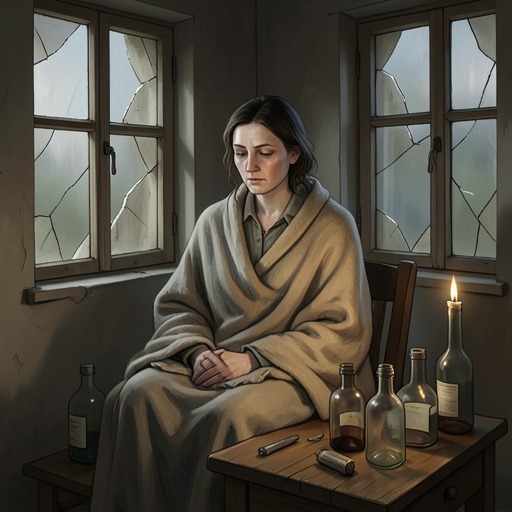
Chanson douceLouise’s “delirious melancholy” is both a medical phrase and a condition of accumulating distress: a state in which exhaustion, dread of bodily decline, hatred of her home, and an intimate life spent at the margins converge. The words briefly give her sadness a form, but they do not make her suffering legible to the people who try to understand her.
A Name for Distress
In a small flower-covered notebook, Louise records the term used by a doctor at Henri-Mondor Hospital: “Mélancolie délirante.” She finds beauty in the phrase. For a moment, it introduces poetry and escape into her sadness, turning a medical description into words she can keep and revisit. Her handwriting is made of crooked, heavily pressed capitals; on the page, the words resemble the unstable wooden structures Adam builds for the pleasure of watching them collapse.
The notebook gives the condition a material trace, but not a stable explanation. Its precarious lettering and collapsing-structure image place Louise’s private record beside a child’s play: both are constructions whose fragility is visible even as they are made. What she can preserve is a phrase, not a clear account of what has brought her to this state.
Exhaustion, Age, and the Apartment
Louise’s distress takes the form of an increasingly consuming fear of old age. For the first time, she imagines a body going wrong and gestures that hurt down to the bones. Medical expenses loom alongside the prospect of becoming bedridden and ill in an apartment with dirty windows. The fear turns into an obsession, binding the future she dreads to the place where she lives.
She hates the apartment. The smell of mold rising from the shower stall seems to reach her mouth; green growth fills the joints and crevices. Although she scrapes at it furiously, it returns during the night, denser than before. The recurrence gives the domestic setting the force of her anxiety: an effort to remove the visible sign of decay cannot keep it from coming back.
Intimacy Without a Room of Her Own
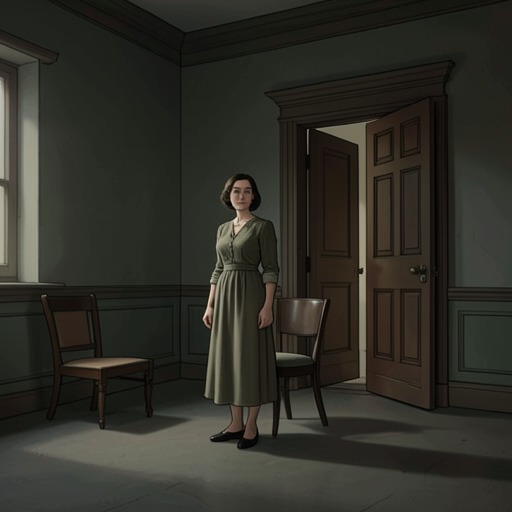
A hatred rises in Louise that disrupts both her servile impulses and her childlike optimism. Her thoughts blur as she is absorbed in a sad, confused dream, haunted by the feeling that she has seen and heard too much of other people’s private lives—an intimacy to which she herself has never had access. She has never had a room of her own. The lack is not merely spatial: it gives her exposure to other people’s domestic intimacy a painful contrast with her own exclusion from it.
The novel presents her condition through overlapping pressures rather than a single disclosed cause. Bodily vulnerability, financial fear, the decaying apartment, and involuntary proximity to other people’s private lives gather into a hatred that unsettles the compliant and hopeful self she has been. Her written diagnosis offers a name, while the remembered absence of a private room points toward the social and emotional deprivation that the name cannot contain.
Investigation and the Limits of Knowing
After Louise’s crimes, Captain Nina Dorval tries to reconstruct the life behind the woman under investigation. She questions the Rouvier family, M. Franck, Mme Perrin, and doctors at Henri-Mondor Hospital, where Louise had been admitted for mood disorders. She spends hours reading the flower-covered notebook, its twisted letters and unfamiliar names, and tracks down neighbors from the time Louise lived in Bobigny, as well as nannies from the square. The answers offer little access: one person remembers only brief greetings, and no one seems to have known Louise closely.
The investigation makes the notebook significant in two different ways. For Louise, the doctor’s phrase briefly gives sadness a poetic shape; for Nina, the pages become evidence in an effort to penetrate a silence that remains largely intact. The gap between those uses reflects the central difficulty of understanding Louise: a diagnosis and a record can be found, but neither by itself makes her private experience transparent.