Mila Massé
Chanson douceMila Massé, daughter of Myriam and Paul and older sister to Adam, is a slight, quick-witted child whose games and clashes with Louise expose the instability beneath the family’s domestic calm. She can be defiant and theatrically self-absorbed, yet she also seeks Louise’s affection; their bond turns on a recurrent tension between intimacy and fear, and an amusement-park disappearance leaves them joined by a secret neither tells her mother.
Identity and Introduction
Mila enters the story within the practical hopes her parents attach to finding a nanny. Before Louise is hired, Myriam imagines taking the children to the carousel and shopping for dinner: Mila would ask for a toy while Adam sucked a piece of bread in his stroller. This ordinary picture of family life is set against the book’s knowledge that Adam is already dead and Mila will soon die. The gap between the anticipated outing and the children’s fate makes Mila’s small requests carry a weight her parents cannot foresee.
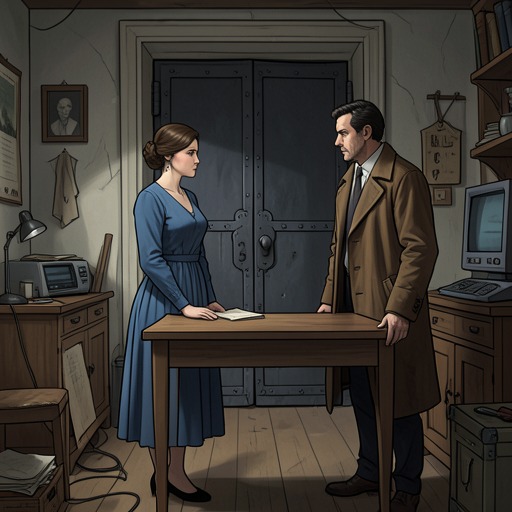
Louise’s first meeting with the family becomes, in Myriam’s later account, an instant choice made by Mila. Just awakened from her nap by Adam’s shrill cries, the girl hides close to Paul’s legs as he carries the baby into the room. Louise takes Adam from him, then pretends she has glimpsed a missing princess. She searches beneath the table and behind the sofa, drawing Mila into laughter. Myriam remembers the scene as proof that her daughter chose the nanny, although the moment also establishes Louise’s particular talent: she approaches Mila through an invented game, giving the child a role and a reason to emerge.
Temperament, Play, and Defiance
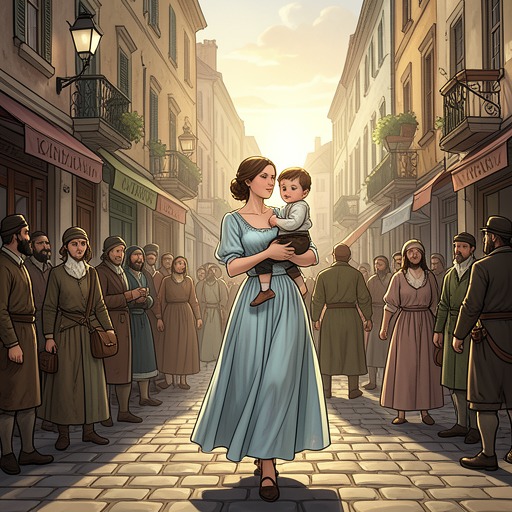
Mila is described as slight, with a dancer’s bearing, but her reserve does not make her compliant. Louise tightens her hair into severe buns that pull Mila’s eyes toward her temples, giving her the look of a cool, noble heroine. In public, Mila answers frustration with screams, throws herself to the pavement, and sometimes lets Louise drag her along while bystanders watch. She knows that an audience embarrasses the nanny and makes her more likely to give way.
Her self-consciousness is unusually vivid. Mila studies her reflection as she cries and keeps her eyes on shop windows while walking, sometimes colliding with posts or stumbling over the pavement. On the way to school she drags her feet, steals a raspberry from a fruit stall, climbs onto window ledges, hides in doorways, and runs away. Louise has to push the stroller while calling after her; Mila stops only at the edge of the pavement. The child’s mischief is not simply an expression of independence: it repeatedly puts Louise in the position of pursuing, pleading, and managing the risk.
Mila’s moods can reverse just as sharply. After frightening Louise, she may return contrite and affectionate, cling to the nanny’s legs, and cry for tenderness. That turn from provocation to reconciliation does not resolve their conflict; it makes their attachment more difficult to separate from the strain Mila deliberately creates. Louise’s investment in the child is tested in public, where Mila’s resistance becomes both a performance and a means of exerting leverage.
Play offers a more imaginative version of their relationship. Louise devises elaborate games of police and thief, inventing settings, costumes, and twists in the plot. She is willing to be imprisoned behind imaginary bars or to chase Mila as the representative of order. Mila sometimes loses interest, while Louise urges the game to continue. Yet the games also reveal how much care Louise puts into constructing a world for her: even recreation becomes a carefully arranged activity in which the nanny supplies the setting and the child is invited to take part.
Louise and the Game of Disappearance
Louise’s favorite game is hide-and-seek, but it dispenses with counting and rules. Without warning, she vanishes into a concealed corner where she can keep the children in sight. She hides beneath a bed or behind a door, holding her breath while Mila and Adam search. At first, the children treat her absence as exciting. Mila claps and shouts; Adam laughs so hard he repeatedly falls onto his bottom. They call for Louise, expecting the game to end with her discovery.
Louise does not answer even when their excitement becomes panic. Adam cries, calls her name, and struggles to understand why she will not emerge. Mila begins to fear that Louise has really left them alone in the apartment, with night coming and no assurance that she will return. She protests that the game is not funny and begs the nanny to show herself. Louise remains hidden, watching their distress without relenting. The scene makes abandonment more than a theme in the children’s play: for Mila, the possibility that the person who cares for her has disappeared becomes an immediate, embodied terror.
Mila gradually learns to search more systematically, pulling doors open, lifting curtains, and looking beneath the bed. Louise responds by finding new hiding places—in a laundry basket, beneath Paul’s desk, inside a cupboard, or in the dark shower stall. When Mila cannot find her, she sobs, but Louise stays still. The game’s repetition changes its meaning: what begins as surprise becomes an experiment in how long the children can endure not knowing whether the nanny is present. Mila’s growing skill at finding hiding places does not end the imbalance, since Louise can always invent another refuge.
The Amusement-Park Separation and Shared Secret
At the amusement park, the three spend time together among rides, gardens, ice cream, and balloons. Louise rides despite her vertigo, holding Adam securely as the train drops into dark tunnels. For their picnic she brings an old wool blanket that Myriam had left in a ball beneath her bed; Louise has cleaned and mended it. All three fall asleep on the grass. When Louise wakes, Adam is beside her, but Mila is gone.
Louise searches in mounting panic, carrying Adam as she circles the rides and the shooting-gallery stand. She cannot answer strangers who ask whether she needs help. Her knees begin to fail, and she struggles to call Mila. At last she sees the child on a bench at the end of an avenue, eating an ice cream beside an older woman who has taken her in. The woman rebukes Louise for allowing Mila to be alone and says she could ask the girl for her parents’ number. Mila slips from the stranger’s arms and runs to Louise instead.
Louise embraces Mila, kisses her neck, strokes her hair, and apologizes for her carelessness. As the woman leaves, Louise tightens her hold until Mila says she is being suffocated and tries to wriggle free. Then Louise warns her never to wander off again, invoking a stranger who could take her away and keep her from her parents. The tenderness of the reunion turns into a threat: Louise uses the child’s fear of being abducted and abandoned to enforce obedience. Mila bites Louise’s shoulder hard enough to draw blood.
That evening, Louise does not tell Myriam that Mila wandered off or that she was bitten. Mila also stays silent, though Louise has not instructed or threatened her to do so. Each now has a grievance against the other, and the concealed episode gives them a secret that seems to bind them together more tightly than before. Their silence does not make the relationship safe; it makes the rupture private, unavailable to the parent who might have understood what happened.
Family, Care, and Foreshadowing
Mila’s place in the household is shaped by her parents’ work and by the labor Louise assumes. Paul and Myriam seek someone energetic and available so that they can work, while Myriam privately resists Emma’s advice to screen out applicants with children of their own. In the interview process, Myriam rejects Malika, a Moroccan candidate, partly because she fears a shared language and religion would create an intimacy she could not control. Mila’s care therefore begins within a system that ranks prospective caregivers by their suitability to employers’ needs, even as Mila herself responds to Louise with a closeness that exceeds a simple service arrangement.
Louise’s care becomes embedded in the family’s daily routines. When Myriam tries to tell her she can leave after the children’s bath, Louise keeps cleaning, folds towels, empties the washing machine, prepares the children’s bed, and begins dinner. She gently pushes Myriam away from the saucepan and urges her to rest and enjoy the children. As Myriam gives over more tasks, Mila no longer asks when her mother will return. Louise grows both nearly invisible and indispensable, sustaining a household whose intimacy depends on work the parents increasingly cease to notice.
The family’s apparent harmony is shadowed by evidence of harm. After Myriam notices a mark on Adam’s bare arm, she asks Louise whether it is a bite. Louise says that she knows about it, has applied cream, and that Mila bit him. The text does not establish the circumstances of this injury in the available scenes, but the explanation places Mila inside a troubling pattern of bites and concealed incidents, recalling her attack on Louise at the amusement park. In the novel’s retrospective frame, the ordinary child who once asked for a toy and ran ahead of the stroller is also a victim of the violence that ends her life. Her story exposes how the rituals of play and care—searching, holding, bathing, protecting—can become entangled with fear and coercion, while adults mistake a household’s smooth functioning for security.