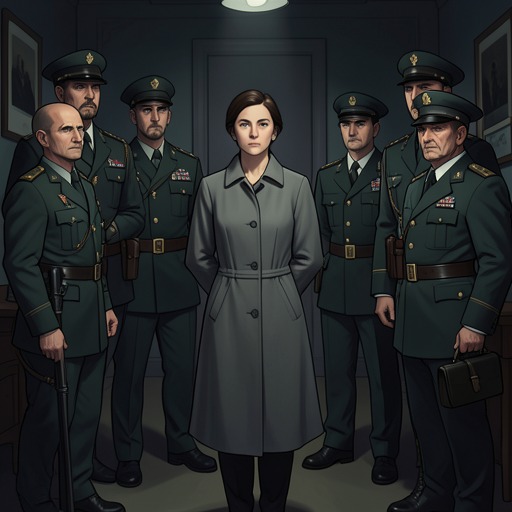
Nina Dorval
Chanson douceNina Dorval is the police captain who leads the investigation into the murders of Mila and Adam Massé. She is both a meticulous custodian of the crime scene and an investigator drawn into the intimate, sealed world of Louise’s life: unable to question the comatose suspect, she reconstructs her past and prepares to inhabit her movements in a reenactment. The case becomes a test of whether accumulated evidence can make a hidden sequence of violence legible.
Identity and Arrival at the Crime Scene
Nina is the first investigator to reach the Massé family apartment after Rose Grinberg’s call. Rose, the children’s music teacher, has already named the suspected killer: the nanny. When Nina arrives, an ambulance has just taken Mila toward the nearest hospital, and onlookers gather in the street, watching the emergency response and asking questions. Nina orders the crowd cleared, including a man photographing the building entrance. Her first actions establish the controlled, procedural manner with which she approaches a scene already exposed to public curiosity.
In the stairwell, Nina meets the rescuers carrying Myriam out. Louise remains upstairs, unconscious, with a small white ceramic knife in her hand. Nina orders that Louise be taken out by the rear entrance. Inside, she assigns tasks to the officers and watches the forensic team work in white coveralls. Her attention is not confined to the obvious evidence: in the bathroom she removes her gloves, puts her fingers into the cold, cloudy bathwater, and traces currents that carry a toy pirate ship. She immerses her arm to the shoulder before an investigator asks her to leave so he can take measurements. The gesture suggests how forcefully the scene pulls her toward its physical details, even as police procedure requires distance.
Reading the Apartment
Nina dictates a close inventory into a recorder: the smell of soap and blood, the television left on and the program it is showing, a crumpled shirt protruding from the open washing machine, a full sink, and the children’s clothes strewn across the floor. Two pink plastic plates remain on the table with lunch drying on them; investigators photograph the coquillettes and pieces of ham. The ordinary remnants of a meal sit beside the evidence of catastrophe. Later, after Nina learns more about Louise and hears of the nanny’s reputation for obsessive neatness, she is struck by the disorder in the apartment. That contrast becomes one more problem for the investigation rather than a detail she can simply explain away.
At the opening of the account, Nina lies awake in her apartment on Boulevard de Strasbourg while rainy August leaves Paris deserted and quiet. The next morning, at 7:30, the hour when Louise used to arrive for the children, the seals on the Rue d’Hauteville apartment are to be removed for a reenactment. Nina has notified the investigating judge, prosecutor, and lawyers, and has announced that she herself will play the nanny. She knows the case better than anyone present and has been at its center since Rose’s call; the decision makes her knowledge bodily and performative, not merely documentary.
Reconstructing Louise’s Movements
The investigation initially has to proceed without Louise. She does not emerge from her coma, and witnesses describe a nanny who had seemed beyond reproach. Nina nevertheless believes there is a gap to find and vows to understand what happened behind the closed doors of childhood. She summons Wafa to police headquarters at 36 and questions her. Wafa weeps and struggles to speak; Nina loses patience and tells her that she is not interested in her immigration papers, work contract, Louise’s promises, or Wafa’s own naivety. She wants to know whether Wafa saw Louise that day.
Wafa recalls arriving in the morning and finding Louise open the door only a little, as though concealing something. Alphonse slips between Louise’s legs and runs to the children, who are still in their pajamas and sitting in front of the television. Wafa tries to persuade Louise to let them go for a walk because the weather is good and the children will be bored. Louise refuses to let her in. Wafa calls Alphonse, who is disappointed, and leaves with him. The account places Louise at home that morning but does not resolve why she refuses the proposed outing.
Rose’s testimony creates a further gap in the day’s chronology: she is certain she encountered Louise in the building hall an hour before the nanny’s nap, and an hour before the murder. If Louise later left the apartment, where she went and how long she remained outside become urgent questions. Police search the neighborhood with Louise’s photograph, questioning people around the square, the café Le Paradis, and the passages of Rue du Faubourg-Saint-Denis. Nina repeatedly watches supermarket surveillance footage, following Louise’s quiet progress through the aisles and studying her small hands as they reach for a carton of milk. The footage turns an apparently unremarkable errand into evidence to be examined frame by frame.
The Search for a Past
After two months of investigation, conducted day and night, Nina begins to feel that she knows Louise better than anyone. The case has expanded beyond the apartment and the hours before the murders into a search through the suspect’s history. Nina questions Bertrand Alizard, whose fear of blood and unpleasant surprises has kept him in the corridor while police search Louise’s studio. The drawers are empty and the windows immaculate; officers find no substantial clue, only an old photograph of Stéphanie and several unopened envelopes.
Nina also questions the Rouviers, M. Franck, Mme Perrin, and doctors at Henri-Mondor Hospital, where Louise had been admitted for mood disorders. She spends hours reading Louise’s flower-covered notebook, whose crooked writing records unfamiliar names with the careful application of a lonely child. Nina tracks down neighbors from Louise’s time in a house in Bobigny and speaks with nannies at the square, but no one seems to have known her well. The replies amount to little more than greetings, with nothing to report. Each inquiry adds particulars to Louise’s surroundings while underscoring how little access other people had to her.
That investigative accumulation does not give Nina direct access to Louise’s mind. She asks a nurse to leave the hospital room and sits alone beside the unconscious suspect, whose neck and hands are bandaged. Nina studies her closed eyelids, gray roots, dry, deeply lined skin, and the faint pulse beneath her earlobe. She does not touch the motionless body. Instead, she speaks to Louise as one might speak to a child pretending to sleep, telling her that she knows Louise can hear her. The scene makes the limits of interrogation plain: Nina can assemble records and testimony, but the person at the center of the case remains silent.
Reenactment and Narrative Role
Nina believes a reenactment can act as a kind of revelation. In her experience, returning to a crime scene may bring a detail into view or make a contradiction finally make sense. The planned reconstruction will take place in the apartment where nothing has changed since the day in May; no one has returned to retrieve belongings or papers. Outside, bouquets and children’s drawings still mark the building, while candles remain around the entrance. Nina will pass them, take the lift, and strike the three opening knocks of the scene she intends to replay.
To perform Louise’s part, Nina anticipates being overwhelmed by the apartment’s disorder and by the sequence of repetitive domestic movements: from bedroom to kitchen, bathroom to kitchen, rubbish bin to dryer, bed to entryway cupboard, balcony to bathroom. She imagines Louise bending down, rising onto her toes, pressing her fingers into her ears against the children’s cries, and taking a knife from a cupboard. She also reconstructs a glass of wine by the open window, with one foot on the small balcony, before the invitation to the children to take a bath. The reenactment is therefore not simply a procedural display: it is Nina’s attempt to test whether the mundane circuit of care, noise, household work, and exhaustion can be followed far enough to illuminate the violence. Yet its hoped-for revelation remains prospective; the evidence presented here ends as Nina prepares to begin it.