No place to go and loneliness
Chanson douceHaving nowhere to go is both a material danger and an emotional condition in the novel: Louise’s grief, estrangement, and precarious housing converge in a loneliness that first erases her from the human landscape, then makes her observe that landscape with painful intensity. Her return from the Massé family’s holiday to an isolated studio in Créteil dramatizes the distance between temporary belonging and a life without secure refuge.
The Meaning of Having Nowhere to Go
An epigraph from Dostoevsky’s Crime and Punishment gives the condition its starkest formulation: “Car il faut que tout homme puisse aller quelque part.” The question that precedes it—whether one understands what it means to have nowhere left to go—returns in the novel as more than a question of shelter. Louise’s circumstances make the phrase concrete, but the deeper wound is the prospect of having no place in which she is expected, recognized, or able to remain.
An earlier epigraph from Rudyard Kipling’s Plain Tales from the Hills offers a related warning about the unseen inner life of domestic workers. A woman who employs Mademoiselle Vezzis judges her as useless and unclean without considering that the nanny has her own life and private troubles. Together, the epigraphs frame Louise’s predicament: other people can depend on her labor while failing to see her as a person with needs and affairs of her own. The problem is not simply that she lacks comfort, but that her presence and private suffering can go unrecognized.
Return to an Empty Life
After the delayed flight from Greece lands in Paris in the early evening, Louise makes solemn farewells to the children, holding and kissing them for a long time. She tells Myriam and Paul to call if they need anything, then watches them head for the airport parking. Louise walks toward the RER alone. In the empty carriage she curses the landscape: the platforms where groups of young people linger, the worn apartment blocks and balconies, and the hostile faces of security guards. She summons memories of Greek beaches, sunsets, and dinners by the sea as if invoking miracles. When she opens the door of her studio, her hands tremble; she wants to tear the sofa cover or punch the window, while pain burns through her and she struggles not to scream.
The studio is not a chosen home. After Jacques’s death and her expulsion from the house, Louise spent weeks wandering before finding a furnished apartment in Créteil through a nurse at Henri-Mondor Hospital who had taken an interest in her. The landlord required few guarantees and accepted cash. The circumstances explain why the room offers shelter without security or attachment: Louise has a roof, but the apartment and its furniture are not an expression of a life she has made for herself.
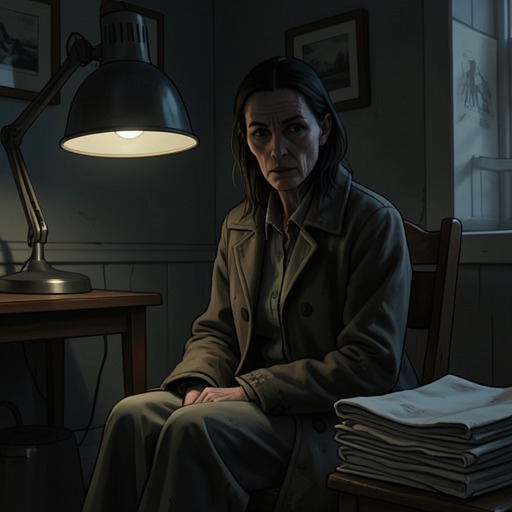
The first weekend after her return stretches that disconnection into time. Louise stays in bed until ten on Saturday, then lies on the sofa with her hands crossed over her chest, staring at dust on the green light fixture. She has fallen asleep in a blue synthetic dress so badly creased that it made her sweat. In the night she wakes unable to tell whether an hour or a month has passed, or whether she is sleeping at Myriam and Paul’s or beside Jacques in the house in Bobigny. She closes her eyes and drops back into a brutal, delirious sleep. The confusion between her former home and the employers’ household registers how little firm ground her present life provides.
Estrangement and the Lost Home
Weekends also summon the history of Louise’s estrangement from Stéphanie. When they lived together, Stéphanie complained that Sundays brought nothing to do and that Louise did not give her the activities she arranged for the other children. As soon as she could, Stéphanie began staying out all night with neighborhood adolescents. She returned hungry in the morning, eating from the containers Louise had prepared for Jacques’s lunches, sometimes standing against the refrigerator door. She dyed her hair red, pierced her nose, and began disappearing for entire weekends. Eventually she did not return.
Louise reported her daughter missing, but was told that running away at that age was common and that she would come back. Louise did not search for her. Later, neighbors told her that Stéphanie was in the south, in love, and moving around; they were surprised that Louise asked neither for details nor for the little information they had. The narrative presents this absence without turning it into a simple reconciliation or a fully explained decision. Stéphanie’s departure is instead tied to her lifelong sense that she was in the way: Jacques was disturbed by her presence, her laughter woke the children Louise cared for, and she made herself press against the narrow hallway wall so others could pass. In time, she acquired what the novel calls a gift for invisibility and disappeared without warning, as if she had always been destined to do so.
Louise’s own departure from the house left another break in the chain of belonging. She packed a suitcase, locked the door twice, and left behind boxes of memories, her daughter’s clothes, and her husband’s schemes. That night she paid a week in advance for a hotel room in the Chinese district, made sandwiches to eat in front of the television, and let fig biscuits melt on her tongue. The hotel is a temporary refuge, but the week paid in advance also marks how precarious that refuge is: it supplies a room, not a settled future.
Solitude in the City
In the hotel room Louise loses her sense of time. She sleeps for hours, wakes with swollen eyes and a painful head in the cold, and goes out only when hunger becomes insistent. Walking through the street, she feels like a spectator absent from a film, watching other people move through a world in which everyone seems to have somewhere to go. The city’s ordinary traffic becomes a measure of her exclusion: other people appear to have destinations, while she experiences herself as a person without one.
That isolation is not only emptiness. The novel describes it as a drug Louise is unsure she wants to give up. Wandering with eyes open until they hurt, she begins to see people with unusual intensity. She studies the gestures of couples at café terraces, the sidelong looks of abandoned old people, and the studied mannerisms of students pretending to revise on a bench. At squares and metro exits, she recognizes the strange procession of people waiting impatiently for appointments, and waits alongside them. Each day brings the company, at a distance, of solitary talkers, disturbed people, and homeless people. Her loneliness makes other lives more palpable, even as it leaves her outside their exchanges.
This perception is sharpened by the imagined alternative of Paris. Louise likes to walk around the Opéra, down Rue Royale and along Rue Saint-Honoré, observing shoppers and shop windows. She wants the suede boots, silk shirts, pink cashmere cardigans, and other goods displayed there, imagining a life in which she could afford to point them out to a saleswoman. On a day when it is too late to go out, she pictures herself instead among people shopping for the new school year, following elegant, hurried women past department stores and brushing through the crowd. These imagined walks do not resolve her isolation; they show how strongly she longs to move unnoticed among people while also wanting the means to belong to the world their windows display.
Precarity and the Fear of Exposure
The return to her studio does not end Louise’s insecurity. One night, after seeing a man crouched in the darkness on her street, she runs upstairs trembling and puts everything in order. She changes her sheets, but the shower has collapsed because the wood beneath the basin rotted, leaving her to wash at the sink with a washcloth. A few days earlier, she washed her hair seated on a formica chair. The damaged fixture turns basic privacy and cleanliness into daily improvisations.
Lying awake, Louise imagines that she will soon be the one out on the street, forced to leave even this squalid apartment and relieve herself outside like an animal. The fear is not presented as a prediction that comes true in this episode; it is the catastrophic future her present instability makes imaginable. The scene connects having nowhere to go with the loss of dignity and privacy, not merely the loss of an address.
The next morning Louise has a fever, chills, and a swollen throat full of ulcers. At half past seven, the phone displays Myriam’s name. Louise reaches toward it and hangs up, then buries her face in the pillow as the phone rings again. Even a possible link to the household that had briefly taken her in does not immediately overcome her physical exhaustion and withdrawal. Across these episodes, refuge remains temporary and belonging remains uneven: Louise can be needed, missed, or invited into a family’s routines without escaping the solitude that waits when she returns to her own room.