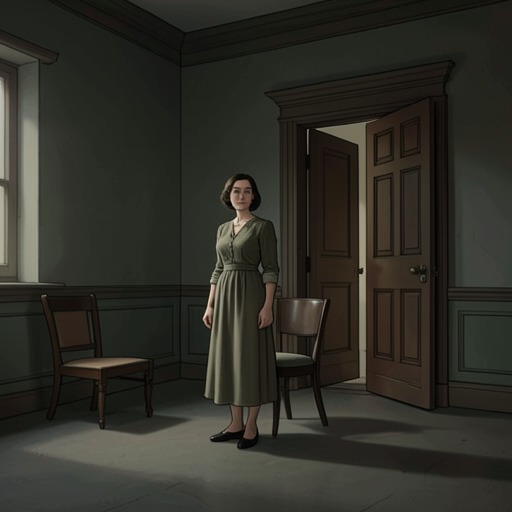
Ritual of daily care transformed into violence
Chanson douceThe transformation of ordinary caregiving into violence is a recurring pattern in Lullaby: acts that make a home feel orderly and safe also become means through which Louise asserts control over the children. From the meticulous work that makes her indispensable to frightening games and the final bath, care is shown not as inherently benign but as an intimate power whose recipient may be unable to refuse it.
Care as Domestic Order
When Louise enters the Massé household, she changes its cramped, disordered apartment into a calm and carefully maintained home. She repairs clothes, washes curtains, changes the bed linen, prepares meals, and keeps track of the children’s schedules and appointments in a flower-covered notebook. Myriam sees the difference as almost magical, and the family comes to depend on the order Louise creates. The work is practical, but it also establishes her authority over the domestic space: she moves objects, reorganizes cupboards, and takes satisfaction in an apartment that seems entirely under her command.
This care answers a real need. Myriam is working late, and Louise makes it possible for her to return to a prepared dinner and calm, cared-for children. Yet the arrangement’s convenience blurs its boundaries. Louise increasingly stays late and sometimes sleeps on the sofa; Myriam is embarrassed by how much unpaid-for help she accepts, while Paul worries that the family may be exploiting her. Myriam apologizes, but Louise insists she is there to help. The household’s comfort thus depends on a relationship in which the extent of Louise’s labor, and the limits of her role, are never fully settled.
Play and the Fear of Abandonment
The change from care to control becomes especially clear in Louise’s games with Mila and Adam. She devises elaborate scenarios, costumes, and imaginary geographies, treating play with a seriousness that can exceed the children’s interest. In hide-and-seek, however, the rules disappear: Louise vanishes without warning and hides where she can watch the children searching for her. She remains silent even as their excitement gives way to distress. Adam cries, and Mila comes to believe that Louise may have left them alone and will not return. The game depends on the children’s fear, while Louise observes rather than reassures them.
Mila gradually learns to search cupboards, lift curtains, and look beneath furniture, but Louise keeps finding new hiding places. The pattern turns the familiar pleasure of finding a caregiver into uncertainty about whether the caregiver is present at all. Its force comes from the imbalance between Louise, who chooses when to disappear and when to end the game, and the children, who cannot know whether the separation is temporary. Play becomes a rehearsal of abandonment rather than a shared activity governed by mutual consent.
Protection That Becomes Possession
A later episode at the amusement park repeats that imbalance in a different form. After Mila strays and an older stranger approaches her, Mila returns to Louise, who comforts her and apologizes for not watching more carefully. But once the stranger has left, Louise holds Mila so tightly that the child asks to be released. Louise then warns her that someone could take her away and keep her from her parents. The warning presents itself as protection, but it uses the prospect of separation to frighten and command the child.
Mila bites Louise in response, and the two keep the incident from Myriam. The silence leaves each with a grievance against the other and binds them together through a secret. In this episode, care cannot be separated cleanly from possessiveness: Louise’s wish to keep Mila close appears as tenderness, but it also denies Mila’s attempt to get free and makes the child responsible for guarding what happened from her mother.
The Final Bath and the Return of Routine
The novel’s most consequential conversion of care into violence is staged through the children’s bath. During the investigation, Nina Dorval reconstructs the afternoon by considering familiar details: whether Adam and Mila enjoyed bathing, whether they usually resisted undressing, and whether a bath at four in the afternoon might have surprised them. She tests the water as she once did for her own children and repeats Louise’s invitation: “Les enfants, venez. Vous allez prendre un bain.” The ordinary words and gesture acquire a different meaning because the reader knows the bath belongs to the events surrounding the children’s deaths.
The reconstruction places routine beside evidence of the crime. Nina enters the apartment, examines the bathwater, and moves her hand through it as if something in the scene draws her toward the bottom. The object that connects the domestic setting to the attack is a small ceramic kitchen knife, a gift from Thomas that Myriam had kept high in a cupboard, away from the children. The bathing ritual is therefore not an incidental detail: it is the form in which an ordinary act of looking after the children becomes part of the fatal sequence.
Meaning and Narrative Function
The novel sets these scenes against Louise’s earlier reputation as an almost miraculous caregiver. She makes the household run, anticipates needs, and allows Myriam and Paul to pursue demanding careers; Myriam becomes accustomed to handing over more of the daily work. The contrast is not simply between apparent kindness and concealed cruelty. The same close attention that makes Louise effective—her command of schedules, rooms, meals, and children—can also leave little space for the children’s refusal or for the employers to recognize the boundaries of her labor and attachment.
Repetition gives the pattern its narrative force. The bath, like meals, cleaning, and play, belongs to the ordinary cycle of family life, but the investigation returns to its gestures after the violence has made them newly legible. Nina’s reenactment makes readers look again at a familiar invitation and recognize the gulf between its reassuring form and its place in the story. Through that reversal, Lullaby presents care as both a necessary relation and a possible instrument of domination when dependence is unequal and intimacy is mistaken for entitlement.