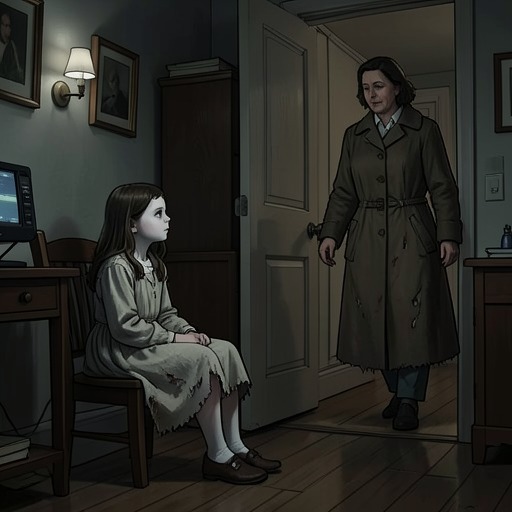
Stéphanie’s Disciplinary Hearing and Expulsion
Chanson douceStéphanie’s disciplinary hearing and expulsion mark the collapse of an opportunity secured through her mother’s employment: the school’s attempt to remove a disruptive pupil becomes, for Louise, a humiliating verdict on her own motherhood, and the journey home ends in violence.
Background and School Difficulties
Louise’s employer, Mme Perrin, had helped Stéphanie enter a Paris secondary school considered better than the one she was expected to attend in Bobigny. The arrangement was presented as a generous opportunity for Louise, who worked hard and was regarded as deserving. But only weeks after Stéphanie began her third year, she repeatedly disrupted class: she laughed, threw objects across the room, swore at teachers, skipped lessons, and smoked cannabis before noon while lying on benches in a square in the fifteenth arrondissement. Her classmates found her both funny and exhausting.
Stéphanie concealed the school’s warnings and meeting requests from Louise. Notes in her correspondence book, disciplinary notices, and summonses to see the headteacher went unanswered; teachers had called Louise’s mobile phone and left messages without receiving a response. The problem therefore reached the hearing not as a single outburst but as a pattern that the school said it had tried, unsuccessfully, to address.
The Hearing
Mme Perrin summoned Louise and told her how deeply disappointed she was. She felt betrayed and said Stéphanie’s conduct had made her ashamed in front of the headteacher, whom she had worked hard to persuade to admit the girl. With the disciplinary hearing approaching, Mme Perrin told Louise that it would be like a trial and that Louise would have to defend her daughter.
At three o’clock, Louise and Stéphanie entered a round, poorly heated room. Large windows with green and blue panes cast a church-like light; around a broad wooden table sat about ten teachers, advisers, and parent representatives. One after another, they described Stéphanie as maladjusted, undisciplined, and insolent. One participant qualified the judgment by saying she was not a bad girl, but that once she started there was no way to reason with her. The adults also questioned Louise for failing to respond to the teachers’ requests for meetings, making her silence part of the case against her.
Louise pleaded for another chance. Through tears, she described caring for her children, punishing them when they disobeyed, and refusing to let them watch television while doing homework. She insisted that she had principles and extensive experience raising children. Yet the hearing’s focus shifted from Stéphanie’s conduct to Louise’s fitness as a mother: as she understood it, she was the one being judged. The teachers, still wearing their coats in the cold room, inclined their heads and assured her that they did not doubt her efforts and believed she was doing her best.
Deliberation, Expulsion, and the Journey Home
The headteacher briefly called Louise and Stéphanie back into the room after the panel had deliberated for barely ten minutes. Louise did not recognize the short wait as a bad sign. The school’s explanation was that Stéphanie remained disruptive and that its staff had failed to channel her despite trying every method available to them. They could not allow one pupil to hold an entire class hostage, the headteacher said, suggesting instead that she might flourish in a neighborhood closer to home, among familiar surroundings. In March, with the winter cold still lingering, an adviser offered help with the administrative arrangements. Louise understood the result plainly: Stéphanie was being expelled.
On the bus home, Louise stayed silent while Stéphanie giggled and watched the window with her headphones in. They walked up the gray street toward Jacques’s house, passing the market. When Stéphanie slowed to look at the stalls, Louise seized her by the sleeve and dragged her onward. Her anger grew darker and hotter as she read her daughter’s casual manner as selfish indifference. At the gate, the disciplinary decision’s consequences erupted into direct violence: Louise punched Stéphanie until she fell, then continued striking and slapping her, pulled her hair, forced her arms away from her face, hit her around the eyes, insulted and scratched her, and spat at her once she stopped moving.
Consequences and Significance
The expulsion’s damage cannot be measured only by the school’s decision. It arrives inside an already unequal relationship: Mme Perrin had used her influence to secure Stéphanie’s place, Louise’s employment framed the place as a favor, and Stéphanie’s conduct was then treated as a betrayal of that favor. In the hearing, the institution’s account of a pupil it could not manage and Louise’s plea for another chance meet across the same table, but they do not carry equal power. The educators decide Stéphanie’s future; Louise can only plead and be assessed in turn.
That reversal sharpens the episode’s central conflict. Louise goes to defend her daughter, yet hears the scrutiny fall on herself, as if her failure to answer messages proves that she is a bad mother. Her appeal rests on the standards she applies at home—punishment, principles, and rules about television—while the school’s decision exposes how little authority those claims give her in the room. The assurance that the staff believe she did her best offers sympathy without changing the outcome: Stéphanie is expelled, and the administrative help offered afterward makes the decision sound settled.
The journey home turns that institutional defeat into violence. The brief, ordinary details—the bus, Stéphanie’s headphones, the market stalls, the gate—make the escalation stark. Louise’s anger is linked to the contrast between her daughter’s giggling, apparently carefree manner and the humiliation Louise has just endured, but the episode does not make that violence equivalent to the school’s judgment or present it as justified. It records a collapse in which Louise’s sense of being judged as a mother gives way to an assault on the child she had gone to defend.
The scene also echoes Louise’s work caring for other people’s children. She can describe herself as experienced and principled in child-rearing, and elsewhere her daily attention to routines, appointments, and household order makes her seem indispensable; here, however, her own daughter’s concealed troubles and the unanswered school messages expose the limits of that competence. The hearing places care, employment, and maternal worth in the same frame, while the beating makes the cost of treating a mother’s identity as a verdict brutally concrete.