Wafa's undocumented immigrant status
Chanson douceWafa’s undocumented status is not a passing biographical detail but the condition around which her life in France is organized: it leaves her dependent on intimate and work arrangements that promise security while restricting her freedom. Through her account to Louise, the novel connects immigration status to sexual vulnerability, a paid sham marriage, and domestic labor whose apparent protection comes at the cost of being unable to refuse an employer.
Arrival and Precarious Beginnings
Wafa is in France without papers and, as she tells it, arrived through a much older man in Casablanca. She had given him massages in a disreputable hotel; he became attached first to her hands, then to her mouth and body. Following her instincts and her mother’s advice, she gave herself to him. He brought her to Paris, where he lived in a shabby apartment and received state money. When he feared she might become pregnant, his children pressed him to put her out, although Wafa says he himself would have liked her to stay. Her arrival therefore offers no secure settlement: dependence on the man who brought her to France ends in eviction when her continued presence becomes inconvenient to his family.
After leaving his apartment, Wafa was taken in by another woman, who registered her on dating sites for young Muslim women without papers. One evening, a man met her at a suburban McDonald’s. He found her attractive and made advances, then tried to rape her. Wafa managed to calm him, and the encounter turned into a negotiation over money. The man, Youssef, agreed to marry her for twenty thousand euros, a sum he described as a cheap price for French papers. The arrangement makes the stakes of her status stark: access to legal security is purchased through a relationship that begins in a dangerous encounter and is explicitly transactional.
Work, Housing, and Dependence
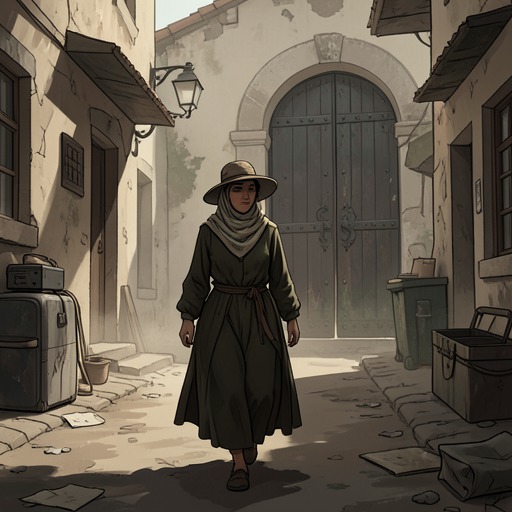
Wafa finds a job with a French-American couple who treat her well but are very demanding. They rent her a room in a maid’s quarters a hundred metres from their home. That accommodation gives her somewhere to live, yet it is also bound to her labor: as Wafa puts it, because they pay the rent, she can never tell them no. The arrangement converts housing into leverage. Her employer’s support is real, but it does not free her to set limits on the work.
The contrast with the Massé household’s search for a nanny shows how undocumented status is also used as a dividing line between acceptable workers and unacceptable risks. Paul says he does not object to employing an undocumented cleaner or painter, since people have to work, but considers it too dangerous to entrust the children to someone who might be afraid to call the police or go to a hospital. His preference is framed as child safety, yet it excludes undocumented women from childcare precisely because their insecure status might inhibit them from seeking help. Myriam has a different objection to Malika, a Moroccan candidate: she fears that a shared language and religion could create an unwanted familiarity and asks Paul not to hire a Maghrebi woman. Their interview process thus reveals employers sorting candidates not only by qualifications but by immigration status, ethnicity, availability, and the kind of intimacy they are willing to permit.
The Marriage and Its Public Appearance
The plan for Wafa and Youssef’s marriage is initially spare and financial: they will go to the town hall, sign the documents, and Wafa will pay him each month until she obtains French papers. Youssef later changes the arrangement, persuading his mother that they should invite a few friends. He wants the occasion to count as his wedding, and thinks a gathering might reassure the immigration authorities. The ceremony is therefore staged as both a private bargain and a public performance designed to appear credible.
Louise serves as a witness for the first time at the town hall in Noisy-le-Sec. Wearing a pale-blue Peter Pan collar and earrings, she signs the document the mayor gives her. The cheers, applause, and wishes of good luck sound almost sincere. The wedding’s public gestures lend the arrangement the look of an ordinary celebration without changing the terms that brought it about. At the restaurant, La Gazelle d’Agadir, the group gathers among music, laughter, and a black sedan decorated with gold plastic ribbons. Wafa sits at the main table, but Louise notices that she is not free to leave it. The celebration gives the sham marriage a visible social form even as Wafa’s constrained place within it remains legible.
Friendship and the Unrecorded Account
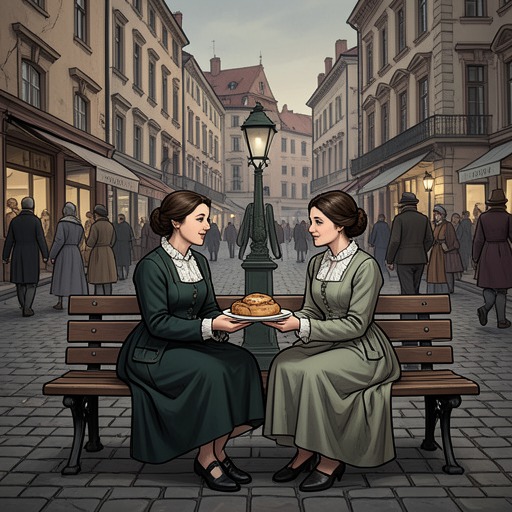
Wafa and Louise meet repeatedly at the square, where Wafa offers pastries and talks freely while Louise listens. Wafa’s confidences are set against the silence Louise brings to the friendship: in her presence, Wafa speaks as though to a priest or the police, recounting details of a life that will never be recorded. Her story survives here through informal speech rather than official documentation, while the papers that might alter her legal position remain something she must pursue through Youssef.
Wafa’s undocumented life also unfolds alongside her affection for children. She loves playing with Alphonse, whose mother employs her, and worries about keeping him warm in the winter cold. Yet she imagines a future in which he grows up, leaves the square for sunny holidays, and is served by one of his own relatives. The tenderness of present-day care exists beside an awareness that the relationship is temporary and unequal: the child she helps raise belongs to a family whose future security is unlike hers.
Significance in the Social World of the Novel
Wafa’s circumstances make visible the precariousness that can be obscured by the everyday routines of childcare. In the square, nannies from many backgrounds share benches and workspaces, while children absorb fragments of their languages and later forget them, along with the faces and voices of the women who cared for them. Wafa’s papers, like the labor and personal histories of these workers, remain largely outside the families’ lasting memory. The novel’s portrait of her status is consequently both specific—an eviction, an attempted rape, a twenty-thousand-euro marriage, rent tied to obedience—and part of a broader pattern in which migrant women’s choices are narrowed by legal insecurity and employer power.
That pattern is not presented as a simple opposition between cruel employers and helpless workers. Wafa says her employers treat her well, and her place to live is real; at the same time, she cannot refuse them. Myriam objects to discrimination against women with children in principle, yet avoids telling Paul that Emma’s advice about excluding nannies with children troubles her, and she herself rejects Malika because she fears cultural familiarity. Across these encounters, sympathy and exclusion coexist. Wafa’s undocumented status reveals how assistance, employment, and apparent inclusion can all be conditional, leaving the worker welcomed into a household or celebration without acquiring the power to determine the terms of her own security.