Event 1
1964 Gatlin massacre and takeover
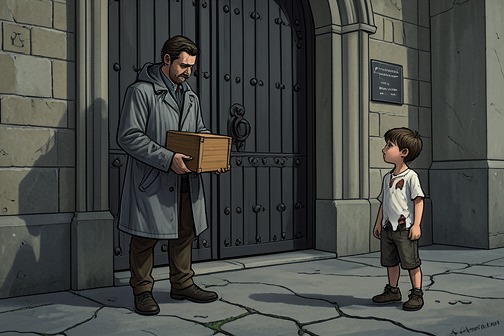
The [1964 Gatlin massacre and takeover](entity:event-recall-event-1964-gatlin-massacre-an-57318231cc5e) began when children in [Gatlin](entity:location-recall-location-gatlin-f5b1a9dfab26), convinced that their community’s survival depended on religious obedience and sacrifice, killed the adults and assumed control of the town. Its consequences lasted well beyond the killings: worship of [He Who Walks Behind the Rows](entity:character-recall-character-he-who-walks-behind-1309718cb722) governed the community, while an age-based sacrificial rule placed a limit on how long any child could remain outside the corn. [Burt Robeson](entity:character-recall-character-burt-robeson-321a2f51bf7f)’s investigation reconstructs the upheaval from altered church signs, religious objects, and a child-written record; the later actions of [Isaac](entity:character-recall-character-isaac-0cf7a5f5888b) and [Malachi](entity:character-recall-character-malachi-0faf6b310916) reveal that the takeover became not a single break with the past but an enduring system of belief, authority, and violence.
## Evidence and Reconstruction
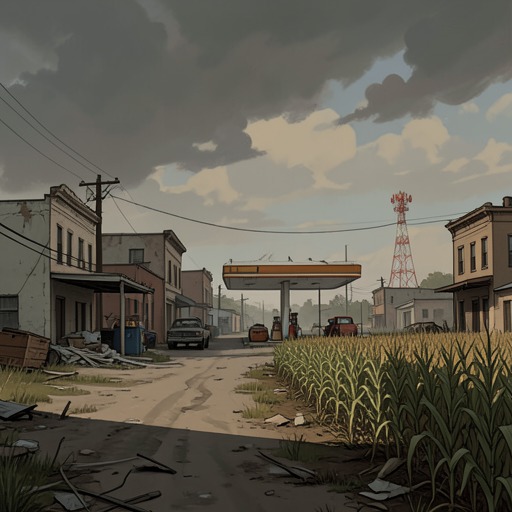
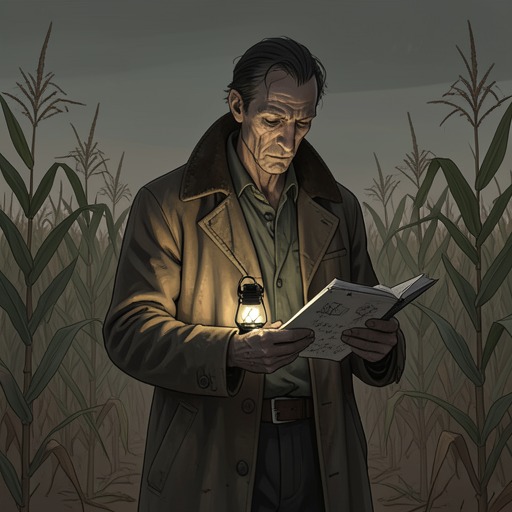
The event is not presented through a complete account of the killings as they happened. Instead, Burt pieces it together in the town years later. In the vestibule of the church, eighteen large wooden letters lie neglected in a dusty pile. Reordering them, Burt discovers that they once spelled [Grace Baptist Church](entity:location-recall-location-grace-baptist-church-d957896867cf). Their removal, and the church’s changed appearance, suggest that the institution has been replaced rather than simply abandoned. He senses that the change is connected to something that happened in [1964](entity:time-recall-time-1964-8bf2f5653675), involving religion, corn, and children.
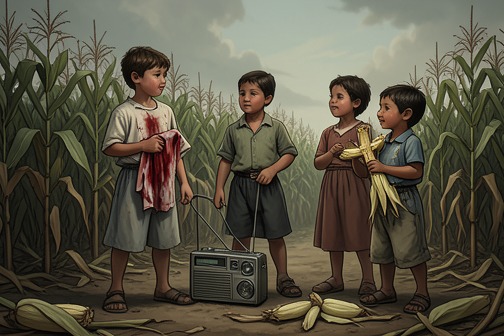
Other remnants point to how the town’s faith took shape. A sermon board announces The Power and Grace of He Who Walks Behind the Rows and bears the date July 24, 1976. In a suitcase, Burt and [Vicky](entity:character-recall-character-vicky-4bc02f6b10d2) find a distinctive devotional object: a crucifix made from dried corn husk, with a miniature cob attached and its remaining kernels arranged as a figure on a cross. In the church, Burt also finds a religious book whose cover declares that the unrighteous must be cut down so that the ground may again be fertile. The object and inscription join Christian forms and language to the agricultural setting, making the corn both the focus of worship and the justification for violent sacrifice.
The evidence is suggestive rather than a neutral chronicle. Burt’s reconstruction draws on the church’s altered identity and a child’s hand in the records, but he frames the origins of the killings as a theory: perhaps the corn was dying, and the children decided that sin and insufficient sacrifice explained its condition. The text supports that proposed connection without establishing every detail of how the children came to believe it. The change is nevertheless clear in its consequences: Gatlin’s religious life becomes centered on a corn god and on the belief that human sacrifice can preserve the community’s favor.
## The Children’s Revolt
Burt identifies Richard Deigan, later known as Amos Deigan, as a central figure in his account of the takeover. Born on September 4, 1945, Deigan took the biblical name Amos in 1964. Burt names Billy Renfrew, George Kirk, Roberta Wells, and Eddie Hollis among Deigan’s friends, along with others, and says that they embraced religion and killed their parents. He describes the killings as having been carried out in different ways, but the underlying fact is the collective destruction of the adult population: the children did not merely change the church’s name or teaching; they removed the adults who had governed their lives.
The age limit was part of Burt’s explanation for what happened next. He links Deigan’s nineteenth birthday, September 4, 1964, to a date recorded in the church book and reasons that Deigan may have been killed as a sacrifice in the corn. Burt also points to Rachel Stigman, formerly Donna Stigman, who had turned nineteen in June, and Moses Richardson, who was about to reach that age. His account suggests that the children’s new order treated nineteen as the end of a person’s permitted life, with the birthday marking a transition from membership in the community to sacrifice. The record does not make every step of that system’s beginnings certain, but its later operation confirms that the prescribed age carried mortal consequences.
## A Takeover Made Visible
When Burt later enters the church, he encounters signs that the new order has become ordinary and public. The church’s sermon board bears the name of He Who Walks Behind the Rows, and the religious writing inside connects the cutting down of the unrighteous with the fertility of the ground. The message makes agricultural prosperity inseparable from moral judgment: in Gatlin’s belief, the condition of the crop and the conduct of the community belong to the same sacred order.
The transformed faith also appears in its material practices. The corn-kernel crucifix gives a familiar Christian image a local substance and a changed emphasis: the body of the figure is made from the crop, while the cross is assembled from husk. Later, when Isaac announces that the sacrificial age has been lowered, the girls make many more corncob crucifixes to ward off further evil. The objects recur across the history of the takeover, first as a sign of the community’s distinctive worship and later as a response to a crisis within it. They do not undo the violence; they show how the children use religious craft and ritual to seek protection under the same faith that demands sacrifice.
Burt’s discovery of the discarded church letters sharpens the contrast between institutional continuity and radical change. The old church has not simply vanished: its vocabulary, books, and forms remain, but they have been reorganized around a different god and a different relation between sin, land, and death. The letters spelling Grace Baptist Church are literally present, yet displaced and forgotten. The children’s takeover thus registers in both doctrine and space: the old name survives as an archaeological trace inside a building whose current religious identity has changed.
## The Age Rule and Its Aftermath
The later revelation about the age limit shows the takeover’s system adapting rather than fading. Isaac, a nine-year-old regarded by the children as a seer, announces that the [Age of Favor](entity:rule-recall-rule-age-of-favor-0da92ffa924d) is being lowered from nineteen plantings and harvestings to eighteen. His pronouncement is presented as the word of He Who Walks Behind the Rows and follows a sacrifice the god has supposedly completed himself. The new limit therefore does not arise as a mere administrative adjustment: it is delivered as divine instruction and changes who is now at risk.
Malachi’s response makes the force of the rule concrete. He has led the hunt for [Japheth](entity:character-recall-character-japheth-a059efd68115), who is thereafter known as Ahaz, cursed of God; Malachi killed him and cast his body out of the corn so that it would not pollute or blight the crop. When Isaac announces the lowered age, the group looks to Malachi and Joseph, the only two among those present who are eighteen. Malachi answers that he obeys the word of God. That response places personal submission inside a collective structure: the group waits for his reaction, and the religious decree has immediate bearing on his own future.
The rule’s consequences extend to the rest of the community as well. There are other eighteen-year-olds back in town, perhaps twenty in all. That night, everyone now above the newly lowered Age of Favor walks silently into the corn and goes to the clearing to seek the continued favor of He Who Walks Behind the Rows. Ruth calls goodbye to Malachi; she is carrying his child and weeps as he leaves without turning back. The scene makes the new limit more than a doctrine: it separates a pregnant woman from the father of her child and sends those who have crossed the threshold toward the place of sacrifice.
## Continuing Violence and Narrative Significance
The takeover’s legacy is also visible in the attack on Burt and Vicky. As children converge on their car, they carry knives, hatchets, pipes, rocks, and hammers; the group’s assault damages the vehicle and leaves Vicky exposed. One boy tells Burt to prepare his soul to stand before God. The religious language that once helped organize the children’s revolt now accompanies another collective act of violence against outsiders. The scene does not repeat the adult killings, but it shows that the community’s inherited boundary between believers and those who enter its space remains enforced through force.
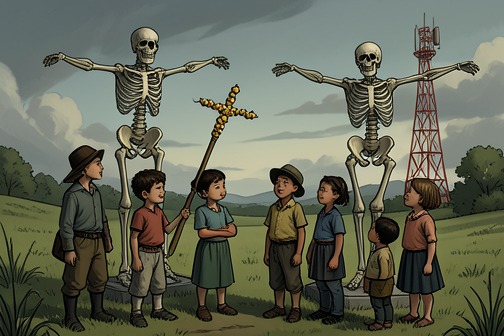
At the story’s end, the children stand in a clearing before two crucified skeletons and two bodies that have not yet become skeletons. Isaac presents this sight as something shown to him in a dream, and the group listens with dread and wonder. The juxtaposition of the bodies with the later revelation of the lowered age limit clarifies the cost of the order established after 1964: the corn’s claim on the community continues, even as the age at which a child must enter it falls. The setting in [Nebraska](entity:location-recall-location-cc9a4ff7018d)’s corn country supplies the religious system with its central image and its purported source of authority. In the takeover’s lasting logic, the crop is simultaneously livelihood, sacred presence, and the ground on which the children’s rule of sacrifice is enforced.
Event 2
Age of Favor sacrifices
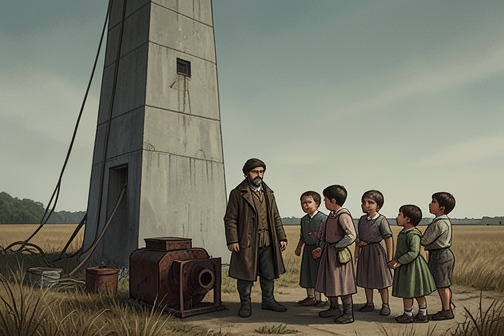
The [Age of Favor sacrifices](entity:event-recall-event-0e93cd2ad5eb) are the age-governed deaths at the center of [Gatlin](entity:location-recall-location-gatlin-f5b1a9dfab26)’s corn religion: members are expected to enter the corn at a specified age and be sacrificed to [He Who Walks Behind the Rows](entity:character-recall-character-he-who-walks-behind-1309718cb722). The practice turns the town’s religious claims into a rule for the community’s future, first setting nineteen as the limit and, after Burt and [Vicky](entity:character-recall-character-vicky-4bc02f6b10d2)’s deaths, lowering it to eighteen. The shift is not merely announced as doctrine: it sends the newly eligible members into the corn that very night.
## Background and the [1964](entity:time-recall-time-1964-8bf2f5653675) rupture
Burt’s account of Gatlin’s past begins with fragments, not a complete history. The church vestibule contains eighteen large wooden letters, discarded in a dusty heap; when he rearranges them, they spell [Grace Baptist Church](entity:location-recall-location-grace-baptist-church-d957896867cf), a name no longer displayed outside. In the sanctuary he finds a book bearing the warning that the iniquitous should be cut down so that the ground may become fertile. A child has written its records of names and birth dates in large, drawn-looking letters, with some writing carefully erased. The entries stop in the period after the names of children born in 1961, and a second book continues the record into 1964 and 1965. Burt takes these signs as evidence of a rupture: something happened in 1964 involving religion, corn, and children.
He reconstructs the event as a hypothesis while speaking to Vicky. Richard Deigan took the name Amos in 1964; on his nineteenth birthday, September 4, 1964, he and other young people may have killed the adults in Gatlin. Burt suggests that they believed the corn was dying because the community had sinned and failed to offer enough sacrifice. He further infers that the young people decided no one among them should live past nineteen, and that Amos himself may have been sacrificed on reaching that age. The account is explicitly conjectural: Burt presents it as a story he has pieced together from the records, not as an eyewitness history.
The church and its discarded name mark how thoroughly the town’s religious order has changed. A sermon board outside displays a message about the power and grace of He Who Walks Behind the Rows, dated July 24, 1976, while the old church letters lie unused inside. The book’s language of fertility, the corn-centered devotion, and Burt’s deductions connect religious authority to the harvest and to the killing of people judged to have reached the end of their permitted lives. The surviving records show the traces of a new order without supplying a complete account of how it was established.
## The rule and its signs
The original threshold is nineteen plantings and harvestings. Burt’s reconstruction makes that number concrete through Amos: born Richard Deigan on September 4, 1945, he would have turned nineteen on September 4, 1964, the date Burt associates with the upheaval. Burt also considers later ages in Gatlin. Rachel Stigman, formerly Donna Stigman, has just turned nineteen; Moses Richardson, born July 29, will reach nineteen in three days. Burt understands that these birthdays may place them in danger under the town’s rule.
The faith has visible objects as well as spoken doctrine. In Vicky’s suitcase, Burt finds a small crucifix made from dry corn husk and cornsilk, with a dwarf cob as its body. Most kernels have been removed, leaving a figure in relief: kernels form its eyes and limbs, and the letters INRI appear above it. Its careful construction joins Christian imagery to the crop on which Gatlin’s worship is organized. After the age limit is lowered, the girls make many more corncob crucifixes, now explicitly as protection against further evil. The object’s meaning thus shifts from a striking emblem of the town’s hybrid faith to a practical response to the danger that follows the new decree.
Burt also encounters the religion in broadcast form. A nearby radio station carries a sermon on atonement and salvation, and its transmission leads him to spot the station’s red tripod tower beyond the corn. The sermon, the church board, the condemning book cover, the birth records, and the corn-made crucifix are different kinds of evidence, but together they show a belief system embedded in public speech, written records, sacred objects, and the town’s treatment of age.
## The attack and the revised decree
The immediate crisis comes when the children converge on Burt and Vicky’s car while Burt is inside the church. The girls wear long brown wool garments and faded sunbonnets; the boys wear black and round-crowned hats. They carry knives, hatchets, pipes, rocks, hammers, and other rural implements. The children damage the car and try to pull Vicky from it. Burt runs to intervene, but the evidence of the attack includes no account here of its full course or of every participant’s fate. The later revelation establishes its consequence for the religious rule: Burt and Vicky’s deaths are described as a sacrifice that the deity itself has completed, rather than an offering conducted according to the accepted procedure.
The revised doctrine is delivered through [Isaac](entity:character-recall-character-isaac-0cf7a5f5888b), the nine-year-old Seer. A year earlier, [David](entity:character-recall-character-david-a0465b0b2f3d), then nineteen, had walked into the corn on his birthday; Isaac became the Seer after the corn took him. Now Isaac tells the assembled children that he dreamed of the Lord as a shadow walking behind the rows. In the dream, the deity says it is displeased with this sacrifice and distinguishes the deaths of Burt and Vicky from the sacrifice made in the appointed place. Isaac’s account invokes an earlier episode involving the Blue Man and a false minister who escaped, but does not explain those events further.
Isaac then announces that the [Age of Favor](entity:rule-recall-rule-age-of-favor-0da92ffa924d) has been lowered from nineteen plantings and harvestings to eighteen. The ruling presents a new age threshold as the divine response to the deaths, and the group receives it with dread and wonder. Those gathered turn their attention to [Malachi](entity:character-recall-character-malachi-0faf6b310916) and Joseph, the two eighteen-year-olds among them; Isaac says there may be about twenty others of that age back in town. The rule therefore changes the stakes for a wider group than the two youths present. Malachi says he obeys the word of God, and the corn appears to approve, reinforcing the impression that the new decree is accepted as both religious command and communal law.
## Consequences and meaning
That night, everyone who is now above the Age of Favor walks silently into the corn and toward the clearing, seeking the continued favor of He Who Walks Behind the Rows. The altered rule has an immediate, collective consequence: those who would have been permitted to live until nineteen are now subject to the sacrifice at eighteen. Malachi leaves without turning back when Ruth calls goodbye. Ruth is pregnant with his child and watches him go; his departure makes the decree a personal separation as well as a public act of obedience.
The ceremony is presented as part of a cycle, not as an isolated death. David’s earlier entry into the corn on his nineteenth birthday provides a precedent for the former limit, while the group’s silent departure after Isaac’s pronouncement establishes the lowered age as the new practice. Corn-made crucifixes follow as an attempted defense against further evil, even as the community obeys the rule that sends its members into the crop. The resulting tension is central to the custom: the corn is at once the source of the community’s religious authority, the destination of its sacrifices, and a presence feared by those who remain.
The Age of Favor also turns a fragmentary history into an operating institution. Burt’s reading of discarded church letters and altered records lets him infer how the town’s order may have begun; Isaac’s vision then supplies an authoritative explanation for why its age limit changes. These accounts are not equivalent forms of proof: Burt is reasoning from incomplete traces, whereas the children treat Isaac’s dream as divine instruction. Together, they show how the town’s violence is bound to an age rule that can be reinterpreted and tightened, while the corn and its deity remain the final authority invoked to justify the change.
Event 3
Burt and Vicky’s attack and sacrifice in Gatlin
[Burt and Vicky’s attack and sacrifice in Gatlin](entity:event-recall-event-1bb7a0331bb4) is the violent culmination of their discovery that the town’s children have built a religious order around [He Who Walks Behind the Rows](entity:character-recall-character-he-who-walks-behind-1309718cb722). The assault destroys their attempt to investigate the community as outsiders: [Vicky](entity:character-recall-character-vicky-4bc02f6b10d2) is taken, Burt dies in the corn, and the children interpret the deaths as a sacrifice that authorizes a change to their rules.
## Causes and Background
Burt and Vicky approach [Gatlin](entity:location-recall-location-gatlin-f5b1a9dfab26) through signs that turn ordinary religious forms into evidence of a distinct local faith. A sermon heard over the radio speaks of atonement and salvation, while the station’s proximity is confirmed by a red tripod tower visible above the corn. Its broadcast places religious language within the same agricultural landscape that governs the town’s life.
A corn-made crucifix provides a more intimate clue. Crafted from dried husk and a small cob, it bears a figure shaped from the kernels left on the cob, with the letters INRI raised above it. The object adapts a familiar Christian emblem to corn, suggesting how the town’s belief has reshaped inherited religious symbols around its own sacred crop.
The church supplies a further warning. Its sermon board announces the power and grace of He Who Walks Behind the Rows, dated the previous Sunday, July 24, 1976. Inside, Burt finds a book whose cover declares that the iniquitous should be cut down so the ground may again be fertile. Together, the sign and the book connect the community’s theology to the land and to the justification of violence; Burt recognizes a single governing idea behind them, though he does not accept its terms.
## The Attack and Vicky’s Disappearance
The church’s warnings become immediate when Vicky sounds the Thunderbird’s horn continuously. Burt rushes outside to find children converging from several directions: side streets, the town green, and the school playground. Their old-fashioned clothing gives the gathering a coordinated appearance, but their weapons are ordinary rural tools—knives, hatchets, pipes, rocks, and hammers. The contrast between their youthful faces and their purposeful approach makes the assault seem less like a spontaneous disturbance than the enforcement of a shared order.
The children surround the car and batter it until its ornament falls away, its tires are slashed, and its windows break. Vicky crouches inside, trying to fend off hands reaching through the shattered glass; when the driver’s door is pulled open, she clings to the steering wheel. Burt had called for her to get the shotgun, but she is too panicked to respond. He runs toward the car, only to be struck in the arm by a knife thrown by a red-haired boy. The attack has divided the pair: Vicky is trapped at the vehicle, while Burt is wounded outside it.
The red-haired boy tells Burt to prepare to stand before God, then reaches for him. Burt pulls the knife from his arm and uses it against his attacker, who dies in front of the watching children. The sudden reversal interrupts the assault but does not restore Burt’s control of the situation. The group falls silent, and he notices that Vicky has disappeared. When he demands to know where she has been taken, a boy answers only with a gesture drawing a blade across his own throat. The children do not explain her fate; their sign makes the threat unmistakable.
## Death in the Corn and Communal Aftermath
Burt searches for Vicky in the corn, where he finds that the children have displayed her at the clearing as a sacrifice. Nearby stand two older skeletons: one in a minister’s surplice and another in a police uniform marked as a chief’s. Their presence links the couple’s fate to earlier victims and to Gatlin’s past, while the clearing’s status as the sacred place of He Who Walks Behind the Rows turns the discovery into a passage from human violence to supernatural danger.
The corn rows close behind Burt, leaving him without an exit. Something immense approaches through the crop and enters the clearing, described as green and bearing enormous red eyes. Burt screams, but the narration says he does not scream for long. The encounter ends his attempt to escape and leaves him dead alongside Vicky; the event’s progression—from a public assault in town to an isolated death in the corn—makes the clearing the culmination of the children’s attack and the domain of the power they serve.
At midday, the children gather again in the clearing, looking at the couple’s bodies and the two older skeletons. [Isaac](entity:character-recall-character-isaac-0cf7a5f5888b), nine years old and already recognized as the Seer since the corn took [David](entity:character-recall-character-david-a0465b0b2f3d) a year earlier, presents the deaths as a revelation: the couple’s sacrifice, he says, was completed by the deity itself. He also identifies them with the Blue Man and the false minister who had escaped many years before, making the new deaths part of Gatlin’s remembered religious history rather than an isolated act.
Isaac declares that the [Age of Favor](entity:rule-recall-rule-age-of-favor-0da92ffa924d) will now be lowered from nineteen plantings and harvestings to eighteen. The change converts the deaths into a rule governing the community’s future: those who have reached eighteen are now subject to sacrifice. [Malachi](entity:character-recall-character-malachi-0faf6b310916) and Joseph are the only two members of the gathered party at that age, and the others wait for Malachi’s response. Malachi, who had led the hunt for [Japheth](entity:character-recall-character-japheth-a059efd68115) and killed him before casting his body out of the corn, accepts the decree as the word of God.
The aftermath extends beyond that gathering. In the following weeks, the girls make many corncob crucifixes in an effort to ward off further evil, turning the corn-made emblem found earlier into a repeated protective object. That night everyone already above the lowered age limit walks silently into the corn toward the clearing to secure continued favor. Ruth, pregnant with Malachi’s child, calls goodbye and weeps as he goes; he does not turn back, and the corn swallows him. The community thus absorbs Burt and Vicky’s deaths by renewing its rites, making sacrifice both the consequence of the attack and the mechanism through which Gatlin enforces its altered order.
## The Rule Change and Its Consequences
At midday, the children gather again in the clearing, looking at Burt and Vicky’s bodies alongside the two older skeletons. Isaac, nine years old and already recognized as the Seer since the corn took David a year earlier, presents their deaths as a revelation: the sacrifice, he says, was completed by the deity itself. He identifies the couple with the Blue Man and the false minister who escaped many years before, folding their deaths into Gatlin’s remembered religious history rather than treating them as an isolated attack.
Isaac then declares that the Age of Favor is lowered from nineteen plantings and harvestings to eighteen. The decree turns the deaths into a rule for the community’s future: those who have reached eighteen are now subject to sacrifice. Malachi and Joseph are the only two among the gathered children who are eighteen, and the others wait for Malachi’s response. Malachi, who led the hunt for Japheth, killed him, and cast his body out of the corn to prevent it from polluting the crop, accepts Isaac’s pronouncement as the word of God. The community’s violence thus becomes not only punishment but a mechanism for changing the institution that governs its members.
In the following weeks, the girls make many corncob crucifixes to ward off further evil, repeating the corn-shaped religious emblem Burt and Vicky had encountered before the attack. That night, everyone already above the lowered age threshold walks silently into the corn and toward the clearing to gain continued favor from He Who Walks Behind the Rows. Ruth, pregnant with Malachi’s child, calls goodbye and weeps as he leaves; Malachi does not turn back, and the corn swallows him. The aftermath shows the community absorbing Burt and Vicky’s deaths by renewing its rites: the sacrifice leads directly to a stricter age rule and to the silent departure of those newly condemned by it.
Event 4
Lowering of Gatlin's sacrifice age limit
The lowering of [Gatlin](entity:location-recall-location-gatlin-f5b1a9dfab26)’s sacrifice age limit is the decree that moves the community’s threshold for sacrifice from nineteen harvests to eighteen. Announced by the nine-year-old seer [Isaac](entity:character-recall-character-isaac-0cf7a5f5888b) after the latest killing, the change converts the children’s account of divine displeasure into an immediate demand: everyone already eighteen must enter the corn that night, including [Malachi](entity:character-recall-character-malachi-0faf6b310916), the leader who had helped enforce the community’s rules. His pregnant partner Ruth’s farewell makes the decree’s cost personal, while the group’s acceptance shows how swiftly a pronouncement attributed to [He Who Walks Behind the Rows](entity:character-recall-character-he-who-walks-behind-1309718cb722) becomes collective action.
## The decree and its religious grounds
The announcement comes in the clearing, where the children stand before two crucified skeletons and two more recent victims. Isaac says that in a dream the Lord appeared as a shadow walking behind the rows and declared himself displeased with the sacrifice. The image joins the community’s central divine figure to the corn itself: the authority that sets the rules is understood to move within the fields that surround and sustain Gatlin.
Isaac presents the change as a response to sacrilege, not as a practical adjustment. In his account, the Lord had provided a designated place for killing and shown the community favor, but a man’s action had violated that order; the Lord had therefore completed the sacrifice himself. The pronouncement invokes the Blue Man and a false minister who escaped many years earlier as precedents. The threat of divine judgment thus reaches backward as well as forward, placing the latest event within a history of transgression and punishment.
## From nineteen harvests to eighteen
Isaac states the new rule in exact terms: the [Age of Favor](entity:rule-recall-rule-age-of-favor-0da92ffa924d) is lowered from nineteen plantings and harvestings to eighteen. The threshold is measured in cycles of cultivation, binding the community’s reckoning of age to the agricultural time of the corn. A single year is removed from the interval before sacrifice, but the consequence is immediate rather than gradual: those who have already reached eighteen fall under the decree at once.
The children’s attention turns to Malachi and Joseph, the two eighteen-year-olds in the group. About twenty others of that age remain in Gatlin, so the change extends beyond the gathering and threatens a larger cohort. The decree does not leave a transition period or distinguish between those who had helped uphold the community and those who had not. Its arithmetic makes the boundary plain, and the gathered children wait for Malachi’s response as the one who had led the hunt for [Japheth](entity:character-recall-character-japheth-a059efd68115).
## Malachi’s submission and the night procession
Malachi answers that he obeys the word of God. His response gives the announcement public assent from a figure who has exercised authority within the group: he had led the pursuit of Japheth, later called Ahaz, and had killed him before casting his body out of the corn to prevent its polluting or blighting the field. Now Malachi accepts the same religious order as a sentence upon himself. The corn seems to sigh approval, an apparent sign within the scene that the community reads the decree as confirmed.
That night, everyone already above the new Age of Favor walks silently into the corn and toward the clearing. The narration gives no separate account of each person’s departure; instead, the collective procession makes the ruling’s effect visible in a single movement. Among those leaving is Malachi. Ruth calls goodbye and waves, while her pregnancy makes clear that she carries his child. He does not turn back. The corn swallows him, converting a rule announced in a dream into an irreversible separation for the people who have crossed the revised age threshold.
## Ritual aftermath and the community’s future
In the weeks that follow, the girls make many corncob crucifixes in the hope of warding off further evil. The objects echo the corn-based religious imagery already present in Gatlin, but their stated purpose is defensive: the community responds to the latest sacrifice and the new decree by multiplying protective tokens. That response does not undo the rule. It shows how the announcement continues to shape ordinary practice after the night of the procession.
Ruth turns away crying and secretly hates the corn, while also fearing the presence she believes watches from within it. Her private resistance contrasts with the public obedience of Malachi and the silent procession. At the same time, her fear reflects the force of a faith that treats even concealed thoughts as visible to its god. The lowered threshold therefore changes more than the timing of sacrifice: it draws those already eighteen into the fields, reinforces the authority of the corn’s religion through ritual and submission, and leaves those who remain to live under a rule newly demonstrated to reach into private life as well as communal ceremony.