Anonymous online friendship
Cinder & EllaAnonymous online friendship is the intimate, sustaining bond between Ella and Cinder, formed through two years of almost constant email before they ever meet or speak by phone. Their correspondence gives Ella companionship after bereavement and upheaval, and later becomes the fragile bridge back to a friend she believed lost. Yet its anonymity is both refuge and obstacle: Ella can be candid in writing while hiding the injuries and fears that make an in-person meeting seem dangerous, and Cinder’s affection grows without his knowing what happened to her.
Formation Through Shared Stories
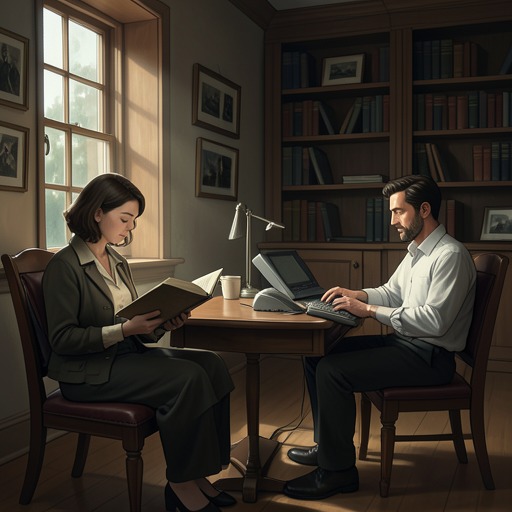
Cinder finds Ella through her blog, Ellamara’s Words of Wisdom, where she reviews books and films. Ella began the blog at fifteen and is approaching its third anniversary when Cinder asks about the occasion. Their shared devotion to the fantasy series The Ash Chronicles helps establish the connection. Ella chose the name Ellamara after the series’ druid priestess, a character her mother loved enough to name her daughter after; Ella takes pride both in the name and in her mother’s preference for Ellamara over the more popular warrior princess, Ratana.
Their first point of contact is disagreement as much as affinity. Cinder initially writes to argue that Princess Ratana is a better match for Prince Cinder, while Ella considers Ellamara the more compelling, underestimated character. He goes on to disagree with most of her reviews. The recurring disputes give the friendship a lively form: they can challenge each other without the exchange becoming hostile, and their shared fandom offers an enduring subject to return to.
The bond is emotionally significant well before it is embodied. Ella describes Cinder as her best friend in the world after her mother, despite never having met him or heard his voice. The relationship is built from repeated written attention: reviews, counterarguments, jokes, and personal messages. In place of face-to-face familiarity, each learns the other through habits of expression and the subjects that reliably draw them into conversation.
The Gift and the First Rupture
As the blog’s third anniversary approaches, Cinder asks Ella for her address because he has obtained a gift for her. For him, the request marks a decisive step beyond their established anonymity: he wants to give her something that might win her heart, and hopes their connection can become more. Ella calls him a creepy internet stalker, believing the remark to be a joke. He takes it as one, but she does not answer again.
The silence soon acquires a meaning neither friend can correct. Cinder first supposes that Ella’s phone has died; after a day without a reply, he worries that his request frightened her. When her regular Friday blog post also fails to appear, he recognizes that something is seriously wrong. He sends message after message and waits for a reply or for the blog to resume. After a month without a word, he concludes that Ella must have died. He grieves for his best friend and for the girl he has fallen in love with, not knowing that she is alive and unable to write back.
Ella’s absence is caused by catastrophe, not rejection. She has been in a car accident, spent time in a coma, and then endured a long hospitalization. Her mother died in the crash. Afterward Ella moves in with her father and his family; her old home is cleared and rented out before she is discharged, and she misses her mother’s funeral. She does not reconnect with old friends or resume her blog. The break in correspondence therefore records the abrupt destruction of her former life, while Cinder experiences the same break as an unexplained loss.
Reconnection as a Lifeline
When Ella eventually writes to Cinder again, she explains the accident and the long silence. He answers in less than five minutes. His reply relaxes her whole body: it is unmistakably the same friend, still eager to talk. The speed and familiarity of that response turn the act of sending one email into a small return to life. Ella feels that a part of her dead heart has awakened and that, for the first time since the accident, she can breathe properly again.
Cinder has postponed a date to speak with her. He dismisses the date as tiresome and tells Ella that she mattered more; then he responds to what she has disclosed with alarm and concern. He remembers how close she was to her mother, is shocked that she had to move in with a father she had not seen for years, and is angered that her father sold her books. He offers practical solidarity in the language available to him: he asks what he can do, imagines flying out to get her, and even threatens to punch her father. Ella’s overwhelming loneliness lifts. The darkness has not disappeared, but she is no longer alone in it.
Before the accident, their messages had already served as Ella’s private means of enduring school. When classmates tease her from a distance, she keeps her head down, completes her work, and holds back tears until she can lock herself in her room. There she cries and writes to Cinder. His foolish stories and irreverent comments about books and films draw her into answering him, and the exchange repeatedly helps her feel better.
Cinder sometimes asks about the crash, Ella’s mother, and her new family. Ella cannot yet speak about those subjects. She tells him she is fine or says she does not want to discuss anything sad; he does not press, instead steering the conversation toward what he knows will make her laugh. She calls him her sunbeam and the one thing keeping her from falling apart. His restraint is part of the support: he remains present without demanding a disclosure she cannot manage.
Intimacy, Secrecy, and the Fear of Meeting
The renewed correspondence revives Ella’s wish to know the person behind the screen. She wants to give Cinder a face, hear the laughter behind his typed “LOL,” and discover how his voice sounds when he calls her Madam. But she also knows that meeting could intensify feelings she already has. Her mother once feared Ella might fall in love with him; Ella now recognizes that she has, and believes she has loved him for a long time.
That longing collides with the conviction that Cinder would not want her once he saw her scars. Ella imagines that, although he might remain her friend, he could be ashamed of her or reluctant to introduce her to attractive friends. She fears he might look away as Jennifer does, or regard her as an obligation as her father seems to. These are anticipations shaped by rejection and stigma, not knowledge of Cinder’s response. Still, they govern her choices: a meeting cannot be undone, and she is afraid of losing the one friend she believes she has.
After their first renewed conversation, Ella withholds the truth that she now lives in Los Angeles and does not suggest meeting. When Cinder asks whether she will keep writing, she promises she will if she can. He logs off glad that she is safe; Ella is left with guilt because silence about her circumstances feels like a lie. Alone, she tells herself that perhaps one day she will find the courage to face him. The hope is genuine but deferred: the friendship has resumed, while the conditions for meeting remain unresolved.
From Private Correspondence to Public Exposure
The novel later reveals how the friendship’s private intimacy becomes vulnerable when Cinder’s public identity enters it. Ella recognizes that Cinder is connected to Hollywood and suspects he has used those connections to arrange a birthday distraction for her. Her friends Vivian and Rob disagree about whether he was behind the gesture, while Ella reasons that he knew her birthday and had access through his father’s position in the film industry. The online friend she once knew only through messages is now entangled with celebrity and public attention.
When Ella and Cinder are together in person, the central concealment becomes explicit. Ella tells him she cannot hide her injuries from his fans or the people managing his career; she believes they would not accept her, and she doubts she could withstand the attention or having the world learn what she has endured and done. Cinder cries as she speaks. He tells her that she has survived something terrible and should not be ashamed of her scars, but his changed expression unsettles her. Once he knows the truth, Ella fears he sees her not as the friend he knew through email but as a damaged person liable to collapse.
That fear helps drive her later refusal to begin a relationship with him. Ella imagines her suffering, her mother’s death, the accident, and her suicide attempt becoming public entertainment if reporters expose her scars and identity. She also recalls the public hatred that followed their brief involvement and the false impression that Cinder had to create to protect his career. In therapy, she acknowledges that she still wants him and would run back to him if the public accepted her, but she believes renewed intimacy would again make her a target and endanger his career. The anonymity that once allowed affection to grow at a safe distance cannot protect them from celebrity culture once their private bond becomes visible.
As a narrative relationship, Ella and Cinder’s correspondence makes absence legible in two sharply different ways: he mistakes her silence for death, while she experiences his returning email as proof that connection remains possible. Their shared books and playful disagreements provide continuity through grief, and Cinder’s willingness to wait when Ella cannot speak gives the friendship its sustaining force. But the bond also shows the limits of intimacy without full knowledge: affection can survive distance, yet Ella’s fear of stigma and exposure keeps the possibility of meeting—and later of loving openly—under constant threat.