Aria's ball gown
Cinder & EllaAria’s ball gown, a costume being fitted for a dancer on Celebrity Dance Off, gives Ella a rare chance to encounter her scarred body without having beauty reduced to the question of whether the scars can be ignored. Invited to try the gown on as a stand-in for Aria, she emerges from behind a screen and sees herself as beautiful for the first time since her accident. The garment matters both as skilled costume work and as the center of a small, sustaining act of recognition.
Identity and Design
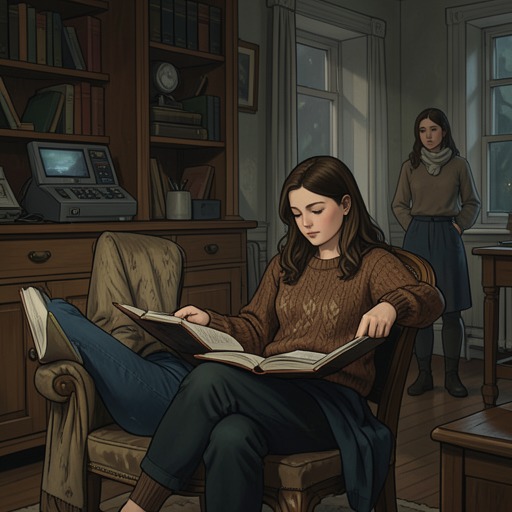
The gown is being made for Aria, a dancer on the television reality show Celebrity Dance Off. When Ella visits Vivian’s home, she recognizes that the sequined garment being worked on is a ball gown and correctly guesses its intended wearer. Her familiarity with the show is more than casual: she tells Vivian’s fathers that the costumes are the only reason she watches. That enthusiasm lets her respond to the dress not only as an object she might wear, but as the work of artists whose craft she already admires.
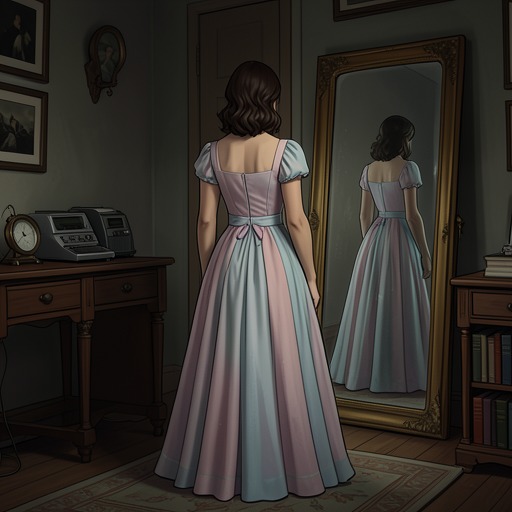
The costume is still being altered when Ella sees it. Its floor-length skirt conceals her legs, while its sleeveless, backless cut leaves her back, shoulders, and right arm exposed. Those details make the gown at once an elaborate performance costume and a revealing test of how Ella feels about being seen. Its eventual feathered hem is not finished in advance: Stefan removes the blue-green feather boa from his neck and carefully pins the feathers onto the skirt while Glen holds the fabric taut.
Ella as Aria’s Stand-In
Stefan and Glen Euling are the lead costume designers for Celebrity Dance Off and do their work at home. After Stefan estimates that Ella is close to Aria’s size, he asks her to try on the gown so he can make further adjustments. Ella is excited by the invitation, then frightened by the prospect of standing in an open-backed, sleeveless dress. Stefan reassures her that he will not prick her with the pins, though the fitting itself requires patience and close physical work.
Ten minutes after stepping behind a screen, Ella comes out in the gown, its long skirt covering her legs. The others look at her scars, but do not fix their attention there for long; their gazes move on to the whole of her appearance. Glen and Stefan circle her, assessing the fit like professionals at work. Glen then asks her to turn toward a full-length mirror. He arranges her hair in an updo, draws out a few curled black strands to frame her face, and calls the reflection an angel. Their response treats the fitting as an act of making and seeing, not as an inspection of her injuries alone.
Alteration and Collaboration
The gown’s transformation continues after Ella has seen herself in it. Stefan helps her onto a stool, and he and Glen kneel to work at the hem. Glen lifts and stretches the skirt while Stefan searches for the right place to pin each feather. Their coordinated movements make the work resemble a careful operation: one designer holds the material steady as the other makes precise adjustments. Ella jokes that the pair must be related to her physical therapist, who also devises elaborate ordeals for her. The joke acknowledges the discomfort and duration of standing for alterations without diminishing the care behind the work.
The practical demands are part of the gown’s meaning in the scene. Vivian teases that Ella may feel differently after hours of sore feet, pins, and difficulty getting to the bathroom in the fitted costume. Stefan dismisses those inconveniences as a small price for a work of art. The dress is not simply handed over as a finished fantasy; it is adjusted around Ella’s body, with its fit and hem shaped through sustained attention. The feather boa that first matched the sequins becomes literal trim, transferred from Stefan’s neck to the gown’s edge.
Beauty, Scars, and Significance
The decisive change takes place in the mirror. In the gown, with Glen and Stefan smiling at her reflection, Ella feels beautiful for the first time since her accident. The moment does not depend on the scars disappearing: the dress exposes much of her upper body, and the people in the room notice the scars. What changes is the frame of attention. Their gaze registers her injuries but does not stop there, while the gown’s silhouette, Glen’s styling, and the approving faces behind her let Ella perceive herself as more than the aftermath of the accident.
That recognition belongs to a specific, collaborative encounter rather than to a claim that a costume can heal her. Ella’s delighted declaration that she loves Vivian’s fathers, and Vivian’s proud affection for them, make the fitting a moment of welcome as well as craft. The gown is intended for a televised dance performance, yet in this private fitting it serves another purpose: it lets Ella stand before a mirror, fully dressed and carefully attended to, and recover a sense of beauty without having to deny her scars.