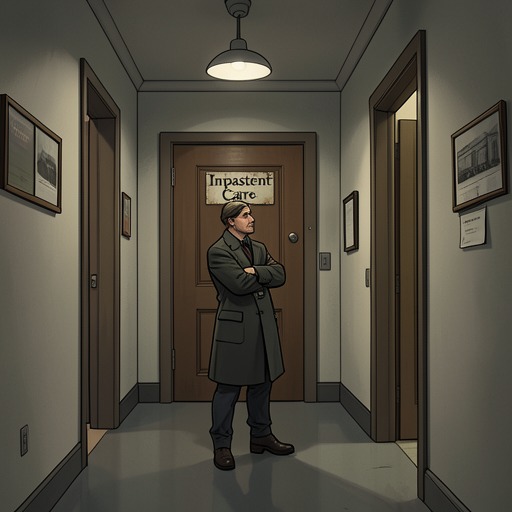
Beverly Hills rehabilitation clinic
Cinder & EllaThe Beverly Hills rehabilitation clinic is the quiet, controlled setting of Ella’s inpatient recovery, where intensive treatment and enforced separation from outside pressures gradually give way to supervised family contact and a wider circle of support. Its significance lies in that change: the clinic begins as a place of isolation, but becomes the setting in which Ella can speak openly about feeling unwanted and see her loved ones assemble as a safety net.
Setting and Daily Care
Ella describes the clinic as calm, luxurious, and unexpectedly idyllic. The few patients staying there are called “guests,” and, apart from required therapy sessions, the place could resemble a wellness hotel. The contrast between its restful appearance and the seriousness of Ella’s treatment gives the clinic an unusual atmosphere: comfort is present, but recovery is structured and cannot be mistaken for a holiday.
That structure includes daily visits from Dr. Parish and daily work with Ella’s physical therapist, Daniel. Ella also joins group therapy every other day. A dietitian meets her soon after admission to discuss her meal plan with the kitchen staff, while her nurse, Cody, continues to visit once a week. Daniel’s schedule becomes daily even though Ella’s bruised hip would not itself require the increased frequency; his visits also provide companionship. Ella notices his attention to a beautiful pop singer who is another patient and teases him about looking toward her in the gym, a small moment of humor within the clinic’s otherwise carefully managed routine.
Isolation and Its Limits
The clinic initially sharply restricts Ella’s contact with the outside world. She is not allowed to speak with anyone beyond her doctors. Dr. Parish explains the no-visitor rule by pointing to Ella’s family as a major source of stress; the bans on friends, phone, television, and internet are intended to shield her from the commotion surrounding Brian Oliver. Ella misses her friends and finds the confinement intensely boring, but she does not miss the media frenzy.
The restrictions are temporary rather than absolute. About a week after Ella’s admission, Dr. Parish allows her father and Jennifer to visit, on the condition that their time together is supervised. The visit functions as family therapy, and Dr. Parish encourages Ella and her father to continue such sessions regularly. Ella is surprised that her father agrees immediately. He tells her that he will do what is needed to repair their relationship, says he has enjoyed having her back in his life, and apologizes for having let her down.
Family Therapy and Difficult Conversations
The supervised sessions give Ella a setting in which to name what she cannot resolve simply by returning to her father’s home. She tells him that she is trying to recover but struggles in the presence of his family: she feels unable to breathe freely in his house, like an outsider and an intruder, and believes that she brings trouble and is not wanted there. Her father answers that, despite the adjustment, he wants her. Ella distinguishes his welcome from the uncertainty she feels about Jennifer and Anastasia.
The clinic’s therapeutic work also makes space for painful history rather than demanding an instant reconciliation. Ella asks her father why he left without saying goodbye, calling or visiting. The sessions therefore address both her current sense of exclusion in the blended family and the earlier abandonment that shapes her distrust. The clinic does not make those injuries disappear; it provides a supervised context in which they can be spoken between them.
From Separation to a Safety Net
After about a month, Ella is brought from the small visitor room to a common room where the people closest to her have gathered: her father, Jennifer, Juliette, Rob, Vivian and her two fathers, along with members of the rehabilitation team. Ella has not seen most of them during that month. Her father and Jennifer have attended weekly therapy sessions; Vivian and her fathers have visited once, when the possibility of Ella moving in with them was discussed. Dr. Parish identifies the assembled group as Ella’s safety net and explains that they have come to support her through the next step.
That image of a safety net connects the clinic’s work to the condition Dr. Parish had earlier set for Ella’s eventual independent living: she needed to show that she would not be entirely alone, and that she could build dependable support around herself. The clinic’s boundaries are thus both protective and transitional. It limits contact while Ella is acutely vulnerable, then makes room for chosen and family relationships to re-enter under supervision, presenting recovery not as isolation completed but as preparation for life supported by others.