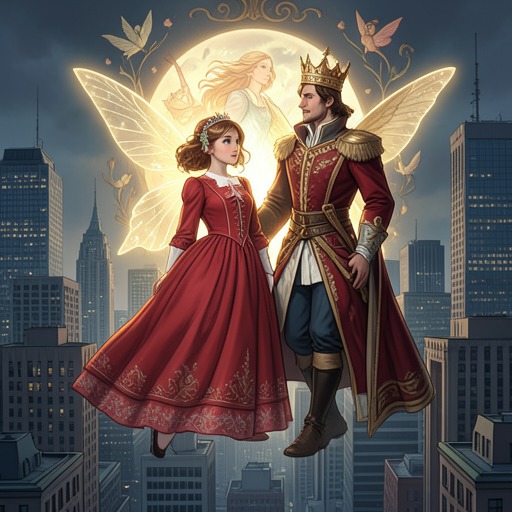
Cinderella motif
Cinder & EllaThe Cinderella motif gives Ella and Brian’s relationship a fairy-tale vocabulary, but the novel uses that vocabulary to expose the pressures that can make romance feel like a public test of worth. Ella imagines herself as a commoner and Brian as a prince expected to choose a celebrated, beautiful partner; against that script, her decision to preserve their friendship while refusing a place in Brian Oliver’s life becomes an act of self-protection and self-definition.
The motif as a language of unequal choice
Cinderella is not simply a comparison for an unlikely couple. It is a way for Ella to name the distance she perceives between her own position and Brian’s celebrity. The story’s familiar contrast—commoner and prince—gives shape to her fear that affection cannot overcome the expectations surrounding his public image. In her understanding, even if Brian loves her, he may still choose the relationship that others expect him to choose.
That fear sharpens when Ella considers the consequences of being publicly associated with Brian. She believes his relationship with Kaylee Summers has been important to his image, and that their own connection has already damaged what he hoped to achieve through that staged romance. She anticipates that the public will not forgive her for appearing to have been involved with him while he was in that relationship. The fairy-tale divide therefore represents not only social status, but also the unequal exposure of their lives: Brian’s image is something to manage, while Ella expects to be judged for her body and her place in the story.
Cinder, Ellamara, and the argument over nobility
The motif is also embedded in the pair’s history as readers and interpreters of The Druid Prince. Ella and Brian’s recurring dispute concerns Cinder’s decision to marry Ratana, the crown princess of Flachlande, despite being in love with Ellamara. Ella argues that Ellamara became a priestess only after Cinder rejected her and broke her heart. She sees his decision not as noble sacrifice but as cowardice: he did what was expected because it was easier than fighting to be with the woman he loved.
Brian defends Cinder from the opposing perspective. Ellamara was a commoner, Ratana was a crown princess, and their marriage brought peace between two kingdoms. He insists that Cinder put the good of the kingdom ahead of his personal feelings, a choice he regards as noble. Their disagreement is more than a fan’s argument about a fictional hero. Ella and Brian are testing competing definitions of courage and duty: whether love should challenge social arrangements, or whether a person should accept the role and obligations assigned to him.
The debate reaches into the beginning of their own connection. Brian’s first comment on Ella’s blog defended Cinder’s marriage to Ratana, even though Ellamara was his true love. Ella remembers that exchange as the start of everything between them. Their disagreement therefore acts as a recurring interpretive key: they can share enthusiasm for Cinder while remaining divided over what his choice means, and the question becomes newly charged when their own feelings make the story’s commoner-and-prince pattern feel personal.
A birthday prince, briefly
The fairy-tale language also appears in a lighter, affectionate moment. When the group reacts to the possibility of styling, Rob agrees that, because it is Ella’s birthday, he will be her fairy-tale prince for a day. Ella calls him her “Aschenprinz,” or ash prince, kisses his cheek, and tells him he is the best. Rob presses her hand again and makes clear that the favor has a limit: he will not let anyone put makeup on him.
The exchange gives Ella a prince who is not defined by celebrity, rank, or a consequential romantic choice. Rob’s role is temporary, playful, and offered for her birthday; the comic boundary around makeup keeps the scene grounded in the group’s familiarity with one another. Set beside Ella’s fears about Brian, the moment broadens the motif beyond a single romance. A prince can be a friend’s affectionate gesture, rather than a title that dictates whom a woman should love or what she must accept.
The script turned against itself
When Ella confronts the possibility of a life with Brian, the Cinderella pattern becomes the structure of her fear. She imagines that he will eventually make the choice expected of him: not necessarily Kaylee, but someone famous and beautiful, someone the world will consider worthy of him. Ella casts herself as worse than a nobody, describing herself as disabled, deformed, scarred, and ugly. The language shows how completely public standards of beauty and celebrity have entered her private calculation of whether she can belong beside him.
Her fear is not presented as a simple misunderstanding that love can instantly correct. She tells Brian that even beautiful Hollywood stars are criticized for minor imperfections and that the rest of the world will not overlook her scars. She also doubts her own ability to withstand the scrutiny, describing herself as insecure, hopeless, and weak. Brian answers that she is not weak and asks her to give them a chance, promising that they would face the difficulty together. His reassurance offers partnership, but it does not erase the pressures Ella believes would surround that partnership.
Ella’s answer preserves the distinction between loving Brian and consenting to the life attached to his name. She tells him he is still her best friend, that she loves him more than anyone in the world, and that she will always be there for Cinder. But she cannot be part of Brian Oliver’s life. The separation of Cinder from Brian Oliver makes the emotional paradox explicit: she can remain devoted to the private friend without accepting the public role of the celebrity’s partner.
Rewriting the fairy tale as refusal
The motif’s significance lies in its reversal of the expected romantic resolution. Ella does not wait for a prince to overcome the social divide on her behalf, nor does the evidence establish that Brian’s promise can make the public’s judgment disappear. She makes the decisive choice herself, refusing a relationship whose exposure she believes she cannot bear while affirming the friendship and love that remain. Her decision is painful, not triumphant, but it gives her a measure of agency within a story shaped by celebrity, beauty standards, and unequal public attention.
The novel’s use of Cinderella is consequently double-edged. The fairy tale offers Ella a recognizable image for longing and social distance, while Cinder and Ellamara’s disputed story lets her and Brian debate whether a supposedly noble choice is courage or capitulation. Ella’s own ending to this particular exchange refuses the assumption that love must culminate in becoming the prince’s chosen partner. The motif survives, but its meaning shifts: the crucial choice belongs not only to the prince, and Ella’s worth is not settled by whether he chooses her.